
Introducing the European Court of Auditors’ 2021 annual report on EU agencies
 |
Executive summary
I The European Court of Auditors (ECA) is the externalauditor of the EU’s finances1. In this capacity, we act as the independent guardian of the financial interests of EU citizens, helping to improve the EU’s financial management2.
II This document presents the results of our annual audit of the EU agencies and other EU bodies (collectively referred to as ‘the agencies’) for the 2021 financial year, as well as additional agency-related audit results, including work on a horizontal topic related to the risk of conflicts of interest, carried out by the ECA during the same year.
III Overall, our audit of the agencies for the financial year ended 31 December 2021 produced positive results, in line with those reported in previous years. Through the statements of assurance issued for each agency, we provided:
- unqualified (clean) audit opinions on the reliability of all agencies’ accounts;
- unqualified (clean) audit opinions on the legality and regularity of the revenue underlying all agencies’ accounts;
- unqualified (clean) audit opinions on the legality and regularity of the payments underlying all agencies’ accounts, except for eu-LISA for which we issued a qualified opinion.
IV Nevertheless, for most agencies, we draw attention to areas for improvement in our emphasis of matter and other matter paragraphs, and in our observations not calling the audit opinions into question. In total, we made 77 observations concerning 33 agencies to address areas requiring further improvements such as public procurement, budgetary management, recruitment and management and control systems.
V We also proposed the following actions to be taken to addressthese areas for improvement:
- The agencies concerned should further improve their public procurement procedures, ensuring full compliance with the applicable rules, to ensure they achieve the best possible value for money. In particular, when implementing framework contracts, agencies should only use specific contracts to procure goods or services covered by the associated framework contract;
- To resolve excessive levels of carry-overs, the agencies concerned should further improve their budget planning and its implementation cycles.
- The EU Agencies Network should contact the Commission and legislators to propose changes to the regulatory framework defining a minimum set of rules applicable to members of the EU agencies’ boards in relation to conflict of interest and ‘revolving door’.
- The agencies should strengthen their internal procedures and controls concerning potential ‘revolving door’ situations, in order to ensure full compliance with the applicable rules.
- The agencies should introduce internal rules for members of their boards on conflicts of interest in general and ‘revolving door’ situations in particular.
- The agencies should actively monitor the professional activity of their senior staff members (including those that have left the agency within the last two years) in order to be able to detect undeclared ‘revolving door’ situations and ensure compliance with previously imposed restrictions.
What we audited
01 The EU agencies are distinct legal entities set up by an act of secondary legislation to carry out specific technical, scientific or managerial tasks that help the EU institutions to design and implement policies. They are located in different Member States, and have significant influence in areas of vital importance to European citizens’ daily lives, such as health, safety, security, freedom and justice.
02 There are three types of EU agencies: decentralised agencies, the Commission executive agencies and other bodies. The differences between them are described below.
03 The number of agencies has increased over the years. Our report for 2021 covers 44 agencies, as shown in Figure 1, three more than our report for 2020. The three new agencies are:
- the European Labour Authority (ELA), which started operations on 17 October 2019 and has been financially autonomous since 26 May 2021;
- the European Public Prosecutor’s Office (EPPO), which started operations on 1 June 2021 and has been financially autonomous since 24 June 2021;
- the European Health and Digital Executive Agency (HaDEA), established on 16 February 2021.

Note: The year mentioned in the figure refers to the year that the founding act of the agency (or its predecessor) came into force.
Source: ECA.
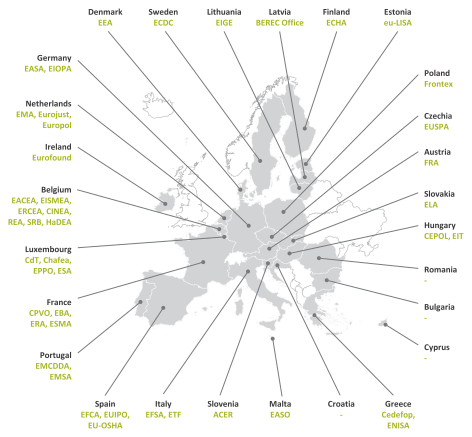
04 All executive agencies are located in Brussels. Decentralised agencies and other bodies are located across the EU in different Member States, as shown in Figure 2. Their locations are decided by the Council or jointly by the Council and the European Parliament.
Decentralised agencies address specific policy needs
05 The 33 decentralised agencies3 play an important role in preparing and implementing EU policies, especially for technical, scientific, operational or regulatory tasks. Their role is to address specific policy needs and to reinforce European cooperation by pooling technical and specialist expertise from the EU and national governments. They are set up to operate for an indefinite period by a Regulation of the Council or of the European Parliament and the Council.
European Commission executive agencies implement EU programmes
06 The seven Commission executive agencies4 carry out executive and operational tasks relating to EU programmes, such as supporting stakeholders in delivering the European Green Deal (CINEA) and managing certain Horizon Europe projects (REA). They are set up to operate for a fixed period of time (currently until 31 December 2028).
Other bodies have specific mandates
07 The four other bodies are the EIT, the EPPO, the ESA and the SRB. The EIT is an independent decentralised EU body which pools scientific, business and education resources to boost the EU's innovation capacity by providing grant funding. The EPPO is an independent EU body which investigates and prosecutes crimes against the EU budget. The ESA was tasked with guaranteeing the regular and equitable supply of nuclear fuels to EU users in line with the Euratom Treaty. The SRB is the key authority of the Single Resolution Mechanism in the European Banking Union. Its mission is to ensure the orderly resolution of banks which are failing or likely to fail, with as little impact as possible on the real economy and public finances of EU Member States. In addition to our report, we also produce a report each year on the SRB’s contingent liabilities5.
Agencies are financed from various sources and under different MFF headings
08 In 2021, the total budget of all agencies (excluding the SRB) was €4.1 billion (2020: €3.7 billion). This is equivalent to 2.5 % of the EU’s general budget for 2021 (2020: 2.3 %), as shown in Figure 3.
09 The 2021 budget of the SRB was €9.7 billion (2020: €8.1 billion). This consists of contributions from banks to set up the Single Resolution Fund (€9.6 billion) and to finance the SRB’s administrative expenditure €119 million).
10 The budgets of the decentralised agencies and the other bodies cover their staff, administrative and operational expenditure. The executive agencies implement programmes financed from the Commission’s budget. Their own budgets, amounting in 2021 to €326 million (2020: €273 million), only cover their own staff and administrative expenditure. The amount (payment appropriations) spent by the executive agencies in 2021 on implementing programmes on behalf of the Commission amounted to €13.1 billion (2020: €14.9 billion).

Source: Draft general budget of the European Union for the 2021 financial year; Final annual accounts of the European Union 2021 and Annual Activity Reports of the executive agencies for 2021, compiled by the ECA.
11 Most agencies, including all executive agencies, are financed almost entirely by the EU general budget. The others are fully or partially financed by fees and charges from industries and by direct contributions from countries participating in their activities. Figure 4 shows a breakdown of the agencies’ budgets by source of revenue.

* The accounts of EUSPA for 2021 present a final budget of €44.1 million, while actual revenue amounted to €1.8 billion. This difference is explained by operational activities that are financed through assigned revenue; these are included in the approved budget as a token entry.
Note: Other miscellaneous revenue or budgetary reserves are not included.
Source: Agencies’ final annual accounts 2021, compiled by the ECA.
12 Figure 5 presents the agencies’ 2021 budgets. They are broken down by type of expenditure (Title I – staff costs, Title II – administrative expenditure, and Title III – operational expenditure, together with any other titles used), not by activity. Overall, agencies’ staff and administrative budgets represent around 14 % of total payment appropriations available for Multiannual Financial Framework (MFF) heading 7 – European public administration. This compares with 47 % for the Commission, 18 % for the Parliament, 9 % for the EEAS and 5 % for the Council.

* The accounts of EUSPA for 2021 present a final budget of €44.1 million, while actual revenue amounted to €1.8 billion. This difference is explained by operational activities that are financed through assigned revenue that are included in the approved budget as a token entry.
** The figure for SRB comprises two parts: Part I with €119 million for the administration of the Board and Part II with €9 574 million for the Fund. It does not include the Reserve.
Source: Agencies’ final annual accounts 2021, compiled by the ECA.
13 Figure 6 shows how many staff members each agency employed at the end of 2021. In total, the agencies employed 14 431 members of staff (2020: 12 881). This figure corresponds to the actual number of posts occupied by permanent officials, temporary and contract staff members and seconded national experts on 31 December 2021. Taking the establishment plans approved in the EU general budget as a basis, about 17 % of all EU staff work for agencies. This compares with 50 % working for the Commission, 14 % for the Parliament, 6 % for the Council and 4 % for the EEAS.

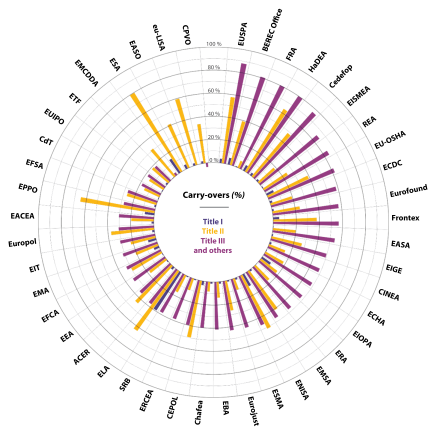
Budgetary and discharge arrangements are similar for all agencies except for EUIPO, CPVO and SRB
14 For most decentralised agencies and other bodies and for all the Commission executive agencies, the European Parliament and the Council are responsible for the annual budgetary and discharge procedures. The timeline of the discharge procedure is shown in Figure 7.

15 However, two fully self-financed decentralised agencies (CPVO and EUIPO) are subject to budgetary and discharge procedures administered respectively by their Administrative Council or Budget committee, but not by the European Parliament or the Council6. Similarly, the SRB’s annual budgetary and discharge procedure is the sole responsibility of its Board.
The EU Agencies Network facilitates inter-agency cooperation and communication with stakeholders
16 An EU Agencies Network (EUAN) was set up by the agencies as an inter-agency cooperation platform to enhance the agencies’ visibility, to identify possible efficiency gains, and to promote actions with clear EU added-value. It recognises the agencies’ need to communicate in a more coordinated way with their stakeholders and the general public on issues of shared concern, and provides a central point for gathering and disseminating information among all agencies. In 2015, EUAN endorsed its first multiannual strategy including priorities which are implemented in yearly work programmes specifying its activities and its objectives. In 2020, EUAN endorsed its second multiannual strategy (2021-2027)7 incorporating the political and strategic direction of the Commission around two strategic pillars:
- EUAN as a role model for administrative excellence;
- EUAN as a well-established institutional partner.
17 EUAN is chaired by a different agency every year on a rotational basis, with plenary meetings coordinated by the Shared Support Office taking place twice per year. The ECA cooperates with EUAN by sharing good practices and providing information on audit processes and results.
18 At the centre of EUAN’s work and the core of both multi-annual strategies is the aspect of sharing services, knowledge, and expertise. Some examples of cooperation include the sharing of services in the areas of disaster recovery, accounting, joint procurements, COVID-19-related matters and data protection.
Our audit
Our mandate
19 As required by Article 287 of the Treaty on the Functioning of the European Union, we have audited:
- the accounts of all 44 agencies, which comprise the financial statements (i.e. the balance sheet, the statement of financial performance, the cash flow statement, the statement of changes in net assets and a summary of significant accounting policies and other explanatory notes) and the reports on the implementation of the budget (which aggregate all budgetary operations and explanatory notes) for the financial year ended 31 December 2021, and
- the legality and regularity of the transactions underlying those accounts.
20 On the basis of the results of our audit, we provide the European Parliament and the Council, or the other discharge authorities, with one statement of assurance as to the reliability of each agency’s accounts and the legality and regularity of the underlying transactions. We complement the statements of assurance with significant audit observations, where appropriate.
We report suspected fraud to the relevant EU bodies OLAF and EPPO
21 We cooperate with the European Anti-Fraud Office (OLAF) in matters related to suspected fraud and other illegal activity affecting the EU’s financial interests, and with the EPPO in matters related to suspected crimes against the EU’s financial interests. We notify OLAF or the EPPO about any suspicion that arises in the course of our audit work, even though our audits are not designed specifically to identify fraud.
Digitalisation of audit procedures at the ECA continues
22 As mentioned in previous years’ reports8, the ECA has been using the annual audit of the EU agencies as an opportunity to test the potential of automated audit procedures. The audit of the agencies consists of around 200 audit procedures covering areas such as payments, salaries, procurement, budget, recruitments and the annual accounts. For the 2021 financial year, we extended the use of procedures related to salaries and data extraction to all agencies. Our testing of the legality and regularity of commitments and payments and of the reliability of the annual accounts still covered the EU executive agencies only, as they shared a sufficiently similar IT environment.
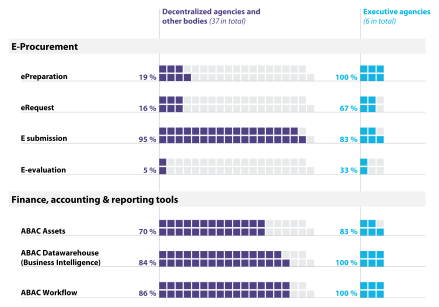
23 We intend to explore the possibilities to expand our use of digital audit techniques to other areas and to all agencies. However, in this we face serious obstacles because, as Figure 8 shows, gaps in the use of standardised IT tools remain, in particular as regards the decentralised agencies. Besides, even though some agencies have the same IT systems, we have identified discrepancies in how they use some of the functionalities of these tools. This lack of consistency is another factor hampering opportunities for expanding the use of digital audit procedures. For the 2022 financial year, we are launching a pilot project to digitalise aspects of the audit on EU agencies’ public procurement.
Our opinions
Results from the annual agency audits for the financial year 2021 are positive
24 Overall, our audit of the annual accounts of the agencies for the financial year ending on 31 December 2021 had positive results (see Figure 9). However, we have raised observations on irregularities and weaknesses affecting the reliability of the accounts and the payments underlying the accounts, in particular in relation to procurements.

‘Clean’ opinions on the reliability of all agencies’ accounts
25 For the 2021 financial year, the ECA issues unqualified (“clean”) audit opinions on the accounts of all 44 agencies (see Figure 9).
‘Emphasis of matter’ paragraphs are important for understanding the accounts of the EMA, Frontex, SRB and the EIGE
What are ‘Emphasis of matter’ paragraphs?
‘Emphasis of matter’ paragraphs draw readers’ attention to a matter, presented or disclosed in the accounts, which is of such importance that it is fundamental to their understanding of the accounts or the underlying revenue or payments.
26 In the 2021 financial year, we have used ‘emphasis of matter’ paragraphs in our reports on four agencies: EMA, Frontex, SRB and the EIGE.
27 The EMA’s accounts include significant disclosures on the lease on the EMA’s former premises in London. This lease runs until 2039 and does not contain a break clause, but the premises can be sublet or assigned subject to the landlord’s consent. In July 2019, the EMA reached an agreement with its landlord, and has sublet its former premises to a subtenant with effect from July 2019, under conditions that are consistent with the terms of the head lease. The term of the sublease lasts until the EMA’s lease expires in June 2039. Since the EMA remains a party to the head lease, it could be held liable for the entire amount remaining payable under the contractual obligations of the head lease if the subtenant fails to meet its obligations. As of 31 December 2021, the total estimated outstanding rent, associated service charges and landlord insurance to be paid by the EMA up to the end of the lease term was €383 million.
28 Frontex is funded by the EU budget and contributions from non-EU Schengen area countries (SACs). The accounts of Frontex include a disclosure that the non-EU Schengen area countries contributions were not calculated correctly. As a result, the non-EU Schengen area countries paid €2.6 million less than they should have done, an amount which was compensated from the EU budget. However, given that there was a surplus in 2021, this had no impact on the operating revenue of the statement of financial performance for 2021.
29 The SRB is exposed to litigation associated with its collection of contributions to the Single Resolution Fund, as well as to litigation associated with the tasks it performs in its capacity as the resolution authority. The SRB’s accounts include a disclosure describing administrative appeals and judicial proceedings related to ex-ante contributions between some banks and national resolution authorities and the SRB, as well as other legal actions brought against the SRB before the General Court and the Court of Justice of the European Union. Their possible impact on the SRB’s financial statements for the financial year ended 31 December 2021 (in particular on contingent liabilities, provisions and liabilities) is subject to a specific annual audit, as stipulated under Article 92(4) of the SRM Regulation.
30 EIGE disclosed a contingent liability in its accounts which will be incurred if the Lithuanian Supreme Court rules against EIGE in an ongoing case concerning temporary agency workers. The potential financial impact is estimated at €22 000.
The impact of the Russian war of aggression against Ukraine
31 We drew attention to the disclosures of three agencies (EASO, EUSPA and the SRB) regarding the impact of the Russian war of aggression against Ukraine on their activities. Faced with an increased demand for assistance from Member States receiving refugees from Ukraine, EASO requested additional human and financial resources. EUSPA’s activities were affected by the interruption in the use of Russian Soyuz launchers for Galileo satellites. The SRB assesses that the war increased risks to financial stability, in particular credit risks in relation to banks’ exposures toward counterparties in Russia, Belarus, and Ukraine and with loans to domestic firms most exposed to the effects of the war.
‘Clean’ opinions on the legality and regularity of the revenue underlying all agencies’ accounts
32 For the 2021 financial year, the ECA issues unqualified (“clean”) audit opinions on the legality and regularity of the revenue underlying all agencies’ (see Figure 9).
‘Emphasis of matter’ paragraph aids understanding of the SRB’s revenue
33 We also used an ‘emphasis of matter’ paragraph in our report on the SRB, because a part of the SRB’s revenue in relation to the ex-ante contributions to the SRF is under legal dispute. This is relevant for our opinion on the SRB’s revenue because, depending on the outcome of the litigation, the SRB might have to recalculate the amounts of contributions from certain banks.
‘Other matter’ paragraph address an issue of specific importance for the SRB’s revenue
What are ‘Other matter’ paragraphs?
Other matter’ paragraphs present significant issues, other than those presented or disclosed in the accounts, which are nevertheless relevant for the understanding of the accounts or the underlying revenue or payments.
34 In the 2021 financial year, we have used an ‘Other matter’ paragraph only for the SRB. The SRM Regulation does not establish a comprehensive and consistent control framework to ensure the reliability of the information provided by the banks to the SRB for the calculation of the ex-ante contributions to the SRF. However, the SRB performs consistency and analytical checks of the information, as well as some ex-post checks at the level of the banks. Furthermore, the SRB cannot release details on the risk-adjusted contribution calculations for each bank as they are interlinked, and include confidential information about other banks. This may affect the transparency of these calculations. We noted that for the calculation of the 2021 and 2022 contributions, the SRB has improved transparency towards banks by organising a consultation phase. ln this consultation, the SRB communicated data that allowed banks to simulate the calculation of the 2021 and 2022 ex-ante contributions.
‘Clean’ opinions on the legality and regularity of the payments underlying the agencies’ accounts, except for eu-LISA
35 For the 2021 financial year, we issued unqualified (“clean”) audit opinions on the legality and regularity of the payments underlying the annual accounts for 43 of the 44 agencies (see Figure 9).
36 For eu-LISA, we issued a qualified opinion. Of the 28 payments we audited, six were non-compliant (see Box 1). Three of these payments related to a specific contract which implemented a framework contract without specifying the details of the services required (quantities and delivery dates), and thus did not create a clear legal commitment. We also identified other payments, outside our initial sample, linked to that contract and affected by the same non-compliance. The three other non-compliant payments from our initial sample related to three different specific contracts, which fundamentally deviated from the corresponding framework contracts. The total amount of expenditure affected is €18.11 million. This represents 6.2 % of the total payment appropriations available in 2021.
Issues with budgetary planning and procurement of eu-LISA
For the 2019 financial year, we reported on the risks associated with the practice of giving resources to eu-LISA before legislation defining the requirements for the IT systems to be developed had been adopted. We found that these risks materialised: the resulting time pressure on eu-LISA to commit and spend the funds before they lapsed, had contributed to cases of non-compliance in procurement procedures and contract implementation. These cases non-compliance included the absence of information, in a specific contract, on the quantities and delivery dates of the services acquired, and changes of contract scope, duration or value going beyond the flexibility allowed by the Financial Regulation. As a result, we issued a qualified opinion on the legality and regularity of eu-LISA’s 2021 payments. Last year, we qualified our opinion on the legality and regularity of eu-LISA’s 2020 payments over similar cases of non-compliances in contract implementation.
Action to be taken 1
eu-LISA should improve its procurement procedures and contract management, in particular as regards defining the services and goods acquired in the specific contracts and limiting changes to the scope, duration and value of contracts to the flexibility allowed by the Financial Regulation.
eu-LISA should also contact the Commission to propose changes to its multiannual budget planning, so that it only receives funds for developing systems when the legislation (including delegated or implementing regulations) defining the associated requirements is adopted, and when the project scope can be specified with sufficient detail
‘Emphasis of matter’ paragraph aids understanding of Frontex’s payments
37 Frontex’s accounts include a disclosure regarding €18.1 million of payments made in 2021 for the implementation of a budgetary commitment from 2020 carried to 2021 without Frontex having entered into a legal commitment before the end of 2020, as required by the EU Financial Regulation. We reported on this issue in our 2020 specific annual report9. Total payments in 2021 were €18 375 458. Frontex rectified this non-compliance by means of subsequent legal commitments throughout 2021.
‘Other matter’ paragraphs on issues of specific importance for HaDEA’s payments
38 We draw attention to the fact that the Commission Implementing Decision (EU) 2021/17310 entrusted the Director-General of DG SANTE with the authority to act as HaDEA’s interim Director until HaDEA gained the operational capacity to implement its own budget. On 19 February 2021, the Director-General of DG SANTE delegated that authority to another DG SANTE official, appointing him as interim Director of HaDEA. Article 26 of HaDEA’s Financial Regulation allows budgetary powers to be delegated. However, it cannot be interpreted as allowing the whole authority of the interim Director to be delegated, because this would contravene the Commission Implementing Decision.
Our observations address areas for improvement
39 In total, we made 77 observations concerning 33 agencies pointing out areas where further improvements are needed. These numbers include the two observations which served as the basis for the qualified opinion for eu-Lisa, as well as the observation covered by the ‘other matter’ paragraph for HaDEA. For comparison, for the 2020 financial year we made 60 observations. Most of the observations concern shortcomings in public procurement procedures, management and control systems and in budgetary management. Weaknesses in public procurement procedures remain the most significant source of irregular payments.
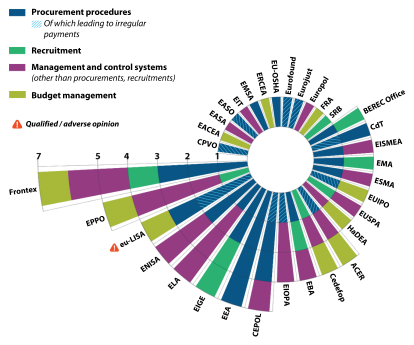
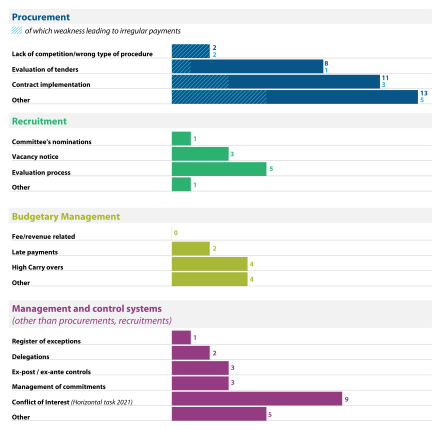
40 Figure 10 and Figure 11 show the number of different types of observations raised across 33 agencies throughout our report.
Public procurement weaknesses are increasing and remain the largest source of irregular payments
41 The objective of public procurement rules is to ensure fair competition between tenderers and to procure goods and services at the best price, respecting the principles of transparency, proportionality, equal treatment and non-discrimination. We audited procurement in all the 44 agencies. For 22 agencies (ACER, BEREC Office, CdT, CEPOL, CPVO, EASO, EBA, EEA, EIGE, EIOPA, EISMEA, ELA, EMA, EMSA, ENISA, ESMA, EUIPO, eu-LISA, EU‑OSHA, Eurofound, Eurojust and Frontex), we reported contracts affected by various sorts of public procurement shortcomings, including payments made in the 2021 financial year, stemming from irregular procurement procedures reported in previous years. Box 2 presents examples of typical irregularities in the implementation of procurement contracts.
Example of irregular implementation of contracts
CEPOL had a framework contract, valid until March 2022, for travel agency services. The scope of the contract did not include certain countries outside the EU. Travel services for these countries were covered by other contracts until the end of 2020. In summer 2021, despite the unpredictable travel situation, it became probable that CEPOL would need to organise in-person activities in non-EU countries. After assessing the situation and the various available options, CEPOL opted to use the existing framework contract to cover the events in these countries, even though such events did not fall within the scope of the contract. This contravened the Financial Regulation. CEPOL noted this decision in its registry of exceptions. The associated payments, amounting to €76 590 in 2021, are irregular.
42 We note an increase in the number of procurement observations we raised over the last three financial years (from 20 in 2019 and 18 in 2020 to 34 in 2021), as well as in the number of agencies concerned (from 11 in 2019 and 14 in 2020 to 22 in 2021). As shown in Figure 12, since the 2019 financial year, we have raised new procurement-related observations every year for two agencies (CEPOL and the EMA).
Figure 12 – Our observations on public procurement weaknesses and irregularities have become more frequent over the last three years

Source: ECA.
Action to be taken 2
Public procurement errors remain the most frequent type of errors detected in our audits of the agencies. The agencies concerned should further improve their public procurement procedures, ensuring full compliance with the applicable rules, to ensure they achieve the best possible value for money.
In particular, when implementing framework contracts, agencies should only use specific contracts to procure goods or services covered by the associated framework contract. Agencies should also ensure that they comply with the conditions for modifying existing contracts set out in the Financial Regulation.
Management and control systems are affected by weaknesses
43 For 16 agencies (ACER, Cedefop, CEPOL, EASA, EBA, EIOPA, EISMEA, EIT, ELA, ENISA, EPPO, ESMA, Europol, EUSPA, Frontex and HaDEA) we report weaknesses in management and control systems other than those concerning procurements or recruitments. For these 16 agencies, our observations include potential cases of conflict of interest, missing ex-ante/ex-post controls, inadequate management of budgetary and legal commitments, and failures to report issues in the register of exceptions.
44 Figure 11 shows the most common types of internal control weaknesses we identified Box 3 provides examples of such weaknesses in relation to the risk of conflict of interest.
Governance issues and conflicts of interest can impede the effectiveness of EU agencies
The role of the three European supervisory authorities – EBA, EIOPA and ESMA – is to ensure a level playing field for the supervision of financial services. Their founding Regulations include various provisions to ensure that Members of their Boards of Supervisors “act independently and objectively in the sole interest of the Union as a whole” and do not “seek nor take instructions from any government […] or from any other public or private body”11.
Under the European supervisory authorities’ rules of procedure, Board of Supervisors members who have a conflict of interest may not take part in the Board’s discussions or vote on the matter in question. However, the members may remain present in the meeting if nobody objects (EBA and EIOPA) or unless the majority of members vote to exclude them (ESMA). This creates a risk to the Boards’ independence, at least in appearance.
In previous years, we reported in several special reports on governance issues affecting the European supervisory authorities, and the detrimental impact of these issues on their objectives.
In our special report on stress tests for banks12, we found that national authorities have significant involvement in the EBA’s governance structure, since the EBA’s Board of Supervisors comprises national representatives whose appointment is not subject to any approval by EU bodies. This can give rise to tensions, as members of the board may act to promote of purely national rather than wider European interests.
In our special report on insurance supervision13, we observed that the efficiency and effectiveness of EIOPA’s work often relied on the quality of the input of national authorities, and depended on their willingness to co-operate. EIOPA’s current governance structure gives national authorities the power to influence the extent to which their own work will be reviewed, and the conclusions of such reviews. The BoS approves all key documents, such as EIOPA’s oversight strategy. This may compromise EIOPA’s independence and prevent it from achieving its objectives.
In our special report on anti-money laundering14, we found that EBA staff carried out thorough investigations of potential breaches of EU law, but we found written evidence of attempts to lobby panel members during the period when the panel was deliberating on a potential recommendation. In the end, the Board of Supervisors rejected the draft recommendation.
In our special report on investment funds15, we found that ESMA faces challenges in using its tools effectively. These challenges include problems caused by ESMA’s own governance structure, its dependency on the goodwill of national authorities and the willingness of its own Board of Supervisors. We found that both preferred “non-invasive” convergence tools, whose effectiveness has not yet been demonstrated and which often did not result in effective and consistent supervision. This limited ESMA’s effectiveness.
In all cases, we recommended that the Commission should consider proposing changes to the European supervisory authorities’ governance structure which would allow them to use their powers more effectively. In 2019, though, the legislator did not accept the Commission’s proposed16 revised governance structure.
Recruitment weaknesses are frequently related to the evaluation process
45 For nine agencies (BEREC Office, Cedefop, EBA, EIGE, EMA, EPPO, EUSPA, Frontex and the SRB) we report weaknesses related to various aspects of recruitment procedures, including evaluation processes and vacancy notices. Figure 11 shows the most common types of weaknesses concerning recruitment procedures.
Weaknesses in budgetary management typically result in high carry-overs or late payments
46 For 10 agencies (ACER, Cedefop, EACEA, EPPO, ERCEA, EUIPO, eu-LISA, FRA, Frontex, HaDEA) we report weaknesses related to various aspects of budgetary management, for example excessive carry-overs of appropriations and high rates of late payments. Figure 11 shows the most common types of weaknesses concerning budgetary management.
47 Figure 13 shows the level of carry-overs, for each budget title and for each agency. While the EU Financial Regulation does not set ceilings for such carry-overs and the multi-annual nature of operations can explain a number of them, excessive levels of carry-overs can indicate delays in the implementation of work programmes or procurement plans. Alternatively, they could indicate a structural issue, weak budgetary planning, or possibly a contravention of the budgetary principle of annuality. We report such weaknesses concerning four agencies (ACER, EACEA, eu-LISA and FRA).
Figure 13 – Level of carry-overs affecting each budget title
Source: Agencies' 2021 final annual accounts, compiled by ECA.
Action to be taken 3
To resolve excessive levels of carry-overs, the agencies concerned should further improve their budget planning and its implementation cycles.
Weaknesses and good practice in the
agencies’ handling of potential
‘revolving door’ situations
48 For the 2021 financial year, we complemented our recurrent audit work on the reliability of the agencies’ accounts and the legality and regularity of their revenue and payments with an analysis of how agencies handled potential ‘revolving door’ situations. Box 4 explains what ‘revolving door’ situations are, and how they relate to the risk of conflict of interest and policy capture.
What are the ‘revolving door’ situations and why are they important?
The Organization for Economic Co-operation and Development (OECD) defines the concept of a ‘revolving door’ as follows. “Conflicts of interest can arise and present the risk of policy capture in the movement between positions in the public and private sectors. When functions cover fields that are closed or were directly controlled by the former public official, this so-called revolving door phenomenon can be perceived as granting an unfair advantage in terms of information, relations or any other type of advantage gained in the previous public functions. In some cases, public officials may be tempted to make or be perceived to have made decisions not in the public interest, but in the interest of a former or future employer.” 17
In the EU context, the European Ombudsman explains that18 “[w]hen a public official moves to the private sector, they are often described as having gone through ‘the revolving door’. This can present a risk to the integrity of EU institutions because valuable inside knowledge can move into the private sector, or because former officials may lobby their former colleagues or existing officials may be influenced by possible future employment.”
Taking a paid outside activity while working for an EU institution or body, such as an agency, may present similar risks to taking a new job after leaving EU public service.
49 Agencies are particularly prone to the risk of ‘revolving door’ situations because of their reliance on temporary staff, which entails high rates of staff turnover, and their governance model, which includes boards whose members tend to serve for relatively short terms. For some agencies, this risk is further heightened by significant regulatory powers (e.g. EBA, EIOPA and ESMA) or links to industry (e.g. EASA, ECHA or EFSA). We decided to examine this topic because of its importance not just for the proper functioning of EU agencies, but also for their reputation and, more broadly, for the reputation of the EU as a whole.
50 We examined cases between 2019 and 2021 in which current or former senior agency staff (executive directors, directors and officials at grades AD14-16) took up a job after leaving an agency or performed a paid outside activity while working for an agency. We also looked into similar cases affecting members and former members of the agencies’ boards, cases which some agencies had only assessed on the basis of their own internal rules. Our scope included 40 agencies. Only Chafea, which was closed in 2021, and the three agencies that only became operational or autonomous in 2021 (ELA, EPPO and HaDEA) were not considered. Box 5 explains the relevant legal standards.
The EU legal framework applicable to managing ‘revolving door’ risks
The rules applicable to handling potential ‘revolving door’ situations and the associated risk of conflict of interest are set out, primarily, in the EU’s Staff Regulations19. These rules apply to the former and current staff of EU institutions and bodies, including EU agencies. The rules include the following.
- Staff members have to inform their agency if they plan to take up a job within two years after leaving the EU civil service.
- Before granting or refusing authorisation for former staff members to carry out an outside activity or a new job, an agency must consult its Joint Committee.
- If an agency considers that there is a risk of a conflict of interest, it may forbid the staff member from accepting the job, or give approval only subject to conditions.
- An agency must also prohibit its former senior officials from lobbying or advocacy vis-à-vis the institution's staff during the 12 months after leaving the service.
- An agency must publish a yearly list of the cases assessed in the context of the risk of lobbying and advocacy.
However, these rules do not apply to members of the agencies’ boards, because they are not considered part of the agencies’ staff. Nevertheless, nine agencies have internal rules dealing with this area.
The current legal framework lacks clear requirements on compliance and monitoring
51 As mentioned in Box 5, the Staff Regulations (including their rules related to ‘revolving door’ situations and conflicts of interest more broadly), by definition do not apply to the members of agencies’ boards, who do not belong to the agencies’ staff. They also do not concern members of the agencies’ scientific committees, expert groups and other similar bodies. This leaves a legal vacuum, because there is no common legal basis defining a minimum level of requirements for these categories of people working for EU agencies, in relation to the risk of conflict of interest and ‘revolving door’ situations. The task of setting applicable rules is left to each individual agency.
52 The EU legal framework for managing the risk of ‘revolving door’ situations sets out very limited obligations for EU institutions and bodies (including EU agencies) to monitor compliance of current and former staff with the ‘revolving door’ requirements. It does not define the manner in which such monitoring could take place or the tools that could be used for that purpose. In consequence, most agencies do not engage in any such monitoring activity, and undeclared ‘revolving door’ cases and breaches of restrictions imposed on departing staff in relation to their new jobs are likely to remain undetected.
53 The rules relating to monitoring and handling ‘revolving door’ situations and the associated risk of a conflict of interest are insufficiently explicit about the obligation for the EU institutions and bodies concerned to publish a yearly list of cases assessed in the context of the risk of lobbying and advocacy. The European Ombudsman already reported on this issue in 2017 (see Box 6). The relevant rules in the Staff Regulations have not changed since then.
The European Ombudsman called for more transparency on the assessment of cases in relation to the risk of lobbying and advocacy
In a 2017 report20, the European Ombudsman stated that “information should be published for all cases assessed, regardless of whether the institution took the view that the notified occupational activity could, or would, entail lobbying and advocacy. This is necessary to ensure an effective and meaningful application of Article 16(3) and 16(4).” The European Ombudsman stated that the information to be published should include:
- the name of the senior staff member concerned;
- the date of departure of the senior staff member;
- the type of post held by the senior staff member and a description of the duties carried out during the last three years in the EU civil service;
- the name of the future employer and a description of the type of duties to be carried out in the new job; alternatively, a description of the intended self-employed activities;
- if the future employer or the self-owned company is registered on the EU Transparency Register, a link to the relevant register entry;
- the institution’s detailed assessment of the case, including its conclusion on whether to authorise it – with or without mitigating measures – and a statement about whether the intended activity may entail lobbying and advocacy and thus warrants the imposition of a lobbying and advocacy ban.
Action to be taken 4
The EU Agencies Network should contact the Commission and legislators to propose changes to the regulatory framework defining a minimum set of rules applicable to members of the EU agencies’ boards in relation to conflict of interest and ‘revolving door’. Where appropriate, similar rules should also apply to members of scientific committees, expert groups and similar bodies outside the scope of the staff regulations.
Agencies mostly comply with their legal obligations
54 When a current or former staff member notifies an agency about their plans to take up a new job, the agency has 30 working days to issue a decision. No such time limit is set for outside activities. Before taking a decision, the agency has to consult the Joint Committee.
55 During the last three years (2019-2021), only 20 of the 40 agencies we examined had considered any potential revolving-door cases related to their senior staff members. Only five had assessed any cases related to members of their boards, taking up a new job or an outside activity. As shown in Figure 14, the total number of cases assessed was 71, of which 43 cases concerned senior staff and 28 concerned board members. These numbers are based on the information we received from the agencies, which, in turn, had relied generally on self-declarations from the staff and board members concerned. We have not carried out an investigation to identify any undeclared cases.
Figure 14 – Most agencies assessed very few cases, or none at all

Source: ECA, on the basis of information received from the agencies.
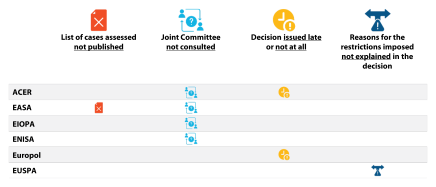
56 We examined a sample of 17 of these cases and concluded that the agencies generally complied with the applicable legal requirements. The infringements we identified in six agencies (see Figure 15) concerned the obligation to publish the list of cases assessed, to consult the Joint Committee, or to issue a formal decision within 30 working days.
Action to be taken 5
Agencies should strengthen their internal procedures and controls concerning potential ‘revolving door’ situations, in order to ensure full compliance with the applicable rules. In particular, they should:
- issue formal decisions within the applicable time limit;
- consult the Joint Committee on all cases before issuing a decision;
- publish a list of all cases assessed in relation to the risk of lobbying and advocacy.
Only a few agencies go beyond the minimum legal requirements when handling potential ‘revolving door’ situations
57 Nine agencies (EBA, EIOPA, the EIT, EMA, ESMA, EUIPO, Europol, FRA and the SRB) had introduced their own internal rules to deal with the lack of provisions in EU legislation governing the activities of members of agencies’ boards. See Box 7.
Examples of revolving door rules from EMA and the EIT
EMA’s internal rules require board members (and their alternates) to notify the EMA immediately of their intention to engage in occupational activities with pharmaceutical companies. From the moment it receives such a notification, the EMA must restrict the person concerned from further involvement in the board’s activities. Similar rules also apply to members of the EMA’s scientific committees and expert groups.
The EIT has a Code of Good Conduct, which addresses conflicts of interest for the members of the governing board. It prevents members of the board from taking any position, paid or unpaid, in any businesses, research centres or universities participating in the EIT’s Knowledge and Innovation Communities or receiving EIT grants, for two years after leaving their post.
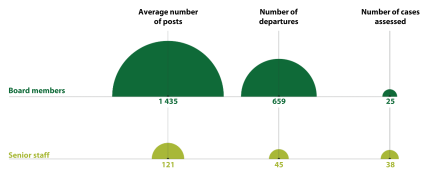
58 The remaining 31 agencies only take into account potential ‘revolving door’ cases concerning their current and former staff. As a result, only a small fraction of potential ‘revolving door’ cases of agencies’ board members are subject to any assessment (see Figure 16). This can result in perceived or actual conflicts of interest, potentially leading to:
- decisions not being made in the public interest, but in the interest of the future employer of the board member concerned;
- unfair advantages for certain private-sector entities in terms of insider information or relations/lobbying.
Figure 16 – Few potential ‘revolving door’ cases related to members of agencies’ boards are assessed
Source: ECA, on the basis of information received from the agencies.
Action to be taken 6
Agencies should introduce internal rules for members of their boards on conflicts of interest in general and ‘revolving door’ situations in particular.
59 In general, we found that agencies rely almost exclusively on self-declarations by the members of staff concerned for identifying potential ‘revolving door’ situations and the associated risk of conflicts of interest. Most agencies do not take any steps to detect whether current staff members may be carrying out undeclared outside activities, or whether their former staff members have taken up new jobs without informing the agency. Nor do they monitor whether former staff members comply with any restrictions imposed on them in relation to their new jobs. However, we have identified four examples of good practices where agencies have introduced procedures for monitoring this. See Box 8.
Only four agencies (the BEREC Office, the SRB, EBA and ESMA) have procedures in place for monitoring compliance with the rules related to ‘revolving door’
The BEREC Office has procedures in place to perform sample checks on former staff members’ compliance with their obligations under Article 16 of the Staff Regulations. These checks focus on senior staff members and on staff members who either were forbidden to engage in a certain occupational activity or were allowed to accept a new job subject to certain limitations.
The SRB has procedures to run compliance checks on former staff members who left the SRB within the last two years, including the use of publicly available databases.
Action to be taken 7
Agencies should engage in active monitoring of the professional activity of their senior staff members (including those that have left the agency within the last two years) in order to be able to detect undeclared ‘revolving door’ situations and ensure compliance with previously imposed restrictions.
Other agency-related products issued by the ECA
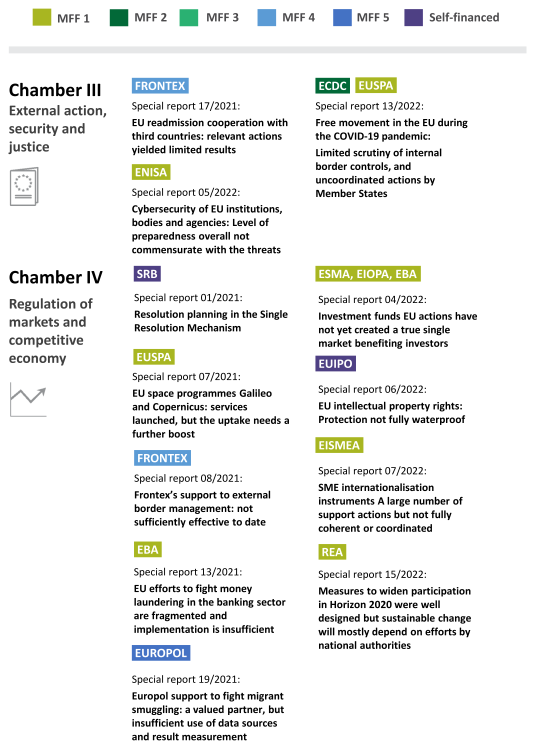
60 Apart from audit reports specifically covering the agencies, in the course of 2021 and the first half of 2022, the ECA also issued a number of special reports on EU policy implementation which referred to a number of agencies, a full list is included in Figure 17.


Agencies are following up on previous years’ audit observations
61 We provide information on the status of follow-up actions taken by the agencies in response to observations from previous years. Figure 18 shows that for the 139 observations that had not been addressed at the end of 2020, corrective action had been completed in 67 cases, and was ongoing in 39 cases in 2021. For 22 agencies (ACER, BEREC Office, CEPOL, CPVO, EASA, EASO, EFSA, EISMEA, EIT, EMA, EMCDDA, ERA, ESMA, ETF, EUIPO, eu-LISA, Eurofound, Eurojust, Europol, FRA, Frontex, and the SRB) we report a total of 48 observations from previous years that have not yet been implemented, 9 of which are outstanding.

62 Box 9 explains the different statuses of follow-up used in this document and gives examples of typical situations to which they apply.
Explanations of status of follow-up used in this document
Completed: The agency introduced improvements to address the observation, supported by evidence and checked by the ECA.
Ongoing: There is some evidence of corrective action having been taken, but the process is not yet fully implemented or complete.
Outstanding: No reaction to the observation or disagreement by the agency.
N/A: The observation is no longer applicable, or the contract which provoked the observation in question has expired. Applicable also when, due to a change of circumstances, the cost of addressing the issue outweighs the benefits.
List of acronyms used for the EU agencies and other bodies
| Acronym | Full name | Acronym | Full name | |
|---|---|---|---|---|
| ACER | European Union Agency for the Cooperation of Energy Regulators | EMA | European Medicines Agency | |
| BEREC Office | Agency for Support for Body of European Regulators for Electronic Communications | EMCDDA | European Monitoring Centre for Drugs and Drug Addiction | |
| CdT | Translation Centre for the Bodies of the European Union | EMSA | European Maritime Safety Agency | |
| Cedefop | European Centre for the Development of Vocational Training | ENISA | European Union Agency for Cybersecurity | |
| CEPOL | European Union Agency for Law Enforcement Training | EPPO | European Public Prosecutor’s Office | |
| Chafea | The Consumers, Health, Agriculture and Food Executive Agency | ERA | European Union Agency for Railways | |
| CINEA | European Climate Infrastructure & Environment Executive Agency | ERCEA | European Research Council Executive Agency | |
| CPVO | Community Plant Variety Office | ESA | Euratom Supply Agency | |
| EACEA | European Education and Culture Executive Agency | ESMA | European Securities and Markets Authority | |
| EASA | European Union Aviation Safety Agency | ETF | European Training Foundation | |
| EASO | European Asylum Support Office | EUIPO | European Union Intellectual Property Office | |
| EBA | European Banking Authority | eu-LISA | European Union Agency for the Operational Management of Large-Scale IT Systems in the Area of Freedom, Security and Justice | |
| ECDC | European Centre for Disease Prevention and Control | EU-OSHA | European Agency for Safety and Health at Work | |
| ECHA | European Chemicals Agency | Eurofound | European Foundation for the Improvement of Living and Working Conditions | |
| EEA | European Environment Agency | Eurojust | European Union Agency for Criminal Justice Cooperation | |
| EFCA | European Fisheries Control Agency | Europol | European Union Agency for Law Enforcement Cooperation | |
| EFSA | European Food Safety Authority | EUSPA | European Union Agency for the Space Programme | |
| EIGE | European Institute for Gender Equality | FRA | European Union Agency for Fundamental Rights | |
| EIOPA | European Insurance and Occupational Pensions Authority | Frontex | European Border and Coast Guard Agency | |
| EISMEA | European Innovation Council and SMEs Executive Agency | HaDEA | European Health and Digital Executive Agency | |
| EIT | European Institute of Innovation and Technology | REA | European Research Executive Agency | |
| ELA | European Labour Authority | SRB | Single Resolution Board |
Audit team
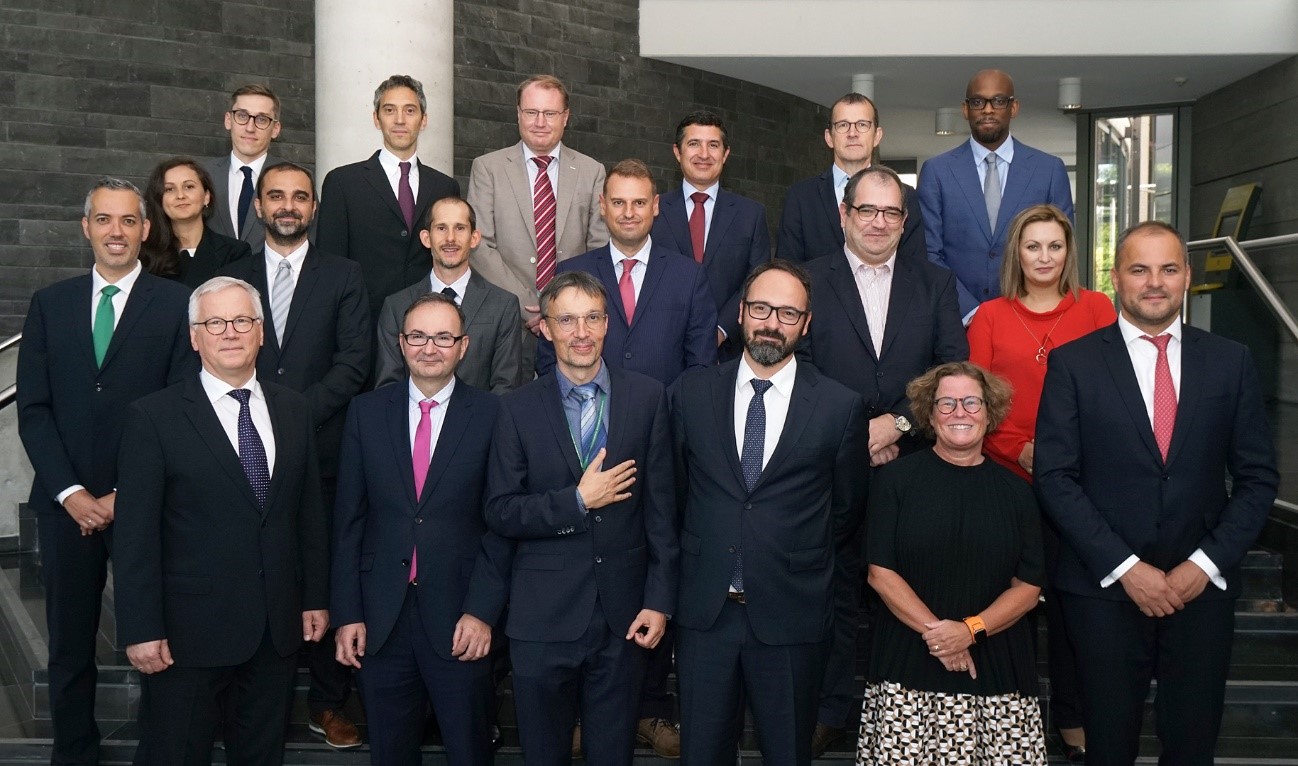
Third row (from left to right): Janis Gaisonoks, Marco Corradi, Peter Eklund, Joao Pedro Bento, Ivo Koppelmaa, Emmanuel Djoffon (Auditors).
Second row (from left to right): Sergio Gascon Samper (Auditor), Alexandra Mazilu (Graphic designer), Nikolaos Alampanos, Armin Hosp, Leonidas Tsonakas, Paulo Oliveira, (Auditors), Ioanna Michali (Assistant).
Front row (from left to right): Rimantas Šadžius (ECA Member), Julio Cesar Santin Santos, Mirko Gottmann (Auditors), Michal Machowski (Principal Manager), Christine Becker (Auditor), Mindaugas Pakstys (Head of Cabinet).
Members of the audit team not on the photo: John Sweeney (Principal Manager), Di Hai, Matthias Blaas (Attachés), Iveta Adovica, Santiago Fuentes,Joaquin Hernandez Fernandez, Marc Hertgen, Tomas Mackevicius, Hans Christian Monz, Roberto Sanz Moratal, Svetoslava Tashkova, (Auditors), Chantal Kapawa (Assistant).
We would like to pay special tribute to Mr Alex Brenninkmeijer (1951-2022), ECA Member, who led this audit until April 2022.
Endnotes
1 Articles 285 to 287 (OJ C 326, 26.10.2012, pp. 169-171).
2 More information on our work canbe found in our activity reports, our annual reports on the implementation of the EU budget, our special reports, our landscape reviews and our opinions on new or updated EU laws or other decisions with financial management implications (www.eca.europa.eu).
3 ACER, BEREC Office, Cedefop, CdT, CEPOL, CPVO, EASA, EASO, EBA, ECDC, ECHA, EEA, EFCA, EFSA, EIGE, EIOPA, ELA, EMA, EMCDDA, EMSA, ENISA, ERA, ESMA, ETF, EUIPO, eu‑LISA, EU‑OSHA, EUSPA, Eurofound, Eurojust, Europol, FRA, Frontex.
4 CINEA, EACEA, EISMEA, ERCEA, HaDEA, REA and Chafea (which ceased to exist on 1 April 2021).
5 See our report for the 2020 financial year.
6 Review 01/2014: “Gaps, overlaps and challenges: a landscape review of EU accountability and public audit arrangements”, paragraph 84.
7 2021-2027 Strategy for the EU Agencies Network, Brussels, 9 November 2020.
8 Annual Report on EU agencies for the financial year 2019: paragraphs 2.34-2.41.
9 Annual report on EU agencies for the financial year 2020: paragraphs 3.30.15.
10 Commission Implementing Decision (EU) 2021/173 establishing the European Climate, Infrastructure and Environment Executive Agency, the European Health and Digital Executive Agency, the European Research Executive Agency, the European Innovation Council and SMEs Executive Agency, the European Research Council Executive Agency, and the European Education and Culture Executive Agency.
11 Articles 42 of Regulations (EU) No 1093/2010, 1094/2010 and 1095/2010.
12 ECA special report 10/2019: “EU-wide stress tests for banks: unparalleled amount of information on banks provided but greater coordination and focus on risks needed”.
13 ECA special report 29/2018: “EIOPA made an important contribution to supervision and stability in the insurance sector, but significant challenges remain”.
14 ECA special report 13/2021: “EU efforts to fight money laundering in the banking sector are fragmented and implementation is insufficient”.
15 ECA special report 04/2022: “Investment funds: EU actions have not yet created a true single market benefiting investors”.
16 Commission proposals on amendments to Regulations (EU) No 1093/2010, 1094/2010 and 1095/2010, COM(2017) 536 final.
17 OECD Public Integrity Handbook; Chapter 13.3.2.
18 The European Ombudsman's work on revolving doors.
19 Articles 12, 12b, 16 and 17 of the EU’s Staff Regulations of Officials and the Conditions of Employment of Other Servants of the European Economic Community and the European Atomic Energy Community.
20 Report of the European Ombudsman on the publication of information on former senior staff so as to enforce the one-year lobbying and advocacy ban.
Contact
EUROPEAN COURT OF AUDITORS
12, rue Alcide De Gasperi
1615 Luxembourg
LUXEMBOURG
Tel. +352 4398-1
Enquiries: eca.europa.eu/en/Pages/ContactForm.aspx
Website: eca.europa.eu
Twitter: @EUAuditors
More information on the European Union is available on the internet (https://europa.eu).
Luxembourg: Publications Office of the European Union, 2022
| ISBN 978-92-847-8843-9 | doi:10.2865/765975 | QJ-AH-22-001-EN-N | ||
| HTML | ISBN 978-92-847-8847-7 | doi:10.2865/457403 | QJ-AH-22-001-EN-Q |
GETTING IN TOUCH WITH THE EU
In person
All over the European Union there are hundreds of Europe Direct centres. You can find the address of the centre nearest you online (european-union.europa.eu/contact-eu/meet-us_en).
On the phone or in writing
Europe Direct is a service that answers your questions about the European Union. You can contact this service:
- by freephone: 00 800 6 7 8 9 10 11 (certain operators may charge for these calls),
- at the following standard number: +32 22999696,
- via the following form: european-union.europa.eu/contact-eu/write-us_en.
FINDING INFORMATION ABOUT THE EU
Online
Information about the European Union in all the official languages of the EU is available on the Europa website (european-union.europa.eu).
EU publications
You can view or order EU publications at op.europa.eu/en/publications. Multiple copies of free publications can be obtained by contacting Europe Direct or your local documentation centre (european-union.europa.eu/contact-eu/meet-us_en).
EU law and related documents
For access to legal information from the EU, including all EU law since 1951 in all the official language versions, go to EUR-Lex (eur-lex.europa.eu).
EU open data
The portal data.europa.eu provides access to open datasets from the EU institutions, bodies and agencies. These can be downloaded and reused for free, for both commercial and non-commercial purposes. The portal also provides access to a wealth of datasets from European countries.