

3. Labour market developments
3.3. Labour market participation
Labour market participation continued to rise in 2023. Following a brief downturn during the COVID-19 pandemic, the labour force participation rate among individuals aged 15-64 in the EU increased consistently, reaching 75.0% in 2023 (+0.5 pp compared to 2022). This increase was marginally more pronounced for women (+0.7 pp, to 70.2%) than for men (+0.4 pp, to 79.8%).
Chart 1.9
Labour market slack continued to decline, while labour market participation rates grew slightly
Various labour market indicators, by educational attainment (% of respective population)
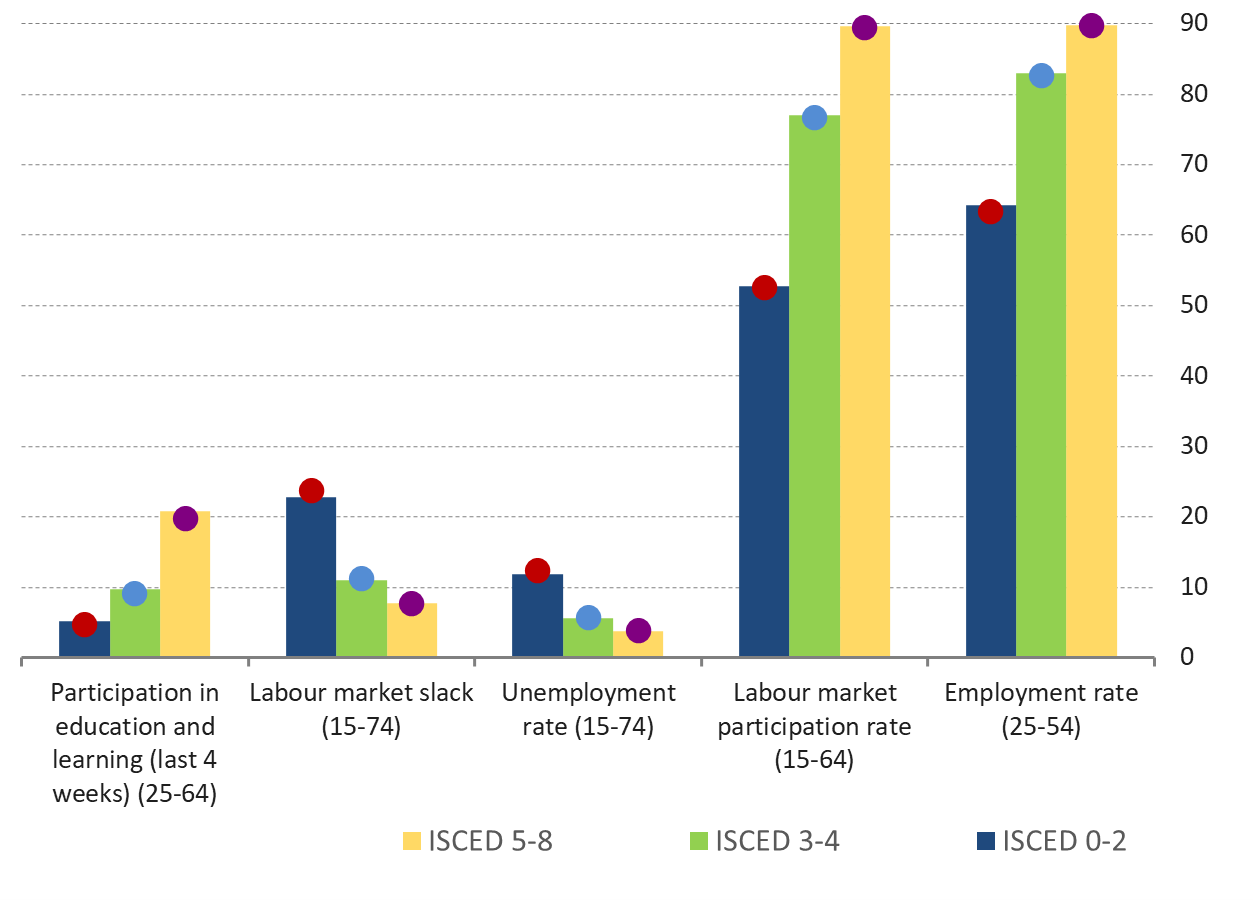
Note: ISCED 0-2: Less than primary, primary and lower secondary education; ISCED 3-4: Upper secondary and post-secondary non-tertiary education; ISCED 5-8: Tertiary education. 2023 data in bars, 2022 data in dots.
Source: Eurostat [lfsi_educ_a], [lfsa_argaed], [lfsa_urgaed], [lfsa_sup_edu], [trng_lfse_03]).
The labour market remained tight, with slack (26) declining steadily since the end of the COVID-19 pandemic. The labour market slack indicator reached 12.0% of the extended labour force (aged 15-74) in 2023, 0.3 pp less than the previous year (Chart 1.9). The decline was similar for women (-0.4 pp, to 13.9%) and men (-0.3 pp, to 10.3%). The decline in the indicator reflected minor decreases in the proportion of people available to work but not looking for a job (-0.2 pp, to 2.8%), in unemployment (-0.2 pp to 5.8%), and in the proportion of part-time workers seeking more hours (-0.1 pp, to 2.5%). People seeking a job but not available remained stable, at 0.9%. Labour market slack was higher for people with lower education (22.8%) than for those with medium (11.0%) or higher (7.7%) education.