 Special Report
The European Semester – Country Specific Recommendations address important issues but need better implementation
About the report:
Since 2010, the European Semester provided an annual cycle of economic and fiscal policy coordination within the EU. We found that the Commission provided a sound analysis of Member States annual economic progress in its country reports, coordinated the Europe 2020 strategy which led to six out eight targets being reached by 2020, and proposed relevant country specific recommendations to Council for Member States. However, we also found that full or substantial implementation of CSRs by Member States was low and made a number of recommendations to improve the effectiveness of the European Semester and the Commission’s work to implement the process in line with the regulation by strengthening: the focus on areas where progress is slow (such as poverty and research); the monitoring of CRS implementation; the link between EU funds to CSRs; and written feedback on National Reform Programmes.
ECA special report pursuant to Article 287(4), second subparagraph, TFEU.
 |
Executive summary
IThe European Semester is an annual cycle of economic and fiscal policy coordination within the EU by the Commission and the Council, to improve the EU’s economic and social sustainability. The European Semester developed over time since it was established in 2010.
IIThe European Semester offers the Commission, Member States and social partners the opportunity to engage in a permanent dialogue with one another. The country-reports draw on in-depth exchanges with governments, national authorities and stakeholders at both technical and political level. The European Semester also influences budgetary and economic policy decisions of Member states. In this context, the Commission uses its discretionary power to identify the most important challenges in each Member State.
IIIThe Commission has a coordinating role and the Council is ultimately responsible for addressing guidance to Member States. The outputs of the process are country-specific recommendations (CSRs) addressed to every Member State by the Council, based on proposals made by the Commission. The Commission monitors the implementation of CSRs.
IVThis report comes at the end of the 10 year term of the Europe 2020 strategy and the start of a new strategic horizon. It is the third in a series of ECA reports on the European semester. In 2018, we published two reports covering two dimensions of the European Semester: the Stability and growth Pact (SGP) and the Macroeconomic Imbalances Procedure (MIP). Altogether these give a comprehensive overview of the effectiveness of EU level policy coordination.
VWe examined whether the Commission was effectively implementing the European Semester procedures for strengthening the surveillance of Member States policies as set out in Regulation (EU) No 1466/97 (hereafter referred to as “the Regulation”). This audit brings together lessons learned from progress towards Europe 2020 targets, implementation of Country Specific Recommendations (CSRs), their formulation and follow-up.
VIProgress towards six of the eight Europe 2020 strategy targets set for 2020 – on key domains such as employment, educational attainment and energy – has been positive, and these are likely to be met in full. However, progress has been slow with regard to poverty and research and development targets.
VIICSRs call for important structural reforms. The Commission’s multi-annual assessments show that Member States have implemented 26 % of CSRs substantially or fully, and about 44 % with at least “some progress”, from 2011-2018. There was “limited progress” or “no progress on implementing the remaining 30 % of CSRs.
VIIIWe looked at documents produced as part of the European semester, and found that CSRs generally address the issues identified in the Country Reports, the priorities set in the Annual Growth Survey and in the Integrated Guidelines. CSRs also identify policy areas which need to be addressed, but often without sufficiently explaining why certain reforms should be prioritised over others. The Commission’s Country reports generally identify important risks and serve as a good basis for formulating CSRs.
IXThe National Reform Programmes (NRPs) contain Member States’ own risk assessments and policy responses. However, we found a number of cases where NRPs lack sufficient information on which priorities and targets are being addressed by their proposed measures. The Commission did not give written feedback on information gaps of individual NRPs.
XBased on our findings, we recommend that the Commission should strengthen:
- the focus on the social and research dimensions in the European Semester process;
- the monitoring of CSR implementation;
- the link between EU funds and Country Specific Recommendations;
- the quality of CSR formulation;
- its assessments of NRPs.
Note to the reader:
Our audit work was completed prior to the outbreak of COVID-19, and therefore this report does not take into account any policy developments or other changes that occurred in response to the pandemic.
Introduction
The European Semester process
01The European Semester is an annual cycle of economic and fiscal policy coordination within the EU by the European Commission and the Council, to improve the EU’s economic and social sustainability and address the structural challenges facing the EU: fiscal policy, macroeconomic imbalances and structural reforms related to long-term growth, employment and other social issues.
02The European Semester was created as part of the EU’s response to the economic and financial crisis in Europe since 20101. The European Semester aims to synchronise the timetables of established procedures to better align the goals of national budgetary, growth and employment policies in the aftermath of the financial crisis (see Annex I). The European Semester brings together several procedures covering complex policy areas with multiple coordination arrangements: the preventive arm of the Stability and Growth Pact (SGP), the macroeconomic imbalances procedure (MIP) and the Europe 2020 strategy for growth and jobs (see Table 1).
Table 1
Policy dimensions and procedures co-ordinated under the European Semester
| European Semester policy dimensions | ||||||
| Domain | Fiscal | Macro-economic | Micro-economic and structural | |||
| EU guidelines | Integrated guidelines: Broad economic policy guidelines (BEPGs) and Employment guidelines (EGs) | |||||
| EU policy | Stability and Growth Pact (SGP) | Macro economic procedure (MIP) | Europe 2020 strategy | |||
| Sub policy | Preventive arm of SGP | Corrective arm of SGP (EDP)* | Preventive action of MIP | Corrective action of MIP | Jobs | Growth |
Note: *The Excessive Deficit Procedure (EDP) falls under the Stability and Growth Pact (SGP), and although it depends on the co-ordination carried out under the European Semester, it has a separate legal basis and procedures for its implementation.
Source: ECA.
The European Semester offers the Commission, Member States and social partners the opportunity to engage in a permanent dialogue with one another. To foster a deeper level of national ownership at Member State level, in-depth exchanges take place between the Commission and national governments, national authorities and stakeholders. The European Semester, influences budgetary and economic policy decisions of Member states. In this context, the Commission uses its discretionary power to identify the most important challenges in each Member State.
04The Europe 2020 strategy for Jobs and Growth2 (the “Europe 2020 Strategy”) was launched on 17 June 2010 during the financial and economic crisis. It succeeded the Lisbon Strategy. Europe 2020 is a 10-year strategy to help the EU overcome the crisis, setting the objective of making the EU a smart, sustainable and inclusive economy. Box 1 shows the targets of the Europe 2020 strategy. Progress made in achieving the objectives of the Europe 2020 strategy is assessed under the European Semester. Member States are invited to report in their National Reform Programmes (NRPs) on progress towards their targets3.
Box 1
EU targets of Europe 2020 strategy
- Raise the employment rate of the population aged 20-64 from the current 69 % to at least 75 %.
- Achieve the target of investing 3 % of GDP in R&D in particular by improving the conditions for R&D investment by the private sector, and develop a new indicator to track innovation.
- Reduce greenhouse gas emissions by at least 20 % compared to 1990 levels or by 30 % if the conditions are right, increase the share of renewable energy in our final energy consumption to 20 %, and achieve a 20 % increase in energy efficiency.
- Reduce the share of early school leavers to 10 % from the current 15 % and increase the share of the population aged 30-34 having completed tertiary education from 31 % to at least 40 %
- Reduce the number of Europeans living below national poverty lines by 25 %, lifting 20 million people out of poverty.
Source: Commission Communication “EUROPE 2020 – A strategy for smart, sustainable and inclusive growth”, COM(2010) 2020, of 3.3.2010, Annex 1, p. 30.
The Commission and the Member States have developed the European Semester over time and besides its core fiscal and socio-economic focus, discussions are being held to increase the focus on environmental sustainability and rule of law. The 2020 EU ‘Annual Growth Survey’ shows a reorientation of the Union’s strategy towards sustainable growth. It sets the United Nations Sustainable Development Goals (SDGs) as a core objective, and casts the European Green Deal as its new growth strategy, with Country Reports in 2020 containing an analysis and monitoring of the SDGs4. In a separate communication, the Commission is exploring ways in which macro-economic surveillance can contribute to identify and address certain rule of law challenges5.
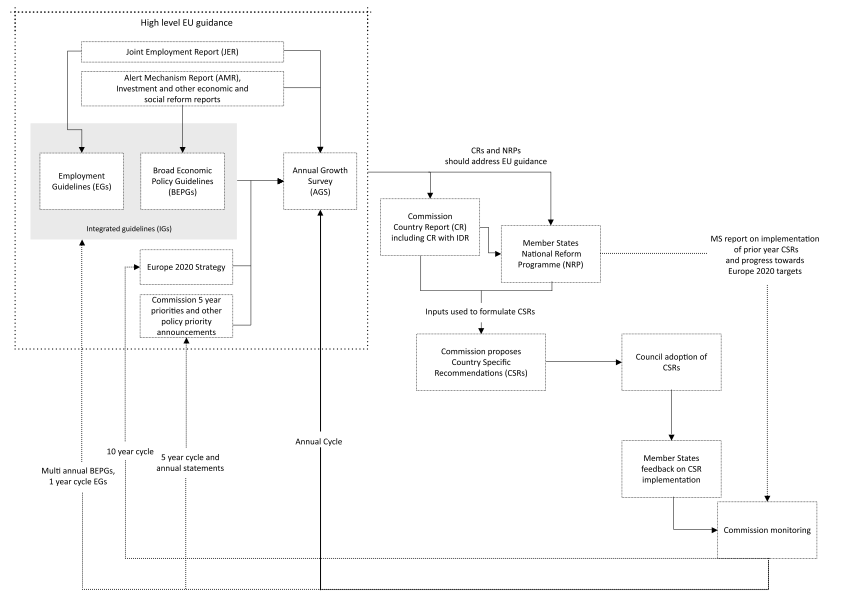
06The European Semester process includes the following documents (see Annex II):
- Broad economic policy guidelines (BEPGs) and employment guidelines (EGs), referred to jointly as “integrated guidelines” (IGs). These guidelines are proposed by the Commission and adopted by the Council, to guide Member State policies in these areas. While the BEPGs are not limited to a specific period (the last BEPGs were approved in 2015), the EGs are updated or reconfirmed each year. Although not binding or enforceable on Member States, the guidelines provide the basis for the Commission to issue Country Specific Recommendations (CSRs). Furthermore, the Regulation requires the Commission to survey and examine their implementation.
- The Annual Growth Survey (AGS) is a communication prepared by the Commission, presented as part of the “autumn package” in November. It outlines the main challenges facing the EU and the euro area, sets out general economic and social priorities for the EU and provides Member States with EU-level policy guidance for the following year. The AGS draws priorities from other reports in the autumn package or other relevant documents, for example: the 2018 AGS “builds on President Juncker’s 2017 State of the Union address, the European Pillar of Social Rights, the White Paper on the Future of Europe and the five subsequent reflection papers. It also takes into account discussions with the European Parliament, the Council, other EU institutions, national parliaments and social partners”.
- The Autumn Package includes, in addition to the AGS, the Alert Mechanism Report (AMR) for the Macroeconomic Imbalance Procedure (MIP), and the Draft Joint Employment Report (DJER). Since 2015, it has included a communication summarising the Commission's assessment of the Draft Budgetary Plans (DBPs) for the following year submitted by the euro-area Member States and recommendations for the euro area.
- Country Reports (CRs) are staff working documents presented by the Commission in February each year since 2015 (before 2015, the Commission issued its SWD in May containing an assessment of the NRP and the In-Depth Reviews (IDRs) were issued separately in April). Country reports contain an assessment of each Member State’s economic situation and progress towards Europe 2020 targets and CSR implementation.
- Stability and Convergence Programmes (SCPs) and National Reform Programmes (NRPs) are submitted by Member States in April each year. The Regulation requires SCPs to cover fiscal plans which take into account the different fiscal and macro economic imbalances issues. It also requires Member States to present National Reform Programmes which outline their plans whilst taking into account the various multiannual and annual guidance provided at EU level, for example MIP related issues, the Union’s Strategy for Growth and Jobs (the “Europe 2020 strategy”), the Integrated Guidelines (BEPGs and EGs), and the Annual Growth Survey. The Commission also issues specific guidance on the format and content of NRPs annually in the form of a letter sent to Member States, every year.
- Staff Working Documents (SWDs) for the preventive arm are prepared by the Commission services in May each year and present their analysis of SCPs. They contain all fiscal risks identified and report on fiscal developments and compliance with the SGP preventive arm fiscal rules framework.
- Country Specific Recommendations (CSRs) are proposed by the Commission to the Council in May for approval in July every year. The Commission then follows up on their implementation to assess progress and reports on this in the Country Reports of the following year. In cases of no progress or deterioration, the Council then decides, based on a recommendation by the Commission, whether any further enforcement steps are necessary (for example, sanctions or other actions, such as decisions to restrict EU funding).
- Follow-up reports: For countries with identified macro-economic imbalances, there is also an exercise to specifically monitor their progress with the policy agenda and MIP-related CSRs. This takes place in November-December. The Commission monitoring reports are discussed in Council committees and are also published. The Council issues conclusions on the overall exercise in January of the following year.
Annex III presents the main changes in the European Semester timetable in the period 2011-2018.
08Since 2011, four Member States in total (Ireland, Portugal, Cyprus and Greece) were excluded from the European Semester for periods during which they were placed under a macroeconomic adjustment programmes. This avoids duplication of recommendations to the measures set out in such programmes.
Responsibility for the European Semester is shared between Commission and Member States
09The Council is ultimately responsible for addressing guidance to Member States on the basis of the Commission’s recommendations. The specific measures needed are to the discretion of national authorities. This discretion is necessary to keep the political ownership at the Member States level (national, regional, local).
10The Commission has a coordination role, with sanctioning powers only in relation to the Stability and Growth Pact and Macroeconomic Imbalance Procedure, and is expected to observe the principles of subsidiarity and proportionality. It is also responsible for the AGS, the CRs and the draft CSRs, the Europe 2020 strategy, SWDs for the SGP Preventive Arm, the DJER, the IDR and AMR, as well as any monitoring and follow-up reporting. The Commission is also responsible for reviewing the process every 5 years and, if necessary, recommending adjustments to it6.
11The Secretariat General of the Commission is responsible for overseeing and coordinating the European Semester and steers the core group of directorates-general (DGs), which includes DG for Economic and Financial Affairs (DG ECFIN), DG for Internal Market, Industry, Entrepreneurship and SMEs (DG GROW), and DG for Employment, Social Affairs and Inclusion (DG EMPL). The participation of DGs within the core group may change according to the priorities of the European Semester process. Country teams include team leaders from the Secretariat General and officers from different DGs, as well as European Semester Officers from EU representations in the Member States.
12The Council is responsible for addressing guidance to Member States. It is expected to follow the Commission’s recommendations and proposals or explain its position publicly if it disagrees7.
13The concept of national ownership is key to the European semester process. It refers to the level of commitment and progress required from Member States in ensuring closer coordination of economic policies and sustained convergence of their economic performances in accordance with Articles 120, 121 and 148 TFEU and the provisions under the Regulation. The concept has been further elaborated over time in different Council and Commission communications and in the Regulation (see Box 2).
Box 2
The concept of national ownership for European Semester implementation
In accordance with the Luxembourg Resolution on economic policy coordination of 1997, enhanced coordination of fiscal policies must adhere to the Treaty principle of subsidiarity, respecting the prerogatives of national Governments in determining their structural and budgetary policies, while complying with the provisions of the Treaty and the Stability and Growth Pact8. This point was once again reiterated in the proposed revisions of the SGP in 20059.
In 2011, Member States reiterated that the “experience gained and mistakes made during the first decade of the economic and monetary union show[ed] a need for improved economic governance in the Union, which should be built on stronger national ownership of commonly agreed rules and policies and on a more robust framework at the level of the Union for the surveillance of national economic policies”10.
Members States are required to take due account of the guidance addressed to them in the development of their economic, employment and budgetary policies before taking key decisions on their national budgets for the succeeding years11 and for implementing their CSRs. Member States present their plans and report progress in their NRPs.
National ownership also refers to a dialogue between the Commission and a multiplicity of actors in Member States at each stage of the European Semester-cycle, with regular missions to Member States at the political and technical level12.
In an effort towards achieving better fiscal discipline and increasing national ownership of EU fiscal rules, the EU fiscal framework requires Member States to establish national budgetary frameworks and independent fiscal institutions in charge of monitoring compliance with numerical fiscal rules and assessing the need to activate correction mechanisms.
Audit scope and approach
14The main audit question was whether the Commission had effectively coordinated economic and structural policies under the European Semester Regulation (EU) 1466/97, referred to as “the Regulation” in this report. We examined the Commission’s implementation of the Regulation. We looked at the framework for the European Semester, and at the Europe 2020 strategy and associated structural reforms necessary for improving social and economic sustainability.
15This report completes a series of three ECA reports on the European Semester. The first two dimensions of the European Semester, the SGP and the MIP, were covered in two special reports published in 201813. More specifically, we addressed the following audit questions:
- Was progress towards Europe 2020 targets sufficient and was the coordination of this strategy under the European Semester carried out effectively?
- Did CSRs address the priorities set in the AGS and IGs and did Member States implement their CSRs fully or sufficiently?
- Was the Commission’s overall monitoring of CSR implementation carried out diligently and did it provide correct information?
- Did the Commission formulate CSRs and prepare its recommendation to the Council on the basis of its assessments contained in Country Reports and its assessments of Member States NRPs?
We examined the European Semester process in detail for a sample of six Member States (Austria, Belgium, Finland, Hungary, Italy, and the Netherlands) over the years 2011-2018 (see Annex IV for the choice of Member States in the sample). Where relevant, we also considered other Member States.
17Our audit criteria came from:
- the requirements of the legal framework, in particular Regulation (EU) No 1466/97 on the European Semester;
- the Europe 2020 strategy and reviews by the Commission itself on the process or its predecessor, the Lisbon Strategy;
- the Commission’s internal guidance to its own country desks or to Member States on producing different assessments and reports;
- documents issued by a number of EU institutions and other international organisations or resulting from research to identify best practice.
We carried out reviews of the whole chain of documents (i.e. AGS, CR, NRP, CSR, follow-up reporting) over two cycles (2014 and 2016) for each Member State in the sample to understand how the process works and whether/how different documents feed into one another in an effective and streamlined manner.
19Our main counterparts were the Secretariat General of the Commission, which is mainly responsible for co-ordinating the process and the core DGs (i.e. ECFIN, EMPL, GROW).
20Our audit work was completed prior to the outbreak of COVID-19, and therefore this report does not take into account any policy developments or other changes that occurred in response to the pandemic.
Observations
Broad progress towards Europe 2020 strategy targets
Six out of eight Europe 2020 targets are likely to be met, while targets for poverty alleviation and research will not be reached
21The Europe 2020 strategy sets out eight targets for Member States. Progress towards achieving the Europe 2020 strategy targets has been generally positive for the EU overall and mixed across Member States (see Annex V). At an EU level, employment, energy and education targets are likely to be met in 2020. However, progress towards poverty alleviation targets has been impacted by the financial crisis of 2008 and progress in Member States towards research and development (R&D) spending targets has been limited (see Figure 1 and Annex V).
Figure 1
EU 2020 indicators used to measure progress towards targets between 2008 and 2018
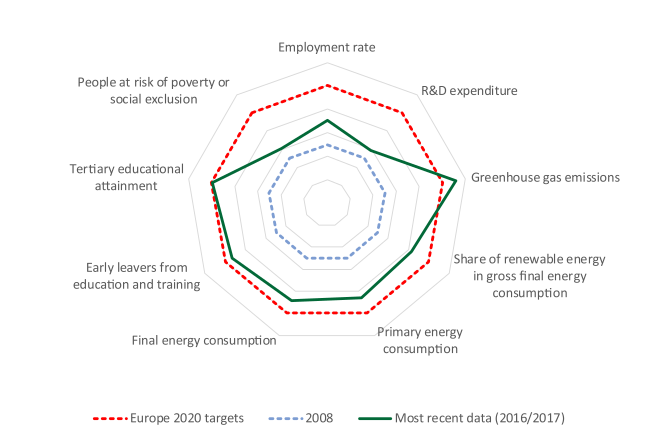
Note: Two indicators measuring Primary and Final energy consumption are used to measure progress towards the target of moving towards a 20 % increase in energy efficiency.
Source: Eurostat.
The number of people at risk of poverty or social exclusion increased in the years immediately following the crisis (from 116 million in 2008 to 122 million in 2012) and started decreasing after 2012 in line with the recovery in the general economy (from 122 million in 2012 to 109.2 million in 2018)14. However, the Europe 2020 target was to lift 20 million people out of poverty or social exclusion from the 2008 baseline down to 96.1 million by 2020.
23With regards to R&D, the target set in 2000 under the Lisbon Strategy was to increase expenditure on R&D to 3 % of GDP in each Member State and to make the EU the most competitive and dynamic knowledge-based economy in the world by 2010. This target was never met. The Europe 2020 Strategy set the same target of 3 %, but for the EU as a whole, allowing Member States to specify their own national targets. National targets vary significantly, as shown in Figure 2.
Figure 2
Research & Development (R&D) expenditure in 2008 and 2018 and R&D target of Europe 2020 Strategy per Member State
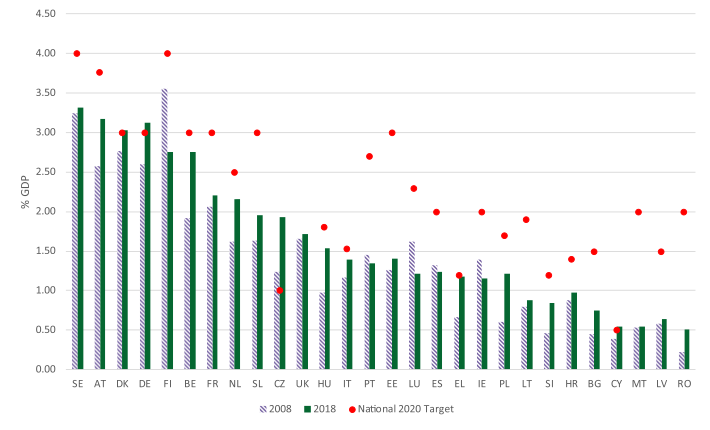
Source: ECA based on Eurostat data; Intramural R&D expenditure (GERD) by sectors of performance [rd_e_gerdtot]; 31 January 2020.
Source: The R&D target for CZ refers to government R&D expenditure only (https://ec.europa.eu/eurostat/statistics-explained/index.php/Archive:Europe_2020_indicators_-_research_and_development).
Over the 10 years from 2000-2010, the level went up to 1.93 % of GDP, an increase of only 0.16 percentage points. During the next 8 years under the Europe 2020 strategy, expenditure increased to 2.12 % of GDP in 2018, a further increase of only 0.19 percentage points (see Figure 3).
Figure 3
Gross domestic expenditure on R&D in the EU-28, (percentage of GDP)

Source: ECA based on Eurostat data.
The Commission did not make sufficient recommendations to address poverty and research in certain Member States
25Between 2011 and 2016, the Commission issued CSRs to 14 Member States directly addressing poverty. However, our analysis found cases where it had not done so when the situation deteriorated. For example, Table 2 shows that in 2016 no poverty-specific CSRs were issued for 11 out of 18 Member States in which the number of people living in poverty and social exclusion had increased (to different degrees) as compared to pre-crisis levels.
Table 2
Member States for which no CSRs related to poverty alleviation were issued in 2016
| MS* | People | Percentage points |
| BE | + 145 000 | + 0.4 |
| CY | + 53 000 | + 4.1 |
| DK | + 119 000 | + 1.6 |
| FI | + 17 000 | - 0.1** |
| FR | + 390 000 | 0.0 |
| LU | + 24 000 | + 3.5 |
| MT | + 18 000 | + 3.7 |
| NL | + 319 000 | + 1.6 |
| PT | + 106 000 | + 1.5 |
| SE | + 224 000 | + 0.8 |
| UK | + 1 202 000 | + 0.9 |
* Greece is excluded, since in 2016 the country was not subject to the European Semester process having being under the third Economic Adjustment Programme (2015-2018).
** Despite the slight decrease in percentage points of people at risk of poverty or social exclusion, Finland is included in the table as it recorded an increase in the number of people (headline indicator for Europe 2020).
Source: Eurostat for poverty or social exclusion data; Commission CESAR database for CSR classification.
The Commission issued a number of CSRs addressing poverty alleviation through areas such as: employment, skills acquisition, life-long learning, childcare and the integration of previously marginalised citizens into the job market. However, in our view the target set in the Europe 2020 strategy and the impact of the financial crisis on the rate of progress would have warranted more CSRs focusing on direct poverty alleviation measures.
27In response to high unemployment, the Commission introduced several important measures financed through the EU budget, for example, by targeting regions experiencing high youth unemployment rates. Despite these efforts, between 2008 and 2018, the poverty incidence, as measured by the ‘risk of poverty’ indicator, sharply diverged between age groups. The risk of poverty increased substantially for the age group 18-24 and declined substantially for the 65+ generation. As a result, the poverty gap between these two age groups reached 7.0 percentage points in 2018, compared to only 1.0 percentage points in 200815 (see Figure 4). Eurostat defines the indicator as the share of persons with an equivalised disposable income below the risk-of-poverty threshold, which is set at 60 % of the national median equivalised disposable income (after social transfers)16.
Figure 4
People at risk of income poverty by age group in the EU-27, 2008-2017 (percentage of total population)

Source: ECA based on Eurostat data, At-risk-of-poverty rate by poverty threshold, age and sex – EU-SILC and ECHP surveys [ilc_li02], updated 31st January 2020.
There are a number of recent developments occurring at the time of the audit which continue to reinforce the focus on both employment and poverty issues:
- in 2017, the European Pillar of Social Rights was adopted, containing 20 principles endorsed by the European Parliament, the Council and the Commission17;
- in the context of the UN’s Sustainable Development Goals (SDGs) for 2030, EU leaders have committed themselves to reducing by at least half the proportion of people living in poverty in all its dimensions, besides other sustainability targets (climate change)18;
- in her Agenda for Europe, the President of the Commission stated that she wants to “reconcile the social and the market” by putting forward an “action plan to fully implement the European Pillar of Social Rights”, and that the European Semester should be refocused into “an instrument that integrates the United Nations Sustainable Development Goals”19.
The European Semester has the potential to be an important policy coordination process for addressing poverty alleviation in a multi-dimensional manner: by ensuring adequate fiscal buffers to provide support during and immediately after a crisis; by making recommendations to all countries where poverty levels are high or deteriorating; and by further strengthening the link between CSRs and budget support to promote reforms.
30With regard to research and development, we found that the Commission did not address CSRs to every Member State that was not approaching its national targets for spending in this area. For example, no corresponding CSRs were formulated for 17 such Member States in 2017 (see Table 3 in Annex VI).
31At the global level, the EU lags behind other advanced economies such as the United States, Japan and South Korea. China has been rapidly catching up in R&D (see Figure 5). In this current context of increased competition by other global players, more needs to be done in this area within and beyond the framework of the European Semester. While Member States have sustained their public expenditure on R&D, the business sector lags behind on such expenditure and is the sector with the most potential for progress in the future20.
Figure 5
R&D expenditure as percentage of GDP for EU in comparison to other global players

Source: ECA based on Eurostat data.
The European Semester has started to reorient its focus on SDGs
32The Commission has started to monitor progress of national policies towards the achievement of SDGs by including a new annex (“E”) which presents a statistical assessment of trends in relation to SDGs in Member States during the past 5 years, based on Eurostat’s set of EU SDG indicators. The Commission has also started to issue CSRs referring to the SDGs. These recent CSRs were not covered in our audit work.
33Similarly, we found a limited number of cases were Country Reports point out rule of law related issues such as judicial independency, corruption, conflict of interest and media freedom. These are good examples of the contribution the European Semester can make to rule of law.
Member States rate of full or substantial CSR implementation is low and the Commission’s monitoring is not always complete
More than two thirds of the CSRs have seen at least ‘some progress’ in implementation, but rate of full or substantial CSR implementation by Member States is low
34The Commission has set up an internal database called CESAR containing assessments made by different DGs of the level of implementation of CSRs. According to CESAR, over the period of 2011-2017, 1.6 % of the CSRs were categorised as “fully implemented” within a year of being issued, while “substantial progress” was achieved in 4.6 % of CSRs (see Figure 6 and Box 3). The majority of CSRs are categorised under the “some progress” (50.9 %) or “limited progress” (35.5 %) categories. CSRs are often in the “some progress” category following the adoption of measures or reforms by national Parliaments or by ministerial decisions.
Figure 6
Annual assessments of CSR implementation status

Source: ECA, Annual assessment 2011-2017 based on the Commission’s database CESAR.
Although this represents an important step towards addressing CSRs, the Commission’s assessment correctly considers that a fair amount of work by Member States is still needed. This suggests that while the European Semester provides a good coordination platform to monitor progress, Member States did not implement CSRs sufficiently to address the structural issues being identified.
Box 3
Levels of implementation as defined by the Commission
At the onset of the European Semester in 2011, the CSR assessment was carried out based on three assessment categories, namely ‘no progress’, ‘partial implementation’ and ‘full implementation’. After two Semester cycles, the assessment categories were further detailed and increased in number to five: ‘no progress’, ‘limited progress’, ‘some progress’, ‘substantial progress’, and ‘full implementation’.
“Some progress” is used when a Member State has adopted measures that partly address the CSR; and/or that address the CSR, but a fair amount of work is still needed to address the CSR fully as only a few of the measures have been implemented. For instance, a measure or measures have been adopted by the national Parliament or by ministerial decision, but no implementing decisions are in place.
“Limited progress” is used to describe that a Member State has announced certain measures but these address the CSR only to a limited extent; and/or presented legislative acts in the governing or legislative body but these have not been adopted yet and substantial further, non-legislative work is needed before the CSR is implemented; presented non-legislative acts, but has not followed these up with the implementation needed to address the CSR.
In May 2017, the Commission introduced a multiannual assessment, which looks over a longer period at whether the CSRs are being implemented. The multiannual assessment captures those CSRs which are being addressed but have taken longer than a year to be implemented. Over the period 2011-2018, the multiannual assessment showed that 9 % of CSRs had been “fully implemented” while “substantial progress” had been achieved in 17 % (see Figure 7).
Figure 7
Multiannual assessments of CSR implementation status

Source: ECA, Multi-annual assessment based on Commission communication "2019 European Semester: country-specific recommendations"; COM(2019) 500 final; 5.6.2019.
If a Member State, after the timeframe has expired, has not adequately responded to a policy recommendation of the Council or develops policies going against the advice, the Commission may issue a policy warning21. Furthermore, the Commission has the option to step up recommendations to include specific measures if Member States do not address the CSRs22. For the sample of CSRs audited, the Commission has not recommended any specific measures, even though a number of CSRs have been repeated over several years due to slow or partial implementation at Member State level.
The Commission has not fully documented its monitoring of the CSR implementation
38We assessed the information recorded in CESAR to determine the quality and reliability of the monitoring process, which serves as a basis for the Commission’s reports. We found that the relevant DGs, in a few cases identified in our sample (19 out of 202 multiannual assessments), had not documented their assessments in CESAR or had not included information for certain subparts of CSRs (subparts of CSRs are different elements contained in a single CSR). CESAR is a useful tool for monitoring CSR implementation, but to maximise its usefulness, completeness of information is important.
39Our review of the monitoring of CSR implementation in subsequent CRs and other Commission reports shows that frequent regroupings of CSR subparts. This makes the rate of progress or implementation difficult to compare over the years.
40Whilst CESAR is an internal database and not suitable for publication, and although a multi-annual overview is published by the Commission there is no consolidated database which is publicly available for retrieving easily the CSRs for all years and their respective implementation status in different years.
Insufficient link between EU budget spending and CSR implementation
41According to the common provisions on the European Structural and Investment Funds (ESIF)23, the use of these funds should be linked to the objectives of the European Semester and, particularly, to the CSRs. A study carried out for the Commission in 201824 shows the extent to which the ESIFs have contributed to the implementation of CSRs (see Box 4).
Box 4
Extracts of key findings on ESIF support for implementing the 2012-2015 CSRs
- Approximately €240 billion out of €281 billion of ERDF, ESF and CF were allocated to fund-relevant CSRs/structural challenges. In other words 85.1 % of the total endowment of these funds contribute to address fund-specific CSRs/structural challenges (Section 6.2.1., paragraph 2, p. 124).
- Member States allocated between 38 % (e.g. Germany) to 100 % (e.g. Latvia and Luxembourg) of their ESI Funds to CSRs (Section 6.2.1., paragraph 5, p. 124).
- The linkages between the programming documents and structural reforms tend to be broad and general. The Partnership Agreements and the Operational Programmes do not explain how the funds will support their implementation, targets and timing (Section 6.2.1., paragraph 6, p. 124).
- The evidence shows that the funds are used to pursue structural reform needs and contribute to implementing CSRs. However, such evidence is not sufficient to assess whether the interventions to date have been appropriate or whether their results are contributing to the required changes (Section 6.2.2., paragraph 4, p. 125).
The efforts to support the implementation of structural reforms through financial incentives from the EU budget date back to 1997 Broad economic policy guidelines (in relation to labour market reforms). All relevant CSRs have been taken into account in the programming of the 2014-2020 ESI Funds through ex-ante conditionalities and/or targeted investment. Since 2016, Country Reports have provided information on the contribution of the EU budget to addressing structural challenges. Given that implementation is still ongoing, results from these investments will take more time to assess.
43In an opinion on the common provisions for cohesion policy funds25, we made recommendations on how the EU budget support for CSR implementation could be more effective in the future. In particular, we recommended that CSRs need to be clear, unambiguous and operational in order to make an appropriate use of the provisions proposed in Article 15 of the draft Common Provisions Regulation (CPR). We also recommended that the Commission should include provisions to assess the fulfilment of criteria in line with related CSRs in relation to Articles 11(2) and 11(4) of the draft CPR.
44A Structural Reform Support Service (SRSS) was put in place in July 2015 to provide technical assistance to Member States in designing and implementing their structural reforms. The Commission in 2017 proposed introducing financial incentives to promote structural reforms26 and in 2018 proposed €25 billion under the 2021-2027 MFF as part of a new Reform Support Programme. The Commission proposal was in a legislative procedure at the time of the audit and integration of the proposed Reform Support Programme could contribute to increasing rate of CSR implementation.
CSRs address relevant risks without sufficiently explaining why certain reforms should be prioritised over others
Number of CSRs and their subparts have decreased since 2015
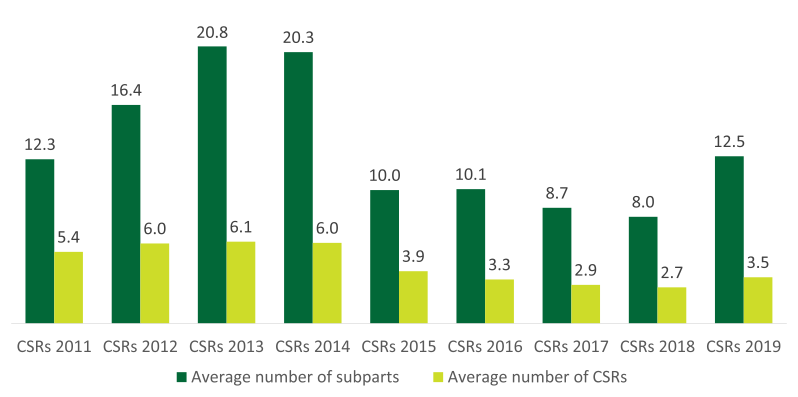
45The Commission decision to streamline CSRs in 2015 resulted in a reduction of the average number of CSR subparts for Member States from 20 in 2014 to 12.5 in 2019. Despite the intention to increase focus of CSRs by reducing their number, in recent years, we have noticed that individual recommendations refer to a number of unrelated policy dimensions or cover a broad range of policies (see Figure 8 and Box 5).
Figure 8
Average number of CSRs and their subparts per Member State, 2011-2019
Source: ECA, based on CESAR.
Box 5
Examples of mixed issues in the audit sample of CSRs for 2016
CSR 3 for The Netherlands refers to reforms of the second pillar of the pension system, distortions in the housing market, household debt bias and mortgage interest tax deductibility.
CSR 2 for Italy refers to reforms in public administration, fight against corruption and length of civil justice proceedings.
CSR 2 for Hungary refers to sector specific taxes, tax-wedge for low-income earners, public procurement transparency, anti-corruption framework and restrictive regulations in the services and retail sectors.
CSR 3 for Finland refers to competition policies in services and retail, entrepreneurship and investment policies, and administrative and regulatory burden.
CSR 2 for Belgium refers to policies on wage growth, active labour market policies, education and vocational training and integration of migrants.
CSR 1 for Austria refers to SGP fiscal targets towards the medium-term budgetary objective, sustainability of the healthcare and pension systems, and fiscal responsibilities across various layers of government.
The Integrated Guidelines serve to set priorities but the Commission does not report on their implementation
46We found that the priorities set out in the annual guidance given to Member States in the Annual Growth Survey and CSRs were generally addressing the Broad Economic and Policy Guidelines (BEPGs) and Employment Guidelines (EGs) (together referred to as Integrated Guidelines (IGs)). While a general reference is made in the recitals of the CSRs, individual CSRs do not make any ex-ante reference to which of the AGS and IG priorities they are meant to address (see Figure 9).
47There has been no ex-post evaluation of the extent to which the Member States, in their implementation of CSRs and all relevant national policies, have addressed the priorities set out in IGs, as required by the Regulation27. Such an ex-post evaluation would provide valuable feedback on the implementation of IG-priorities.
Figure 9
Lack of explicit traceability and feedback between different levels of objective-setting under the European Semester

Source: ECA.
CSRs reflect risks identified in Country Reports, but prioritisation is not clearly explained
48Country Reports contain the main macroeconomic and structural risks and weaknesses identified by country teams and report on policy measures being considered by Member States. They are generally a sound basis for formulating CSRs.
49At the beginning of each CSR, there is a recital, which gives the reasons for making the recommendation. We examined the recitals of our sample of CSRs and found that there was:
- no explanation of the prioritisation logic for inclusion of issues, nor the rationale for omitting certain issues previously identified in the Country Reports, and no explanation for discontinuing prior years’ CSRs that have not been fully implemented;
- no reference to a confirmation or commitment made by Member States in their NRPs on specific reforms or recommendations;
- no explanations of how CSRs interact with each other (i.e. in conflict or mutually dependent).
Proposals for CSRs are formulated through an internal process coordinated by the Secretariat General, and following exchange of views with Member States on different issues. Although the Commission carries out extensive analysis and discussions with Member States, we did not find the criteria based on which certain issues were prioritised and covered by CSRs while others were not. The criteria and rationale for selecting proposed CSRs was not clearly documented.
51Moreover, the feasibility of CSRs depends on a realistic timeframe for implementation. The Commission guidelines indicate that CSRs are expected to be implemented within 12-18 months, however individual CSRs do not specify the exact timeframe within which a Member State is expected to act. We noted that certain CSRs take longer to implement than the standard 12-18 months, which results in a number of CSRs being repeated over several years.
52The feasibility may also depend, on whether they are backed by sufficient financial means to implement them at national level. We found a number of cases where CSRs did not include any indication of the financial resources required to implement them (see Box 6).
Box 6
Examples of CSRs in sampled countries giving no information on the financial means required to implement them
When it made CSR No 2 of 2015 to Belgium, the Commission considered that sufficient resources were available to finance the tax reform by shifting such taxes away from labour to other components. In its subsequent bi-lateral meetings with the Member States, it transpired that there was a financing gap of around 1.5 % of GDP for the tax reform, making such a reform less feasible from a resources point of view.
In the case of the 2013 and 2015 CSRs for Finland, most of the reforms announced are not detailed enough to allow a proper assessment or do not contain the necessary details to understand their impact. Only in a few cases are measures quantified in terms of savings or costs to the budget.
In the case of the 2013 and 2015 CSRs for the Netherlands, we found no comments in the NRP regarding the CSRs’ financial feasibility.
For Hungary we did not find references in the NRP regarding financial feasibility or otherwise of CSRs.
National Reform Programmes do not always provide feedback on EU priority targets or how national stakeholders were engaged
53The Regulation requires Member States to submit NRPs and Stability and Convergence Programmes, and requires the Commission to assess both28. The Commission reviews the submissions before finalising the CSRs, as also stated in the recitals of CSRs. However, we found that the Commission did not assess the rate of CSR implementation reported by Member States or how Member States intended to address important economic and employment challenges or shortfalls in relation to Europe 2020 targets.
54Furthermore, the involvement of the local and regional authorities (LRAs) in the European Semester – including the design and implementation of NRPs – was neither mandatory nor formally organised by the Member States. LRAs are not considered partners in the process, even though a significant share of the CSRs cannot be fully implemented without them playing an active role. For example, LRAs are responsible for more than half of public investment in the EU29. The Commission, however, generally did not provide comments on the absence of consultations with the LRAs and other stakeholders.
55In addition, our review of NRPs submitted in 2014 and 2016 identified cases where NRPs failed to provide information in line with the guidance issued by the Commission (see Box 7).
Box 7
Examples of NRPs not providing feedback in line with Commission guidance
We found that measures proposed in the NRPs did not refer to the priorities identified in the AGS or IGs (e.g. the 2014 and 2016 NRPs of Austria, Belgium, Hungary, the Netherlands and Finland, and Italy‘s 2016 NRP).
We found that certain AGS priorities relevant to a Member State had not been considered in the NRP itself (e. g. Italy’s 2016 NRP makes no reference to important issues such as re-launching investment, digital agenda or flexicurity).
We found that NRPs in the sample were weak as regards reporting the economic and employment situation, the main challenges and the strategic responses to those challenges, in a clear and summarised form in the introductory sections as required by the guidance – they usually covered this in the main text only (e.g. Hungary (2014, 2016), the Netherlands (2016)).
During the audit, we did not find any record documenting the Commission’s assessment of the NRPs. In addition, the Commission does not provide the Member States with formal written feedback on information gaps in their NRPs.
Conclusions and recommendations
57The European Semester is an important policy coordination process, which provides sound annual economic analysis for all Member States and relevant EU economic and social policy guidelines, annual priorities and Country Specific Recommendations. It covers a broad range of fiscal, economic, social and sustainability policy dimensions and related procedures.
58The Commission carries out extensive work, and uses its judgement to identify what in our view are generally the most important challenges in each Member State. Despite the extensive work carried out by the EU and Member States under this coordination process, we conclude that Member States have a low rate of full or substantial implementation of CSRs. We also conclude that the Commission did not use all available provisions available under the Regulation to step up its CSRs when no substantial progress is made over a number of years for certain CSRs.
59Progress towards achieving the Europe 2020 strategy targets has been generally positive for the EU overall and mixed across Member States. At an EU level, six out of eight targets covering one on employment, three related to energy and two to education are likely to be met by 2020, but not those regarding poverty alleviation and R&D. At the same time, we found that the Commission did not address sufficiently the need for action in CSRs for Member States not approaching targets in these areas (see paragraphs 21-31). The consideration of environmental sustainability and rule of law issues under the European Semester are important developments for the future (see paragraphs 32-33).
Recommendation 1 – Place a strong focus on the social and research dimensions in the European Semester processThe Commission should focus on:
- poverty alleviation under the European Semester, through a balanced mix of direct poverty alleviation and employment-related CSRs;
- research and development, issuing relevant CSRs for all Member States which lack progress in this respect;
Timeframe: Starting from 2021 CSRs
60A number of Member States did not fully implement CSRs. The multi-annual assessment shows that Member States implemented 26 % of CSRs substantially or fully over the period 2011-18. Member States did not make enough efforts to fully implement about 44 % of CSRs where some progress has already been registered. The multiannual assessment of CSR implementation gives a better picture than the annual assessments as it captures implementation in all the years following a CSR. However, the Commission did not sufficiently use its powers to recommend specific measures if Member States do not address the CSRs (see paragraphs 34-37).
61We assessed the CESAR database, used for monitoring CSR implementation. In a few cases in our sample (19 out of 202), some DGs did not document their assessments in the database. Complete information would make the database more useful. Frequent regroupings of CSRs also make the monitoring of a specific CSR and/or its subparts less comparable over the years (see paragraphs 38-40).
Recommendation 2 – Strengthen the implementation and monitoring of CSRsThe Commission should:
- ensure that all relevant DGs document their assessments in CESAR;
- set up a publicly available multi-annual database of all CSRs and their implementation status;
- consider recommending specific measures in those instances where Member States fail to act upon guidance received in prior years (Article 2-a(3)(a) of Regulation 1466/97);
Timeframe: For parts (a)and (c) starting from 2021, for (b) starting from 2022
62Country Reports accurately describe risks and weaknesses in Member States and broadly report on policy measures being considered by Member States. They are generally the basis for selecting and formulating CSRs but the link between the use of EU funds supporting reforms and CSRs is not developed enough (see paragraphs 29, 41-44).
Recommendation 3 – Strengthen the link between EU funds and CSRsThe Commission should strengthen the link between EU funds supporting reform processes in Member States and Country Specific Recommendations. CSRs should be taken into consideration in the different stages of budgetary processes.
Timeframe: Starting from 2021 CSRs
63We found the Commission’s coordination under the European Semester to be adequate in identifying relevant risks in the CRs and the CSRs. CSRs generally address priorities set out in the AGS and the integrated guidelines; however, CSRs in certain cases contained a mix of issues, generally had no clear timeframes and costs. CSRs reflect risks identified in Country Reports, but prioritisation is not explained clearly enough. The effectiveness of the European Semester depends equally on the level of national ownership and commitment by Member States to implement CSRs within reasonable timeframes (see paragraphs 45-52).
Recommendation 4 – Improve the formulation of CSRsThe Commission should ensure that individual CSRs deal with one common policy challenge at a time, include measurable targets and a realistic timeframe (annual or multi-annual), and provide fully documented reasoning behind their prioritisation over other issues not included in CSRs.
Timeframe: Starting from 2021 CSRs
64We found that NRPs often do not explain the precise content of measures planned by the authorities, their expected timing, milestones for implementation and estimates of their costs and impact, and are instead often described only in a very general manner. Although the Regulation requires the Commission to assess NRPs, we found that the Commission did not document their assessment on the quality and completeness of NRPs (see paragraphs 53-56).
Recommendation 5 – Provide a clear assessment of NRPsThe Commission should:
- require, in its guidance issued for NRPs, the mapping of Member States policy responses to priorities and targets defined at the EU level, and clear descriptions of how Member States intend to implement each CSR, providing information on timeframes and costs;
- document the assessment on the quality and completeness of information submitted in the NRPs and require further information in case of identified gaps.
Timeframe: Starting from 2021 NRPs
This Report was adopted by Chamber IV, headed by Mr Alex BRENNINKMEIJER, Member of the Court of Auditors, in Luxembourg at its meeting of 30 June 2020.
For the Court of Auditors

Klaus-Heiner LEHNE
President
Annexes
Annex I – Evolution of the process of economic policy coordination since 1993

Source: ECA.
Annex II – The main elements of the European Semester Process since 2015
Source: ECA.
Annex III – European Semester timetable – main changes in the period 2011-2018

Source: ECA.
Annex IV – Selection of Member States for the audit sample
01The audit of the European Semester procedures focused on six member States (five from euro area and one from non-euro area). They are the same sample used in the audit of the SGP Preventive Arm.
02Member States that were under an EDP or an adjustment programme throughout, or covered already under EDP, Greece, or Macroeconomic Imbalance Procedure (MIP) audits, were excluded (with the exception of Italy30). From the remaining Member States, we selected those that had been longer under the corrective arm, showed recent worsening in the structural balance, or had and the highest distance from Medium Term Objective (see Table 1).
Table 1
Selection of Member States for the audit sample
| Analysis of criteria and choice of MS sample for European Semester audit |
| EMU | MS | Structural balance (SB) | Comments | Distance from the MTO (SBt-1-MTOt)* | ||||||||||
| 2011 | 2012 | 2013 | 2014 | 2015 | 2016 | 2011 | 2012 | 2013 | 2014 | 2015 | 2016** | |||
| Euro area | Belgium | -4,03 | -3,42 | -2,73 | -2,85 | -2,48 | -2,10 | ES audit | -4,61 | -4,78 | -4,17 | -3,48 | -3,60 | -3,23 |
| Estonia | 0,27 | -0,10 | -0,40 | 0,31 | 0,31 | 0,18 | At MTO throughout | 0,17 | 0,27 | -0,10 | -0,40 | 0,31 | 0,31 | |
| Ireland | -7,52 | -6,45 | -4,32 | -3,22 | -2,99 | -2,15 | Under PA only in 2016 | -8,83 | -7,52 | -6,45 | -4,32 | -3,22 | -2,99 | |
| Latvia | -1,26 | -0,03 | -0,94 | -1,76 | -2,09 | -1,85 | AT MTO in 2013-14 | -1,19 | -0,26 | 0,97 | 0,06 | -0,76 | -1,09 | |
| Lithuania | -3,59 | -2,60 | -2,27 | -1,42 | -1,20 | -1,43 | AT MTO in 2015-16 | -2,29 | -2,59 | -1,60 | -1,27 | -0,42 | -0,20 | |
| Luxembourg | 1,38 | 2,47 | 2,06 | 2,15 | 0,71 | 0,90 | At MTO throughout | 0,00 | 0,88 | 1,97 | 1,56 | 1,65 | 0,21 | |
| Netherlands | -3,58 | -2,26 | -0,94 | -0,53 | -1,07 | -1,40 | ES audit (1 year more under EDP than LT,LV) | -3,03 | -3,08 | -1,76 | -0,44 | -0,03 | -0,57 | |
| Austria | -2,53 | -1,82 | -1,24 | -0,67 | -0,59 | -1,01 | ES audit (1 year more under EDP than LT,LV) | -2,76 | -2,08 | -1,37 | -0,79 | -0,22 | -0,14 | |
| Portugal | -6,22 | -3,09 | -2,50 | -1,37 | -1,82 | -2,33 | Under EDP throughout | -7,60 | -5,72 | -2,59 | -2,00 | -0,87 | -1,32 | |
| Slovakia | -4,11 | -3,56 | -1,69 | -2,05 | -2,06 | -2,04 | Debt < 60% of GDP throughout | -6,65 | -3,61 | -3,06 | -1,19 | -1,55 | -1,56 | |
| Finland | -0,85 | -1,14 | -0,98 | -1,75 | -1,75 | -1,52 | ES audit | -0,61 | -0,35 | -0,64 | -0,48 | -1,25 | -1,25 | |
| Non euro area | Denmark | -0,50 | 0,04 | -0,18 | 0,56 | -2,26 | -1,36 | Less persistent and lower deficit/debt than HU | -0,22 | 0,00 | 0,54 | 0,32 | 1,06 | -1,76 |
| Croatia | n/a | n/a | -3,57 | -3,85 | -3,49 | -3,84 | Under EDP in 2013-2016 | n/a | n/a | -4,08 | -3,57 | -3,85 | -3,49 | |
| Hungary | -4,52 | -1,44 | -1,47 | -2,50 | -2,35 | -2,63 | ES audit | -1,88 | -2,82 | 0,26 | 0,23 | -0,80 | -0,65 | |
| Poland | -6,07 | -4,04 | -3,44 | -2,65 | -3,01 | -2,65 | Less persistent and lower deficit/debt than HU | -7,26 | -5,07 | -3,04 | -2,44 | -1,65 | -2,01 | |
| Romania | -2,98 | -2,01 | -1,07 | -0,63 | -0,78 | -2,74 | Less persistent and lower deficit/debt than HU | -4,59 | -1,98 | -1,01 | -0,07 | 0,37 | 0,22 | |
| Sweden | 0,00 | 0,10 | -0,19 | -0,82 | -1,04 | -0,96 | At MTO throughout | 1,77 | 1,00 | 1,10 | 0,81 | 0,18 | -0,04 | |
| United Kingdom | -5,84 | -6,56 | -4,55 | -5,15 | -4,48 | -3,30 | Under EDP throughout | -6,00 | -4,59 | -5,31 | -3,30 | -3,90 | -3,23 | |
| Other ECA audits | ||||||||||||||
| Already audited | Germany | -1,34 | -0,12 | 0,27 | 0,82 | 0,92 | 0,71 | EDP | -1,68 | -0,84 | 0,38 | 0,77 | 1,32 | 1,42 |
| Greece | -6,40 | -0,43 | 1,98 | 0,57 | -1,13 | -0,27 | Greek audit | -9,65 | -5,90 | 0,07 | 2,48 | 1,07 | -0,63 | |
| Spain | -6,17 | -3,35 | -1,90 | -1,80 | -2,53 | -2,61 | MIP | -7,04 | -6,17 | -3,35 | -1,90 | -1,80 | -2,53 | |
| France | -5,09 | -4,26 | -3,53 | -2,79 | -2,74 | -2,39 | EDP/MIP | -5,50 | -4,69 | -3,86 | -3,13 | -2,39 | -2,34 | |
| Italy | -3,27 | -1,28 | -0,87 | -1,06 | -0,98 | -1,50 | EDP | -3,27 | -3,27 | -1,28 | -0,87 | -1,06 | -0,98 | |
| Cyprus | -5,50 | -5,14 | -1,69 | 2,02 | 0,35 | 0,22 | EDP | -5,06 | -5,50 | -5,14 | -1,69 | 2,02 | 0,35 | |
| Malta | -2,78 | -3,65 | -2,47 | -2,39 | -2,09 | -1,65 | EDP | -4,02 | -2,78 | -3,65 | -2,47 | -2,39 | -2,09 | |
| Slovenia | -4,79 | -2,13 | -2,16 | -2,75 | -2,69 | -2,48 | MIP | -4,55 | -4,79 | -2,13 | -2,16 | -2,75 | -2,69 | |
| Bulgaria | -1,87 | -0,48 | -0,76 | -2,48 | -2,56 | -2,43 | MIP | -1,51 | -0,87 | 0,52 | 0,24 | -1,48 | -1,56 | |
| Czechia | -2,63 | -1,48 | 0,08 | -0,78 | -1,96 | -1,42 | EDP | -3,06 | -1,63 | -0,48 | 1,08 | 0,22 | -0,96 | |
Source: Commission data (Preventive arm - autumn forecast 2015)
* Distance from MTO (Negative = SB below MTO, Positive = SB above MTO)
** Based on forecast data
| Under Preventive arm | |
| Not at MTO according to Commission assessments of Dec 2015 | |
| Included in ECA MIP audit sample | |
| Included in ECA EDP audit sample | |
| Included in ECA Greek audit sample | |
| Included in ECA European Semester audit sample |
Annex V – EU 2020 headline indicators for EU-28
| Topic | Headline indicator | 2008 | 2009 | 2010 | 2011 | 2012 | 2013 | 2014 | 2015 | 2016 | 2017 | 2018 | Target |
| Employment | Employment rate age group 20–64, total (% of population) | 70,30 | 69,00 | 68,50 | 68,60 | 68,40 | 68,40 | 69,20 | 70,10 | 71,10 | 72,20 | 73,20 | 75,00 |
| • Employment rate age group 20–64, females (% of population) | 62,80 | 62,30 | 62,00 | 62,20 | 62,40 | 62,60 | 63,50 | 64,30 | 65,30 | 66,50 | 67,40 | : | |
| • Employment rate age group 20–64, males (% of the population) | 77,90 | 75,70 | 75,00 | 75,00 | 74,60 | 74,30 | 75,00 | 75,90 | 76,90 | 78,00 | 79,00 | : | |
| R&D | Gross domestic expenditure on R&D (¹) (% of GDP) | 1,84 | 1,94 | 1,93 | 1,97 | 2,01 | 2,02 | 2,03 | 2,04 | 2,04 | 2,06 | 2,12 | 3,00 |
| • Business enterprise | 1,16 | 1,19 | 1,19 | 1,24 | 1,27 | 1,28 | 1,30 | 1,31 | 1,32 | 1,36 | 1,41 | : | |
| • Government | 0,24 | 0,26 | 0,25 | 0,25 | 0,25 | 0,25 | 0,24 | 0,24 | 0,23 | 0,23 | 0,23 | : | |
| • Higher education | 0,42 | 0,46 | 0,47 | 0,46 | 0,47 | 0,47 | 0,47 | 0,47 | 0,47 | 0,46 | 0,46 | : | |
| • Private non-profit | 0,02 | 0,02 | 0,02 | 0,02 | 0,02 | 0,02 | 0,02 | 0,02 | 0,02 | 0,02 | 0,02 | : | |
| Climate change and energy | Greenhouse gas emissions (²) (Index 1990=100) | 90,60 | 83,80 | 85,70 | 83,00 | 82,10 | 80,40 | 77,50 | 78,10 | 77,80 | 78,30 | : | 80,00 |
| Share of renewable energy in gross final energy consumption (%) | 11,10 | 11,90 | 12,50 | 13,10 | 14,40 | 15,20 | 16,20 | 16,70 | 17,00 | 17,50 | : | 20,00 | |
| Primary energy consumption (Million tonnes of oil equivalent) | 1 693,00 | 1 595,00 | 1 654,00 | 1 593,00 | 1 585,00 | 1 571,00 | 1 511,00 | 1 537,00 | 1 547,00 | 1 562,00 | : | 1 483,00 | |
| Final energy consumption (Million tonnes of oil equivalent) | 1 180,00 | 1 108,00 | 1 160,00 | 1 105,00 | 1 106,00 | 1 108,00 | 1 066,00 | 1 088,00 | 1 110,00 | 1 123,00 | : | 1 086,00 | |
| Education | Early leavers from education and training, total (³) (% of population aged 18–24) | 14,70 | 14,20 | 13,90 | 13,40 | 12,70 | 11,90 | 11,20 | 11,00 | 10,70 | 10,60 | 10,60 | <10.00 |
| • Early leavers from education and training, females (³) (% of population 18–24) | 12,70 | 12,30 | 11,90 | 11,50 | 10,90 | 10,20 | 9,60 | 9,50 | 9,20 | 8,90 | 8,90 | : | |
| • Early leavers from education and training, males (³) (% of population 18–24) | 16,70 | 16,10 | 15,80 | 15,30 | 14,50 | 13,60 | 12,70 | 12,40 | 12,20 | 12,10 | 12,20 | : | |
| Tertiary educational attainment, total (³) (% of population 30–34) | 31,20 | 32,30 | 33,60 | 34,80 | 36,00 | 37,10 | 38,00 | 38,70 | 39,20 | 39,90 | 40,70 | >=40.00 | |
| • Tertiary educational attainment, females (³) (% of population 30–34) | 34,30 | 35,70 | 37,20 | 38,60 | 40,20 | 41,40 | 42,30 | 43,40 | 43,90 | 44,90 | 45,80 | : | |
| • Tertiary educational attainment, males (³) (% of population 30–34) | 28,00 | 28,90 | 30,00 | 31,00 | 31,80 | 32,80 | 33,60 | 34,00 | 34,40 | 34,90 | 35,70 | : | |
| Poverty and social exclusion | People at risk of poverty or social exclusion, EU-27 (⁴)(⁷) (Million) | 116,10 | 114,50 | 117,00 | 119,60 | 122,20 | 121,60 | 120,80 | 117,80 | 116,90 | 111,84 | 109,23 | 96,10 |
| People at risk of poverty or social exclusion, EU-28 (⁴)(⁷) (Million) | : | : | : | 121,00 | 123,60 | 122,80 | 122,00 | 119,00 | 118,10 | 113,00 | : | : | |
| People at risk of poverty or social exclusion, EU-28 (⁴)(⁶)(⁷) (% of population) | 23,70 | 23,30 | 23,70 | 24,30 | 24,70 | 24,60 | 24,40 | 23,80 | 23,50 | 22,40 | : | : | |
| • People living in households with very low work intensity, EU-28 (⁶)(⁷) (% of population 0–59) | 9,20 | 9,10 | 10,10 | 10,40 | 10,50 | 11,00 | 11,30 | 10,70 | 10,50 | 9,50 | : | : | |
| • People at risk of poverty after social transfers, EU-28 (⁶)(⁷) (% of population) | 16,60 | 16,40 | 16,50 | 16,80 | 16,80 | 16,70 | 17,20 | 17,30 | 17,30 | 16,90 | : | : | |
| • Severely materially deprived people, EU-28 (⁶)(⁷) (% of population) | 8,50 | 8,20 | 8,40 | 8,90 | 9,90 | 9,60 | 8,90 | 8,10 | 7,50 | 6,60 | 6,00 | : |
Notes:
(1) Total emissions, including international aviation and indirect CO2, but excluding emissions from land use, land use change, and forestry (LULUCF).
(2) Break in time series in 2014 (switch from ISCED 97 to ISCED 2011).
(3) The indicator ‘People at risk of poverty or social exclusion’ corresponds to the sum of persons who are: at risk of poverty after social transfers, severely materially deprived or living in households with very low work intensity. Persons are only counted once even if they are present in several sub-indicators.
(4) The overall EU target is to lift at least 20 million people out of the risk of poverty and exclusion by 2020. Due to data availability issues, the target is evaluated only for the EU-27.
(5) EU-27 data for 2008.
(6) 2018 data are estimates.
Source: Eurostat, Smarter, greener, more inclusive?, 2015-2019 editions.
Annex VI – Assessment of progress towards Europe 2020 strategy targets
01An analysis of the adopted set of nine headline indicators shows the EU’s progress towards its overall 2020 targets in the five areas of employment, research, energy, education and poverty alleviation (see Table 1 and Figure 4). This, however, hides the divergence of individual Member States performance and positions relative to the EU average.
Table 1
EU’s progress towards its overall 2020 targets in five policy areas
| 2020 strategy targets for the EU | Starting data | Latest available data | Key developments within the period | Likely outcome in 2020, based on recent trends |
| Employment | ||||
| Increasing the employment rate of the population aged 20-64 to at least 75 % | 68.6 % (2010) | 73.2 % (2018) | Employment rate gradually recovered exceeding the pre-crisis level. Rise of part-time jobs and youth unemployment in some Member States. Weakened but still significant gender gap. | 75 % target likely to be met |
| Research | ||||
| Increasing combined public and private investment in R&D to 3 % of GDP | 1.93 % (2010) | 2.12 % (2018) | R&D expenditure as a percentage of GDP in the EU stagnated marginally above 2 %. The business sector continued to be the biggest R&D investor. Persisting disparities across EU as business R&D is higher in northern and western EU countries. | 3 % target will not be met |
| Energy | ||||
| (a) Reducing greenhouse gas emissions by at least 20 % compared to 1990 levels | 14 % (2010) | 21.7 % (2017) | Substantial progress made in all three targets. The recovery of the EU economy poses some risks in reaching all targets. | All three targets likely to be met 2020 targets: 20 % for each target respectively |
| (b) Increasing the share of renewable energy in final energy consumption to 20 % | 12.5 % (2010) | 17.5 % (2017) | ||
| (c) Moving towards a 20 % increase in energy efficiency (for primary energy consumption) | 5.7 % (2010) | 15.7 % (2017) | ||
| Education | ||||
| (a) Reducing school drop-out rates to less than 10 % of the population aged 18 to 24 | 13.9 % (2010) | 10.6 % (2018) | Good progress on both targets. Widened gender gap in tertiary education attainment. | Both targets likely to be met 2020 targets: ≤ 10 % and ≥ 40 % respectively |
| (b) Increasing the share of the population aged 30-34 having completed tertiary education to at least 40 % | 33.8 % (2010) | 40.7 % (2018) | ||
| Poverty | ||||
| Lifting at least 20 million people out of the risk of poverty and social exclusion (compared to the 2008 base year) | 0.5 million increase (2010) | 6.9 million decrease (2018) | The number of people at risk of poverty or social exclusion peaked to 122 million in 2012. Since then, it was gradually reduced to 109.23 million in 2017. Some progress in severe material deprivation but no actual progress in the other two forms of poverty, i.e. income poverty and very low work intensity. | Target will not be met 2020 target: Less 20 million people at risk of poverty and social exclusion (i.e. 96.1 million people) |
Source: ECA’s assessment (see Annex VI); Commission, 2019 European Semester: Assessment of progression structural reforms, prevention and correction of macroeconomic imbalances, and results of in-depth reviews under Regulation (EU) No 1176/2011, Appendix 2 – Progress towards Europe 2020 targets, p. 19, 27.2.2019; Eurostat, Smarter, greener, more inclusive?, 2019 edition.
Key facts and obstacles with respect to progress on poverty alleviation
02The Europe 2020 target for poverty alleviation is based on the ‘at risk of poverty or social exclusion’ headline indicator (also referred to as the AROPE indicator31). This is a composite indicator which covers three aspects of poverty: (1) income poverty after social transfers32; (2) severe material deprivation33; and (3) living in very low work intensity households34.
03Despite the Europe 2020 target to lift 20 million people out of poverty or social exclusion35 compared to pre-crisis levels of 2008, according to AROPE indicator in 2018 109 million people, or almost one fourth (22 %) of the population in the EU-27 was still at risk, recording a limited progress of 6.9 million people36. The financial crisis led to substantial worsening of the headline poverty indicator (AROPE) in 2009-2012 following gradual improvement until 2018 (see Figure 1).
Figure 1
AROPE indicator – People at risk of poverty or social exclusion, EU-27 (million people), 2008-2018

Source: ECA based on Eurostat data, as of January 2020.
Despite the overall improvement on the composite indicator, progress varies significantly between Member States and in particular, those with the largest populations at risk of poverty. Figure 2 shows the cumulative difference in the Member States population considered at risk of poverty or social exclusion (in thousands) in 2018 compared to 2008. Overall, twelve out of 27 Member States have seen increases in the number of people over the same period.
Figure 2
Change in people at risk of poverty or social exclusion (thousands people), EU-27, 2018 vs 2008

Source: ECA based on Eurostat data, as of January 2020.
Moreover, differences between countries are even visible in case of some sub-indicators, than those conveyed by a simple comparison of at-risk-of-poverty rates. For example, in 2018 severe material deprivation is practically non-existent in some Member States while it affects around one fifth of the population in others (see Table 2). Moreover, differences between countries are even visible in case of some sub-indicators, than those conveyed by a simple comparison of at-risk-of-poverty rates.
Table 2
Large disparity between Member States based on the sub-indicators of poverty or social exclusion as at 2018
| Higher risk | Lower risk | |
| People at risk of income poverty after social transfers (EU-28: 17.1 %) | 23.5 % (Romania) 23.3 % (Latvia) 22.9 % (Lithuania) | 9.6 % (Czechia) 12 % (Finland) 12.2 % (Slovakia) |
| Severely materially deprived people (EU-28: 5.9 %) | 20.9 % (Bulgaria) 16.8 % (Romania) 16.7 % (Greece) | 1.3 % (Luxembourg) 1.6 % (Sweden) 2.4 % (Netherlands) |
| People living in households with very low work intensity (EU-28: 8.8 %) | 14.6 % (Greece) 13.1 % (Ireland) 12.1 % (Belgium) | 4.5 % (Czechia) 5.2 % (Slovakia) 5.2 % (Estonia) |
Source: Eurostat, January 2020 data.
Labour market developments have played an important role on poverty and social exclusion. After a substantial reduction due to the economic recession (2009-2013), 73.2 % of the EU population aged 20 to 64 were in employment in 2018 (from 70.3 % in 2008; see Figure 3). This was the highest share since 2002 with a notable reduction in the gender gap (11.6 % in 2018 vs 15.1 % in 2008). However, the increase in employment rate was positively influenced by the gradual rise of part-time jobs (18.5 % in 2018 vs 16.8 % in 2008)37.
Figure 3
Employment rate in the EU-28 (age group 20–64, total percentage of population) 2008-2018

Source: ECA based on Eurostat data, as of January 2020.
To further develop the social dimension within the EU, the European Pillar of Social Rights was signed in November 2017, containing a list of principles in 20 areas that are meant to guarantee and improve the “acquis communautaire”. Its success will hinge on its implementation and the level of commitment at the national level. It is still too early at this stage for us to determine in this audit whether this would lead to any improvement over the weak record of the European Semester in this respect.
Key facts and obstacles with respect to progress on R&D expenditure
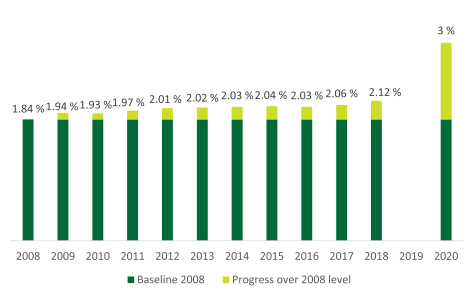
08R&D expenditure relative to GDP EU stagnated marginally above 2 % in recent years and the target of 3 % is unlikely to be reached (see Figure 4).
Figure 4
Gross domestic expenditure on R&D in the EU-28, (percentage of GDP), 2008-2018
Note: Data for 2018 are mostly provisional.
Source: ECA based on Eurostat data, as of January 2020.
With regard to research and development, we found that low consideration was paid in CSRs for Member States that presented a low or even negative growth in their expenditure on R&D (see Table 3).
Table 3
Member States with no CSR on research and development with negative or slow progress, 2016-2017
| MS | CSRs of 2016 | CSRs 2017 | ||||
| R&D expenditure (as percentage of GDP) in 2015 | MS with less than 50 % of progress towards 2020 MS target achieved in 2015 | CSR or sub-CSR for R&D in 2016 | R&D expenditure (as percentage of GDP) in 2016 | MS with less than 50 % of progress towards 2020 MS target achieved in 2016 | CSR or sub-CSR for R&D in 2017 | |
| AT | 3.05 | 40.3 % | NONE | 3.09 | 43.7 % | NONE |
| BG | 0.96 | 48.6 % | NONE | 0.78 | 31.4 % | NONE |
| DK | 2.96 | 82.6 % | Incentivise the cooperation between businesses and universities | 2.87 | 43.5 % | NONE |
| FI | 2.90 % | Negative | Promote entrepreneurship and investment to foster growth of high value added production | 2.75 | Negative | NONE |
| HR | 0.84 | Negative | NONE | 0.84 | Negative | NONE |
| HU | 1.36 | 46.3 % | NONE | 1.21 | 28.0 % | NONE |
| IT | 1.34 | 48.6 % | NONE | 1.29 | 35.1 % | NONE |
| LT | 1.04 | 22.5 % | Improve the adoption and absorption of new technology; coordinate innovation policies | 0.74 | Negative | NONE |
| LU | 1.27 | Negative | Remove barriers to investment and innovation that limit economic development in the business services sector | 1.24 | Negative | Strengthen the diversification of the economy, including by removing barriers to investment and innovation |
| LV | 0.63 | 5.4 % | Consolidate research institutions and provide incentives for private investment in innovation | 0.44 | Negative | NONE |
| MT | 0.77 | 16.3 % | NONE | 0.61 | 5.4 % | NONE |
| PL | 1.00 | 36.4 % | NONE | 0.97 | 33.6 % | NONE |
| PT | 1.24 | Negative | Incentivise cooperation between universities and the business sector | 1.27 | Negative | NONE |
| RO | 0.49 | Negative | NONE | 0.48 | Negative | NONE |
| SE | 3.27 | Negative | NONE | 3.25 | Negative | NONE |
| SI | 2.20 | 41.6 % | NONE | 2.00 | 27.0 % | NONE |
| SK | 1.18 | 97.3 % | NONE | 0.79 | 44.6 % | NONE |
| In 2016, the COM did not propose any directly related CSR for 10 out of 15 Member States with negative or low implementation rate (<50 %) of the 2020 national target | In 2017, the COM did not propose any directly related CSR for 16 out of 17 Member States with negative or low implementation rate (<50 %) of the 2020 national target | |||||
Note: We could not make calculations for Czechia and the United Kingdom, as both countries have not established a clear target for 2020. In addition, Greece was not under the European Semester process due to the three Economic Adjustment Programmes (2010, 2012, and 2015).
Note: 2016 data for Ireland and the United Kingdom.
Source: Eurostat for R&D data; Commission CESAR database for the CSR classification.
Furthermore, the large disparities in the R&D expenditure across EU MS have remained (2017: from 0.50 % of GDP in Romania up to 3.33 % in Sweden). Differences in R&D investment, in particular business-financed R&D is higher in northern and western EU countries, generally reflect differences in industrial structures, knowledge intensity and research capabilities.
Acronyms and abbreviations
AGS: Annual Growth Survey
AMR: Alert Mechanism Report
BEPGs: Broad Economic Policy Guidelines
CESAR: Monitoring database for CSR implementation of Commission
CPR: Common Provisions Regulation
CRs: Country Reports
(D)JER: (Draft) Joint Employment Report
DG: Directorate General
EDP: Excessive Deficit Procedure
EGs: Employment Guidelines
ESIFs: European Structural and Investment Funds
Europe 2020: EU Strategy for Growth and Jobs
IDR: In-Depth Review
IGs: Integrated Guidelines (which include the BEPGs and EGs)
LRAs: Local and Regional Authorities
MIP: Macroeconomic Imbalances Procedure
NRPs: National Reform Programmes
R&D: Research and Development
SCP: Stability and Convergence Programme
SGP: Stability and Growth Pact
SWDs: Staff Working Documents
Glossary
Broad Economic Policy Guidelines (BEPGs): Common priorities and targets for the economic policies of EU countries approved by the Council on the basis of the proposal by the Commission. Envisaged in the Treaty on the Functioning of the European Union. The BEPGs should deal with macroeconomic and structural policies for both the EU as a whole and for individual EU countries.
Country-specific recommendations: Policy guidance formulated annually by Commission to Member States on how to maintain sound public finances. The Commission then submits them to the Council for endorsement in July in the context of the European Semester.
Employment Guidelines (EG): Common priorities and targets for employment policies for EU countries formulated by the Council on the proposal of the Commission, also envisaged in the Treaty on the Functioning of the European Union. EG and BEPG together form the integrated guidelines.
Europe 2020 strategy: The Union’s strategy for Growth and Jobs launched in 2010 for a period of 10 years up to 2020. It emphasises three priorities: smart, sustainable and inclusive growth, with one or more targets (eight in total) for each priority, in five thematic areas (employment; research and development; climate change and energy; education; and poverty and social exclusion). The strategy also has seven thematic flagship initiatives.
Excessive Deficit Procedure (EDP): The corrective arm of the Stability and Growth Pact (SGP) which lays down how countries should take action in the event that their public debt or budget deficit is considered excessive in line with provisions in Article 126 of the Treaty on the Functioning of the European Union. The corrective arm of the Stability and Growth Pact (SGP) which lays down how countries should take action in the event that their public debt or budget deficit is considered excessive in line with provisions in Article 126 of the Treaty on the Functioning of the European Union.
In-Depth-Review (IDR): Analytical document prepared by the Commission aimed at identifying and assessing the severity of macroeconomic imbalances in the context of the MIP. Since 2015 the IDRs have been incorporated in the European semester’s Country Reports.
Macroeconomic Imbalance Procedure (MIP): Surveillance mechanism which aims to identify, prevent and address the emergence of potentially harmful macroeconomic imbalances that could adversely affect economic stability in a particular Member State, the euro area, or the EU as a whole. Since 2012 as part of the European Semester.
Multiannual Financial Framework (MFF): Seven-year framework regulating budget of the EU. It is laid down in a unanimously adopted Council Regulation with the consent of the European Parliament. The financial framework sets the maximum amount of spending in each year for broad policy areas ("headings") and fixes an overall annual ceiling on commitment appropriations and payments.
Spill over effects: Impact that event(s) in one country can have on the economies of other countries. Although there are positive spill over effects, the term is most commonly applied to the negative impact of domestic events on other parts of the world.
Stability and Growth Pact (SGP): An agreement binding on all the EU Member States since 1997 (with reforms in 2005 and 2011) concerning implementation of the Maastricht Treaty provisions addressing the sustainability of Member State fiscal policies, essentially by maintaining public deficit and debt at acceptable levels.
Stability (Convergence) Programme: A document produced annually by euro area (non euro area) Member States which presents policies and measures to ensure sustainable fiscal policies, to maintain their fiscal positions at or above their medium term objectives, or follow a path towards the Medium Term Objective, while simultaneously ensuring adequate debt reduction efforts to comply with the debt rule and the treaty reference value of 60 %.
Sustainable Development Goals (SDGs): The 2030 Agenda for Sustainable Development, adopted by the international community in September 2015, represents an agenda to respond to global trends and challenges. The core of the 2030 Agenda are the 17 Sustainable Development Goals (SDGs) and associated targets, which run to 2030. The international community has an ambitious new frame for all countries to work together on shared challenges. For the first time, the SDGs are universally applicable to all countries and the EU is committed to implementing them.
Replies of the Commission
Executive summary
The European Semester (‘Semester’) was created as part of the EU’s response to the economic and financial crisis that hit Europe ten years ago. Since then, the European Commission and the Member States, through the Council, have developed it continuously to tackle, in a coordinated manner, socio-economic issues, including productivity and competitiveness and the business environment, as well as the economic and social aspects of broader challenges related to climate, energy and sustainability.
The Semester is intended to remain responsive and evolves continuously in scope and emphasis.
The sudden emergence of the COVID-19 pandemic (‘crisis’) and its highly disruptive impact is a shock that has shaken every Member State. The crisis has caused immense short-term damage with long-term repercussions. To confront this crisis, concerted action is imperative. The Commission has responded and tailored its approach to the health, social and economic crisis at hand while keeping a strong emphasis on the post crisis recovery. The Semester is proving invaluable in ensuring that the damage to the economy and to employment is met with co-ordinated EU as well as Member State specific responses. The Commission and Council have agreed to apply the flexibility available within the rules so that governments were able to support economic activity as well as provide a social safety net to the EU’s citizens. The 2020 Country Specific Recommendations (CSRs) address the health and social impact of the immediate crisis as well as the structural challenges that need to be addressed in the recovery phase. In the post COVID phase, the Commission and the Member States will work even closer to ensure that reforms are aligned and better implemented.
The ECA has noted that implementation on 30 % of CSRs between 2011 and 2018 saw ‘limited or no’ progress. Updated data regarding the level of implementation of 2011-2019 CSRs show that Member States have implemented 22 % of CSRs substantially or fully, 46 % with at least “some progress” and the remaining 32 % of CSRs recorded “limited” or “no progress” in implementation. At least ‘some’ implementation at a level of almost 70 percent is a measure of success of the European Semester. This demonstrates the stringent monitoring of the reforms by the Commission but also justifies the Commission’s on-going efforts to improve implementation further. The Commission has also been working on i) increasing the analysis on sustainability inside the Semester documents, ii) continuing to develop the link between the use of the EU funds and the Semester Recommendations, iii) Integrating the Reform Support Programme, and iv) developing the Commission’s qualitative assessment of CSR follow-up.
In the wake of the crisis, where very similar problems have arisen in all Member States, the Commission will work with Member States to further the reform agenda even more.
The ECA observes that although six of the eight Europe 2020 targets are likely to be met in full, progress has been slow with regard to the poverty and research and development targets.
The Commission takes the fight against poverty extremely seriously. It has strengthened its focus on social issues by integrating the European Pillar of Social Rights and the ‘Social Scoreboard’ into the European Semester. It also monitors developments and factors affecting poverty in its annual report Employment and Social Developments of Europe. A large number of Country Specific Recommendations over the years address employment, skills acquisition, adult learning, childcare and the integration of those furthest from the labour market. These are all instrumental in addressing poverty.
For research and development (R&D), some Member States were a lot quicker than others. DE and DK had reached their targets before 2020. At the EU level, R&D intensity increased from 1.81 % in 2000 to 2.19 % in 2018. Although the EU overall has not fulfilled its R&D investment ambition, the 3 % target has had a clear mobilising effect. The increase in public R&D expenditure and in the public support to business R&D in the years of strong fiscal consolidation in the aftermath of the 2008 crisis would not have occurred without a policy focus on the role of R&D for economic growth.
In the wake of the current crisis, the Commission is emphasising that Member States act on both fronts i.e. poverty alleviation as well as research and innovation as priorities for a recovery strategy.
The ECA observes that the Commission does not provide written feedback to the Member States on the National Reform Programmes. The Commission is of the view that a targeted dialogue with the relevant authorities in the Member States is more effective than a general written feedback on the National Reform Programme. The Commission, in the instance of identified gaps, contacts the authorities to request the missing information. The Commission also uses other sources (e.g. the fact-finding missions, bilaterals with Member States, the European Semester Officers) to gain a complete and balanced picture.
The European Semester is a strong partnership between the Commission, the Council and the Member States. The European Parliament is also a key participant through economic dialogues. It focuses the priorities of the Member States and the European Union to carry out structural reforms while investing in a green and sustainable future. The Commission also emphasises that the recommendations are endorsed by the European Council and adopted by the Council after detailed scrutiny by different Council Committees.
The Commission has considered the various observations and the ensuing recommendations of the ECA. While the Commission is receptive to potential improvements in the Semester process, it disagrees with the suggestion that not enough attention was paid to the social and research dimensions in the Semester.
Introduction
Paragraphs 01 to 08 – The European Semester ProcessThe Commission identifies the most important challenges a Member State faces through an evidence-based analysis laid in the Country Report. Those reports are published and publicly available. The Semester evolves over time and beyond its initial focus on fiscal, employment-related and social aspects its focus now also includes the United Nations Sustainable Development Goals insofar as they are encompassed by the legal bases for the Semester. Such analysis was already presented in the 2020 Country Reports. The crisis has presented some immediate health, social and economic imperatives to be tackled. Notwithstanding, for the post crisis recovery, sustainability become a central theme of the Semester and will guide all investment. Europe has a unique opportunity to develop its skills, research and innovation and its infrastructure to promote an economic model based on environmental sustainability and climate neutrality.
The Commission is willing to engage in discussing possible policy solutions and offering technical support upon request. The Commission leaves it to Member States to determine the most appropriate policy measures to tackle the identified priorities. Given the short annual cycle and the possibility of repeating reform needs in successive years, interfering in a policy area which is considered to be a Member State prerogative has not been considered necessary so far. Assistance with reforms has been made possible through the Commission’s ESIF programmes and technical assistance provided through DG REFORM.
The rule of law mechanism is an instrument that is separate from the Semester. Discussions are being held to increase the focus on the rule of law through the introduction of a new rule of law mechanism.
Paragraphs 09 to 19 – Responsibility for the European Semester is shared between Commission and Member StatesThe Commission has indeed taken a number of measures to ensure that there is a regular dialogue and exchange of information with the Member States throughout the Semester cycle.
Observations
Paragraphs 21 to 31 and paragraph 59 – Two of the eight Europe 2020 are unlikely to be met. The Commission did not make sufficient recommendations to address poverty and research in certain Member States. Additional issues such as rule of law.The Commission notes that the achievement of employment and education targets is a precursor to achieving lower levels of poverty and higher levels of research and development. The post financial crisis restructuring and reforms were focused on the financial sector and on the pressing problems of youth unemployment and early school leaving. This proved effective as it achieved record employment and reduced early school leaving which also had an impact on poverty reduction.
The Commission takes the fight against poverty extremely seriously. In its REACT-EU instrument launched as part of the Recovery Plan for Europe, the Commission proposed that the additional resources to be allocated to the European Social Fund should address as a matter of priority, among others, measures to tackle child poverty. The proposed MFF 2021-2027 amended proposal for the European Social Fund Plus (ESF+) includes a requirement that each Member State should allocate 5 % of its ESF+ resources to measures to addressing child poverty. These resources will also directly contribute to the implementation of the future Child Guarantee policy instrument, which the Commission will propose in 2021.
The Commission has strengthened its focus on social issues by integrating the European Pillar of Social Rights and the ‘Social Scoreboard’ into the European Semester. The Commission emphasises that recommendations are not ‘automatically’ issued to Member States that have experienced deterioration in an indicator. The Commission considers social developments, Member State’s ongoing policies as well as progress on relevant reforms. Moreover, a large number of Country Specific Recommendations over the years address employment, skills acquisition, adult learning, childcare and the integration of those furthest from the labour market. They are all instrumental in addressing poverty. As a result, substantial progress has been made in reducing poverty since the 2012 peak of the economic and financial crisis, bringing the share of people at risk of poverty or social exclusion well below the pre-crisis level. In 2018, 110 million people were at risk of poverty or social exclusion in the EU-28 - 13.9 million fewer people compared to the 2012 peak and 7.5 million less than the level pre-crisis (2008). Moreover, 2019 figures available for 8 Member States (AT, BG, DK, LV, HU, PL, RO and FI) show a further decline in the population at risk of poverty or social exclusion.
Research and development expenditure was at very different levels amongst Member States and this has continued depending on the starting point for each country. DE and DK achieved their targets before 2020 and have consolidated their edge in innovation. Other Member States are slower as they try to generalise research and innovation into the academic as well as business environment.
The ECA’s assessment that the Commission did not make sufficient recommendations to address poverty and research in certain Member States is at odds with its acknowledgement that the Commission issued a number of CSRs addressing poverty alleviation through areas such as: employment, skills acquisition, life-long learning, childcare and the integration of previously marginalised people into the job market. The ECA also acknowledges the work on the European Pillar of Social Rights and the UN Sustainable Development Goals. This demonstrates the Commission’s focus on addressing the root causes of poverty: access to job markets, skills and childcare. In the wake of the current crisis, the Commission is placing a strong emphasis on income support and direct poverty alleviation measures. This is already evident in the 2020 Country specific recommendations. The Commission’s endeavour through its 2020 recommendations to the Council is also to invest in research and development to seize the opportunity offered by the greening of the economy and Europe’s commitment to climate neutrality.
In its analysis of a Member State’s business environment, the Commission considers other aspects to the extent that there is a macroeconomic link. In terms of upholding the European Union’s key value of the rule of law, the Commission will publish a Rule of Law report every year with Member State-specific chapters.
Paragraphs 34 to 40 and paragraph 58 and 61 – The Commission’s multi-annual assessments of Member States’ implementation of CSRsThe ECA observes that Member States’ rate of full or substantial CSR implementation is low and the Commission’s monitoring is not always complete.
The Commission is working with Member States to improve their record of full or substantial implementation. The fact that since the outset of the European Semester in 2011, more than two-thirds of country specific recommendations have been implemented with at least ‘some progress’ confirms that important reforms are being carried out, though they may take longer. Some reforms face strong political and societal opposition even when the government demonstrates its commitment.
Member States have made most progress over the years in financial services, access to finance, insolvency frameworks, employment protection legislation and active labour market policies, reflecting the priority given to the stabilisation of the financial sector in response to the economic and financial crisis, which required determined policy action. In the same vein, steps to promote job creation on permanent contracts and to address labour market segmentation reflect the sound implementation of relevant recommendations. Fiscal policy and fiscal governance recommendations have also recorded strong implementation to put public finances on a sound footing in the aftermath of the financial crisis.
The fact that imbalances have progressively improved or been corrected over recent years is also testimony in itself to the successful implementation of reforms.
The Commission carries out annual and multiannual Country Specific Recommendation assessments twice during each Semester cycle. The assessment methodology and the attribution of implementation categories by the Commission have improved over time and are very strict so that the pressure to continue and complete reforms is maintained on the Member State. To facilitate the analysis and make the rate of progress easy to compare over the years, the Commission uses a synthetic indicator to assess progress with Country Specific Recommendations.
In the instance of persistent inadequate implementation, the Commission actively engages with the Member States with a view to ensuring that policy challenges and priorities identified are properly addressed. It does not believe that further Council recommendations and specific measures are conducive to a constructive dialogue in finding a solution. Instead, the Commission considers that this is best achieved by channelling available EU funds towards addressing the CSR. The cohesion policy funds have been aligned to the Semester, while DG REFORM provides technical assistance to Member States. The newly proposed Recovery and Resilience Facility (EUR 561 billion) will be entirely targeting Semester-related policy reforms.
To increase the rate of full or substantial implementation the Commission consults more closely with Member States, provides reform support through a dedicated service and ensures a better linkage of European funds to reforms.
With regard to the CeSAR database for CSR assessments, continuous improvement is being made to its functionality. It is an internal working tool that has been shared with the Member States since December 2019.
Paragraphs 41 to 44 – link between EU budget and CSR implementationThe ECA states that there is “insufficient link between EU budget spending and CSR implementation”. The Commission, however, can confirm that all relevant Country Specific Recommendations were taken into account in the programming of the 2014-2020 European Structural and Investment Funds. It has to be borne in mind that European Structural and Investment Funds are implemented potentially over a ten-year span in the current programming period (due to the n+3 rule). Outputs and results from investment naturally take an even longer time-span to materialise, and therefore it takes a long-term perspective to judge the effectiveness of that strand to foster implementation of Country Specific Recommendations. The ‘study’ referred to by the ECA confirms the linkages between the ESIF programming documents (the Partnership Agreements and Operational Programmes) and the European Semester CSRs. The “broad and general” nature of those linkages stems from the general nature of the Partnership Agreements, which are ‘framework’ programming documents and are thus not intended for specific implementation requirements.
According to the Common Provisions Regulation, the programming documents shall take into account, among other elements, the relevant CSRs when making decisions on interventions. The Partnership Agreements and the Operational Programmes are strategic documents for implementing the ESI Funds during a 7 years period, and are not solely intended for the implementation of the CSRs. Nevertheless, the Country Reports have been reporting regularly since 2016 on the contribution of the EU budget to addressing structural challenges. Moreover, the synergies between the Semester and the use of EU funds have been considerably strengthened over the years and is expected to continue in the next Multi-annual Financial Framework. For 2021-27, the Commission has proposed that Member States should determine how relevant country-specific recommendations are taken into account in the preparation of programming documents. During the 2021–2027 programming period Member States should regularly present to the monitoring committee and to the Commission the progress in implementing the programmes in support of the CSRs. During a mid-term review, Member States should, inter alia, consider the need for programme modifications to accommodate relevant CSRs adopted or modified since the start of the programming period.
On 27 May 2020 the Commission issued a proposal on the Next Generation EU. The first pillar and the centrepiece of the recovery plan will be a new Recovery and Resilience Facility. The Facility builds on the Reform Delivery Tool and replaces the Budgetary Instrument for Convergence and Competitiveness (BICC), which was recently discussed with the co-legislators.
The Commission also proposed the Technical Support Instrument, a stand-alone regulation, which is the continuation of the existing Structural Reform Support Programme (SRSP).
Paragraphs 45 to 52 – Streamlining of Country Specific Recommendations and the prioritisation of reformsThe composite Country Specific Recommendations referred to by the ECA all have a common theme, namely fiscal policy, employment and social policy, the business environment and investment. Components of recommendations relate to different policy areas on which Member States are expected to respond through their different ministries and administrative bodies within a similar timeframe. This reflects the reality that tackling a specific socio-economic challenge requires policy action in different areas. With regard to the prioritisation of reforms, the recommendations proposed by the Commission reflect the Commission’s views on the priority actions to be undertaken.
The process in the Council ensures that recommendations are discussed between Member States before their finalisation. In the end, it is the Council that adopts the recommendations. Moreover, the focus is on continuous dialogue with MSs and stakeholders to identify priorities and concrete reforms. The Commission is of the view that those mechanisms ensure that the recommendations eventually adopted are feasible. The Commission is of course aware that some reforms take more time than others and has therefore developed a multiannual assessment of implementation progress.
On referencing the recommendations to the Integrated Guidelines, there is already considerable referencing in the recommendation documents and neither the Member States nor the Commission have raised a need for yet more referencing. On the wording and the reasoning of the recommendations, it is important to note that each recommendation has a supporting recital as well as supporting analysis in the Country report. In view of the extensive engagement between the Member States and the Commission, there is no ambiguity of messaging.
Paragraphs 53 to 56 – Engagement with national stakeholders and assessment of the National Reform ProgrammesThe Commission requires Member States to engage with stakeholders and it also does so itself during fact finding missions. Moreover, during the programming of funds there is regular exchange between the Commission and local authorities. The local and regional authorities are well integrated in the programming and implementation cycles of cohesion policy funds. The Commission has proposed retaining this for the 2021-2027 programming period.
On the National Reform Programmes, the Commission confirms the consistency of content, but refrains from interfering with the national tradition of documentation and formats. The National Reform Programme has become a very important tool for Member States to facilitate inter-ministerial and inter-regional coordination in the reform process. The Commission´s proposals for Council recommendations on the National Reform Programmes and opinions on the Stability and Convergence Programmes of the Member States are in themselves the documented record of the Commission´s assessment of the Programmes. The assessment is explicitly documented in a standard recital of the CSR legal text. Moreover, information contained in the Programmes is considered for updating the CSR assessment presented in the May Chapeau Communication that forms part of the published Semester package. The content of the CSRs proposals also takes into account measures reported by Member States in their Programmes. The Commission assesses conformity with the template and focuses on the main reform commitments as well as confirmation of the Commission’s own information-gathering through other sources.
With regard to the CESAR database, the Commission’s internal procedures are designed for all relevant DGs to contribute to the overall Commission CSR assessment in CESAR. As a living tool continuously being developed to further improve the assessment and monitoring process, new functionalities are being developed in CESAR to better ensure that all relevant DGs provide their assessment in the database.
The Commission does not agree with the statement that frequent regroupings of CSRs make the monitoring less comparable over the years. The assessment of CSR implementation is done first for each individual subpart and then, by aggregation for the full CSRs. To facilitate the analysis and make the rate of progress easy to compare over the years, the Commission uses a synthetic indicator to assess progress with CSR implementation. Some adjustments have been introduced in CESAR to better trace the recommendations under each policy area over a period of time.
Conclusions and recommendations
59The Commission does not share the ECA’s conclusion that there is insufficient focus on poverty alleviation, nor that there is any imbalance in the CSR mix.
To pay special attention to rule of law issues, a new Rule of law mechanism has been established. Coverage of such issues in the Semester is focused on cases that have a clear macroeconomic impact.
Recommendation 1 – Place a strong focus on the social and research dimensions in the European Semester processThe Commission accepts this recommendation, as it will fully address the socio-economic consequences of the COVID-19 crisis. The Commission is committed to lifting people out of poverty by addressing the causes of poverty risks.
The Commission partially accepts this recommendation, insofar as it cannot commit to issuing CSRs for all Member States which lack progress. In view of the new European Green Deal and digital transition, research and innovation is expected to play a significant role in the European Semester and in making the EU’s economy competitive and climate neutral.
Recommendation 2 – Strengthen the implementation and monitoring of CSRsFirst indent - The Commission accepts this recommendation and is now ensuring that all members of the Country team update their assessment of implementation in CeSAR. As a living tool continuously being developed to further improve the assessment and monitoring process, new functionalities are being developed in CESAR to better ensure that all relevant DGs provide their assessment in the database.
Second indent - The Commission partially accepts this recommendation. It will make sure that the information already publicly available through the country reports on the CSRs and their implementation status is made available also online. This would be subject to the agreement of Member States.
Third indent - The Commission does not accept this recommendation. The Commission is building a cooperative relationship with Member States to identify and address challenges together.
In fact, the Commission is already applying the principle put forward by the ECA, by repeating recommendations under subsequent Semester rounds in case of lack of implementation, and by making them more precise where warranted. Therefore, considering taking further measures under the Regulation is not considered appropriate.
Recommendation 3 – Strengthen the link between EU funds and CSRsThe Commission partially accepts this recommendation for the 2021-2027 Multiannual Financial Framework. There is already some mutually agreed reform conditionality in the programming of ESI funds. Moreover, on 27 May 2020, the Commission proposed a new Recovery and Resilience Facility that will provide large-scale financial support to reforms and investments undertaken by Member States, helping Member States to address the challenges identified in the European Semester. This will, however, depend on the negotiations in the Parliament and the Council.
Recommendation 4 – Improve the formulation of CSRsThe Commission partially accepts this recommendation, insofar as individual CSRs deal with one common policy challenge. The fact that a CSR contains various issues reflects the reality that tackling a specific socio-economic challenge requires policy action in different areas. Measurable targets have existed under the Europe 2020 strategy. Adding yet more targets is not considered useful. Prescribing a timeframe is also not considered practical, as the Commission is aware that reforms may need to be carried out in different stages over time. What could be envisaged is a more detailed qualitative assessment of the implementation efforts of a Member State. This is already recognised when the Commission assesses implementation and applies different assessment categories e.g. limited progress, some progress, etc. The Commission already provides adequate reasoning for the recommendations in the Country Reports and the recitals of CSRs.
Recommendation 5 – Provide a clear assessment of NRPsFirst indent - The Commission partially accepts this recommendation, subject to the outcome of the ongoing negotiations with co-legislators on the MFF and the Recovery and Resilience Facility.
The NRPs complement and confirm the information obtained from other sources. NRPs as currently practiced are considered to be very useful for the formulation of the Country Specific Recommendations and fit for purpose. They already contain various elements as suggested by the ECA. At the same time, the Commission in its ongoing cooperation with Member States will explore what mutually beneficial improvements can be made to the NRPs.
Moreover, in view of the Commission proposals for the 2021-2027 MFF, the structure of the NRPs may be adjusted, as appropriate, in line with the proposed role of NRPs for the Recovery and Resilience Facility. In particular, under the Recovery and Resilience Facility, Member States will be able to put forward their Recovery and Resilience Plans, annexed to the NRPs.
Second indent - The Commission does not accept this recommendation.
The National Reform Programmes play a very important role in securing a commitment to reform implementation within Member States, amongst its own ministries and with stakeholders. For the Commission, the NRPs are a useful tool that bring together and confirm the information that the Commission has gathered through various other channels as part of its continuous economic surveillance activities.
The Commission’s assessment of the NRPs is reflected in the proposed country-specific recommendations and accompanying recitals. Providing an explicit, dedicated assessment of the NRP to the Member State is not considered to bring any added value in view of the current role the NRPs have in the European Semester context.
Endnotes
1 The European Semester was introduced as a new element after agreement in 2010 (see Communication COM(2010) 250 final on Reinforcing economic policy coordination and Communication COM(2010) 367/2 on Enhancing economic policy coordination for stability, growth and jobs – Tools for stronger EU economic governance, respectively) and the amendments made in 2011 by Regulation (EU) No 1175/2011 of the European Parliament and of the Council of 16 November 2011 to Council Regulation (EC) No 1466/97 on the strengthening of the surveillance of budgetary positions and the surveillance and coordination of economic policies (OJ L 306, 23.11.2011, p. 12).
2 See Commission Communication “EUROPE 2020 – A strategy for smart, sustainable and inclusive growth”, COM(2010) 2020, of 3.3.2010, Annex 1, p. 30.
3 Commission Communication “Taking stock of the Europe 2020 strategy for smart, sustainable and inclusive growth” – COM(2014) 130 final/2 of 19.3.2014, p. 18.
4 Commission communication “Annual Sustainable Growth Strategy 2020”; COM(2019) 650 final, 17.12.2019.
5 See Commission communication on Further strengthening the Rule of law within the Union; COM(2019) 163 final, pp. 9-12.
6 Article 12(a) of Regulation No 1466/97.
7 Article 2-a(3) and Article 2-ab(2) of Regulation No 1466/97.
8 Luxembourg European Council 12 and 13 December 1997 Presidency conclusions and – Annex 1 - Resolution of the European Council on economic policy co-ordination in stage 3 of EMU and on Treaty Articles 109 and 109b, Paragraph 3).
9 Council Report to the European Council – Improving the implementation of the Stability and Growth Pact, Brussels, 21 March 2005, 7423/05, UEM 97, ECOFIN 104, p. 4 of the Annex.
10 Regulation (EU) No 1173/2011 on the effective enforcement of budgetary surveillance in the euro area, Preamble paragraph 3, 16 November 2011.
11 Second paragraph of Article 2-a(3) of Regulation No 1466/97.
12 Article 11(1) and (2) of Regulation No 1466/97.
13 See ECA Audit of Macroeconomic Imbalance Procedure (MIP) – Special report 03/2018, and ECA audit of the SGP Preventive Arm Special report 18/2018.
14 2008 was the initial reference period against which targets were set.
15 See also IMF Staff Discussion Note, Inequality and poverty across generations in the EU, January 2018.
16 https://ec.europa.eu/eurostat/tgm/refreshTableAction.do?tab=table&plugin=1&pcode=tessi012&language=en.
17 Commission recommendation of 26.4.2017 on the European Pillar of Social Rights; C(2017) 2600 final.
18 United Nations resolution adopted by the General Assembly “Transforming our world: the 2030 Agenda for Sustainable Development”; A/RES/70/1; 25 September 2015.
19 Political guidelines for the next European Commission 2019-2024 “A Union that strives for more – My agenda for Europe” by President Ursula von der Leyen during her candidature; p. 9.
20 See Figure 2 on p. 4 of ESPC Strategic Notes, European Commission, Issue 6/2015.
21 Under Article 121(4) of the Treaty on the Functioning of the European Union.
22 Under Article 2-a (3)(a) of Regulation 1466/97.
23 Articles 15 and 96 of Regulation 1303/2013 of Regulation (EU) No 1303/2013, of 17 December 2013 laying down common provisions on the European Regional Development Fund, the European Social Fund, the Cohesion Fund, the European Agricultural Fund for Rural Development and the European Maritime and Fisheries Fund and laying down general provisions on the European Regional Development Fund, the European Social Fund, the Cohesion Fund and the European Maritime and Fisheries Fund and repealing Council Regulation (EC) No 1083/2006.
24 Report prepared by Ismeri Europa for the Commission titled "Support of European Structural and Investment (ESI) Funds to the implementation of the Country Specific Recommendations and to structural reforms in Member States", 2018.
25 ECA Opinion 6/2018 concerning the proposal for a Regulation of the European Parliament and of the Council laying down common provisions on the European Regional Development Fund, the European Social Fund Plus, the Cohesion Fund, and the European Maritime and Fisheries Fund and financial rules for those and for the Asylum and Migration Fund, the Internal Security Fund and the Border Management and Visa Instrument; paragraphs 31-34 and recommendation (4), 36-39 and recommendation (9).
26 Commission “Reflection paper on the deepening of the Economic and Monetary Union” COM(2017) 291 of 31.5.2017, p. 24.
27 Article 2-a(2)(a) and (b)) of Regulation No 1466/97 require the surveillance of the implementation of broad economic policy guidelines, and the examination of the implementation of the employment guidelines.
28 Article 2-a (2)(d) of Regulation (EU) No 1466/97.
29 European Committee of the Regions, Opinion – Improving the governance of the European Semester: a Code of Conduct for the Involvement of local and regional authorities, 123rd plenary session, 11-12 May 2017.
30 Italy exited EDP in June 2013, and the period before was partially covered under Court’s EDP audit. It was included in the sample given the extensive application of flexibility clauses under the preventive arm and its overall importance for macroeconomic developments in the EU.
31 Poverty data should be interpreted with caution. For instance, the composite AROPE indicator is particularly affected by the “at risk of income poverty after social transfers” indicator. The latter is a relative measure of poverty and its threshold varies greatly between Member States. It also varies over time as it follows the evolution of the national median disposable income: in a number of Member States the threshold has fallen over the period 2008-2017 (Greece and Cyprus) or stayed nearly stable (Spain and Italy).
32 People living in a household with an ‘equivalised’ disposable income after social transfers of less than 60 % of the national median. This threshold is conventional and represents the level of income that is considered necessary to lead a decent life.
33 People that cannot afford at least three of the following nine items: to pay their rent, mortgage or utility bills; to keep their home adequately warm; to face unexpected expenses; to eat meat or proteins regularly; to go on holiday; a television set; a washing machine; a car; a telephone. In 2017, the EU updated this list which now includes further seven items: to replace worn-out clothing and furniture; to have two pairs of shoes; to spend a small amount of money for personal use; to have regular leisure activities, to go out for a drink/meal once per month, and to have an internet connection. The lack of a washing machine, a TV and a telephone were dropped from the revised list as inadequate measures of deprivation.
34 People aged 0-59 living in households where working-age individuals (excluding students less than 25) worked less than 20 % of their total work potential during the past year.
35 Further to the 2020 target and within the United Nation’s 2030 Agenda for sustainable development, the EU Member States have committed themselves to half poverty in all its dimensions by 2030.
36 Due to lack of comparative data for 2008, Croatia is not included in the calculations (1.1 million people at risk of poverty or social exclusion in 2017).
37 https://ec.europa.eu/eurostat/tgm/table.do?tab=table&init=1&language=en&pcode=tesem100&plugin=1.
Timeline
| Event | Date |
|---|---|
| Adoption of Audit Planning Memorandum (APM) / Start of audit | 19.9.2017 |
| Official sending of draft report to Commission (or other auditee) |
31.1.2019 |
| Adoption of the final report after the adversarial procedure | 30.6.2020 |
| Commission’s (or other auditee’s) official replies received in all languages | 20.7.2020 |
Contact
EUROPEAN COURT OF AUDITORS
12, rue Alcide De Gasperi
1615 Luxembourg
LUXEMBOURG
Tel. +352 4398-1
Enquiries: eca.europa.eu/en/Pages/ContactForm.aspx
Website: eca.europa.eu
Twitter: @EUAuditors
More information on the European Union is available on the internet (http://europa.eu).
Luxembourg: Publications Office of the European Union, 2020
| ISBN 978-92-847-0354-8 | ISSN 1977-5679 | doi:10.2865/627380 | QJ-AB-19-027-EN-N | |
| HTML | ISBN 978-92-847-0356-2 | ISSN 1977-5679 | doi:10.2865/575783 | QJ-AB-19-027-EN-Q |
COPYRIGHT
© European Union, 2020.
The reuse policy of the European Court of Auditors (ECA) is implemented by the Decision of the European Court of Auditors
Unless otherwise indicated (e.g. in individual copyright notices), the ECA’s content owned by the EU is licensed under the Creative Commons Attribution 4.0 International (CC BY 4.0) licence. This means that reuse is allowed, provided appropriate credit is given and changes are indicated. The reuser must not distort the original meaning or message of the documents. The ECA shall not be liable for any consequences of reuse.
You are required to clear additional rights if a specific content depicts identifiable private individuals, f. ex. as on pictures of the ECA’s staff or includes third-party works. Where permission is obtained, such permission shall cancel the above-mentioned general permission and shall clearly indicate any restrictions on use.
To use or reproduce content that is not owned by the EU, you may need to seek permission directly from the copyright holders.
Software or documents covered by industrial property rights, such as patents, trade marks, registered designs, logos and names, are excluded from the ECA’s reuse policy and are not licensed to you.
The European Union’s family of institutional Web Sites, within the europa.eu domain, provides links to third-party sites. Since the ECA does not control them, you are encouraged to review their privacy and copyright policies.
Use of European Court of Auditors’ logo
The European Court of Auditors logo must not be used without the European Court of Auditors’ prior consent.
GETTING IN TOUCH WITH THE EU
In person
All over the European Union there are hundreds of Europe Direct Information Centres. You can find the address of the centre nearest you at: https://europa.eu/european-union/contact_en
On the phone or by e-mail
Europe Direct is a service that your questions about the European Union. You can contact this service
- by freephone: 00 800 6 7 8 9 10 11 (certain operators may charge for these calls),
- at the following standard number: +32 22999696 or
- by electronic mail via: https://europa.eu/european-union/contact_en
FINDING INFORMATION ABOUT THE EU
Online
Information about the European Union in all the official languages of the EU is available on the Europa website at: https://europa.eu/european-union/index_en
EU Publications
You can download or order free and priced EU publications at: https://op.europa.eu/en/web/general-publications/publications. Multiple copies of free publications may be obtained by contacting Europe Direct or your local information centre (see https://europa.eu/european-union/contact_en)
EU law and related documents
For access to legal information from the EU, including all EU law since 1952 in all the official language versions, go to EUR-Lex at: http://eur-lex.europa.eu/homepage.html?locale=en
Open data from the EU
The EU Open Data Portal (http://data.europa.eu/euodp/en/data) provides access to datasets from the EU. Data can be downloaded and reused for free, both for commercial and non-commercial purposes.