 Special Report
ESF support to combat long-term unemployment: Measures need to be better targeted, tailored and monitored
About the report:Long-term unemployment can have severe consequences for the individuals concerned, and a negative impact on growth and public finances. The EU identified a number of policy responses to cover long-term unemployment. During the 2014–2020 period, ‘access to employment’ funded through the European Social Fund (ESF) measures reached many long-term unemployed, but did not specifically target them. Moreover, such ESF measures were not always adapted to address the specific needs of the long-term unemployed. We recommend that the Commission insists that Member States target specifically long-term unemployed and their needs by means of the 2021–2027 ESF+ support, that measures apply an individualised approach for long-term unemployed, and that the Commission evaluates the effectiveness of the ‘access to employment’ measures for them.
ECA special report pursuant to Article 287(4), second subparagraph, TFEU.
 |
Executive summary
I Long-term unemployment refers to persons who have been unemployed for at least 12 months. Not having a formal job for such a long period of time can have severe consequences for the individuals concerned, such as a higher risk of poverty, social exclusion, and even health problems. Long-term unemployment thus also affects our social fabric. At the same time, from an economic perspective, long-term unemployment has a negative impact on growth and public finances.
II In the EU, labour market policies are a national prerogative: Member States (sometimes together with their regions) are responsible for deciding on and implementing appropriate measures for reducing (long-term) unemployment. At the same time, the Member States work together with the EU towards developing a coordinated employment strategy, in particular to promote a skilled, trained and adaptable workforce, and labour markets which are responsive to economic change. Within the strategy framework, the EU’s role involves encouraging cooperation between Member States and supporting – and, if necessary, complementing – their actions.
III Since 2011, the Commission has been reviewing Member States’ labour market policies through the European Semester process. Based on the Commission’s analysis, the Council has adopted a number of country-specific recommendations asking the Member States concerned to take specific measures against long-term unemployment, including an individualised approach. In 2016, this approach was endorsed by the Council Recommendation on long-term unemployment.
IV The European Social Fund (ESF) is the EU’s main financial instrument for supporting Member States’ active labour-market measures. During the 2014–2020 period, four of the 11 thematic objectives set out in the Common Provisions Regulation for the European structural and investment funds are relevant for the ESF, and three of them at least partially addressed the specific issue of long-term unemployment. In particular, around EUR 11.4 billion was allocated to the investment priority “Access to employment for jobseekers and inactive people, including the long-term unemployed, and people far from the labour market, also through local employment initiatives and support from labour mobility”. This is the only investment priority that specifically refers to the long-term unemployed, together with other groups of disadvantaged jobseekers and inactive people. According to the Commission, this priority covers around half of all ESF spending on long-term unemployment measures.
V Our audit assessed whether 2014–2020 ESF funding, through its “access to employment” investment priority, was effective at combating long-term unemployment. In particular, we analysed to what extent ESF spending was targeted at measures helping long-term jobseekers to find a job. In addition, we examined whether Member States applied an individualised approach when implementing “access to employment” measures to facilitate the (re)entry into the labour market of the long-term unemployed. Lastly, we checked whether the Commission had taken the necessary action to obtain relevant and sufficient data to determine the impact of ESF funding on long-term unemployment.
VI We found that ESF “access to employment” measures financed different interventions during the 2014–2020 period that benefitted many of long-term jobseekers. These ESF measures mostly targeted the long-term unemployed as a subgroup, either of all unemployed and/or of “disadvantaged” groups. This was in line with the funding scope for this investment priority, which refers to the long-term unemployed but encompasses all jobseekers and inactive people. This approach was also applicable to other relevant ESF investment priorities. Based on the data available for the “access to employment” priority, we also noted that the proportion of long-term unemployed supported by ESF “access to employment” measures did not necessarily reflect the scale of the issue in some Member States.
VII Our analysis also showed that the concept of an individualised approach was not always taken up by the ESF measures implemented for the 2014–2020 period. It would have been an opportunity to enhance the effectiveness of ESF measures for long-term jobseekers as these may not always have addressed their specific needs.
VIII Our audit also highlights another frequent weakness in the ESF monitoring and evaluation framework: the lack of a specific category of expenditure for different target groups (such as the long-term unemployed) makes it difficult not only to identify how much EU funding has been allocated to such measures, but also to evaluate its results and impact on the target group.
IX For the 2021–2027 programme period, we recommend that the Commission should:
- insist that the Member States target specifically long-term unemployed and their needs by means of ESF+ where national or regional LTU is high;
- insist that the Member States apply an individualised approach to all long-term unemployed when implementing “access to employment” measures under the ESF+; and
- evaluate the effectiveness of “access to employment” measures for the long-term unemployed.
Introduction
Long-term unemployment: a persistent problem in the labour markets of some Member States
01 In the EU, long-term unemployment (LTU) has been identified as a particular problem for many years. People who stay out of employment for longer periods face more problems finding work because they lose motivation, confidence, and skills[1]. In addition, employers may be more reluctant to hire someone who has not worked for a long time[2]. Long periods of unemployment entail a higher risk of poverty, social exclusion and even health problems[3]. LTU thus also affects our social fabric. At the same time, from an economic perspective, long-term unemployment has a negative impact on growth and public finances[4].
02 Box 1 defines the term “long-term unemployment”. The definition follows the guidelines of the International Labour Organization, and Eurostat uses it for producing data on LTU in the EU.
Definition of long-term unemployment
LTU refers to the number of people who are out of work and have been actively seeking employment for at least 12 months.
An unemployed person is defined as someone aged 15 to 74 who was without work during the reference week, was currently available for work and was either actively seeking work in the previous four weeks or had already found a job starting within the next three months. The unemployment period is defined as the duration of a job search, or the length of time since the last job was held (if shorter than the time spent on a job search). This definition follows International Labour Organization guidelines[5].
Eurostat produces data on LTU in absolute numbers, as a share of the active population, and as a share of total unemployment.
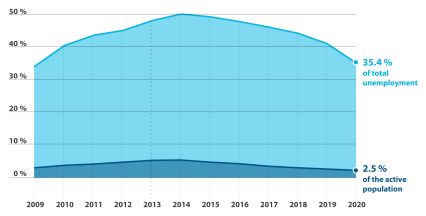
03 In the EU, LTU was exacerbated by the financial and economic crisis that occurred at the end of the first decade of the 21st century: in 2014, around 11 % of all people active in the labour market were unemployed, compared to around 9 % in 2009. At the same time, around 50 % of all unemployed people had been without a job for more than a year in 2014, compared to around 34 % in 2009. Recently, the situation has broadly returned to the pre-crisis level. According to the latest annual data available (2020), 15 million jobseekers across the EU-27, 35 % of whom (5.3 million people) were long-term unemployed (see Figure 1, Figure 2 and Annex I for the situation in each Member State). However, the economic consequences of the COVID-19 pandemic increase the risk of reversing this downward trend in the years to come.
Figure 1 – EU-27 long-term unemployment as a share of the active population and of total unemployment (2009–2020)
Source: ECA, based on Eurostat data (table labelled “une_ltu_a”, extracted in July 2021).
Figure 2 – EU-27 number of unemployed and long-term unemployed (2009–2020)

Source: ECA, based on Eurostat data (table labelled “UNE_RT_A”, extracted in July 2021).
04 Although the economic recovery after the financial crisis saw LTU numbers improve at EU level on average, progress has been uneven, with significant disparities in LTU remaining between Member States. Eurostat data for 2020, available at the time of the audit, show that seven Member States[6] were above the EU-27 average LTU rate as a share of total unemployment (35.4 %), compared to 10[7] in 2014. Of these seven, Greece and Italy reached 66.5 % and 51.5 %, respectively. Three other Member States (Belgium, Bulgaria and Slovakia) had an LTU rate as a share of total unemployment above 40 %, and Slovenia and France a rate of above 35 % (see Annex I). The LTU rate in these Member States is an average of 13.1 percentage points higher than the EU-27 rate (compared to 9.2 percentage points in 2014).
05 At regional level, the disparities in the LTU rate are even greater. This is illustrated by expressing the LTU rate as a percentage of the active population: in 2019, about one third of EU-27 regions (using Eurostat’s NUTS 2 classification) had an LTU rate that was above the EU-27 average (2.8 %). The LTU rate ranged from 0.3 % to 18.4 % (see Picture 1 and Picture 2).
Picture 1 – Long-term unemployment rate compared to the EU average in 2013

Note: The dark grey area are regions where Eurofound/Eurostat did not obtain sufficient or reliable NUTS2 regional data. This applies in particular for the regions in two Member States: Austria and Ireland. Applying the data for these Member States as a whole (see Annex I), would colour Austria dark green and Ireland orange.
Source: Eurofound, based on Eurostat data.
Picture 2 – Long-term unemployment rate compared to the EU average in 2019
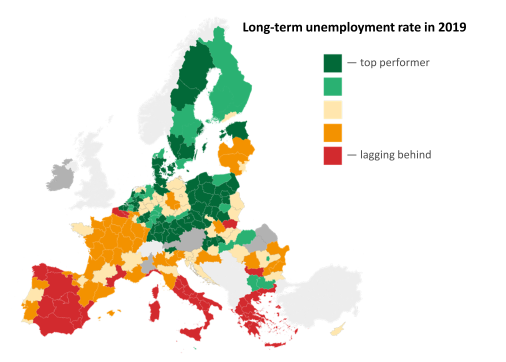
Note: The dark grey area are regions where Eurofound/Eurostat did not obtain sufficient or reliable NUTS2 regional data. This applies in particular for the regions in two Member States: Austria and Ireland. Applying the data for these Member States as a whole (see Annex I), would colour Austria light green and Ireland beige.
Source: Eurofound, based on Eurostat data.
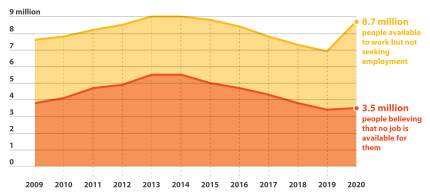
06 As well as monitoring LTU data, the Commission monitors changes in the proportion of potential workers in the EU who are “available to work but not seeking”, including those in the “believing no job available” category (so-called “discouraged jobseekers”)[8]. As these potential workers are not actively looking for employment, they are not counted as unemployed and/or long-term unemployed, but as inactive.
07 According to Eurostat data, the 2008 financial crisis resulted in more people dropping out of the labour market and into inactivity, peaking in 2013–2014 at around nine million people “available to work but not seeking”, including more than five million in the “believing no job available” sub-category. Subsequently, the number of potential “discouraged” jobseekers fell until 2020, when it increased again to 3.5 million people, together with the overall category of people “available to work but not seeking” (see Figure 3).
08 However, these data do not show how many people who had previously counted as long-term unemployed stopped looking for a job because they had become “discouraged”. The statistics would count them not as long-term unemployed but as inactive, the result being an automatic reduction in the long-term unemployed number. There is a risk that this could generate a false impression of a positive change in the employment situation in a given geographical area.
Source: ECA, based on Eurostat data (table labelled “lfsi_sup_a and lfsa_igar”, extracted in July 2021).
EU initiatives in the area of employment policies
Employment policies: a national prerogative
09 In the EU, labour market policies are a national prerogative: Member States (sometimes together with their regions) are responsible for deciding on and implementing appropriate measures to reduce (long-term) unemployment. At the same time, the Member States work together with the EU towards developing a coordinated strategy for employment, in particular to promote a skilled, trained and adaptable workforce, and labour markets which are responsive to economic change. Under its strategic and coordination framework, the EU not only encourages cooperation between Member States but also supports – and, if necessary, complements – their actions[9].
The EU’s “Europe 2020” strategy”
10 In 2010, the Commission proposed the “Europe 2020” strategy for smart, sustainable and inclusive growth[10], the aim being greater coordination of national and EU policies. One of its five headline targets concerns employment, in particular raising the employment rate of the population aged 20–64 from 69 % to at least 75 % by 2020. The European Council adopted this strategy in March 2010.
11 As part of the Europe 2020 strategy, the Commission adopted the “Agenda for new skills and jobs” initiative[11]. This proposes 13 actions that aim to help Europe’s labour market function better through increased job flexibility and security, incentives to invest in training, decent working conditions, and easier job creation.
12 Another constituent part of the Europe 2020 strategy is the European Employment Strategy, (EES), which was first introduced in 1992. It is the cornerstone of the EU’s employment policy, with the objective of creating more and better jobs throughout the EU. The strategy is implemented through the European Semester. The Council’s Employment Committee (EMCO), which is the main advisory committee for Employment and Social Affairs Ministers in the Employment and Social Affairs Council (EPSCO) in the employment field, supports the implementation of this strategy.
The European Semester process
13 The implementation of the European Employment Strategy is an intrinsic part of the European Semester process, an annual cycle of macro-economic, budgetary and structural policy coordination between Member States. As part of the European Semester, the Member States submit their national reform programmes, which the Commission then analyses for consistency with the “Europe 2020” strategy.
14 The Commission and the Council monitor the employment and social situation in the Member States in greater detail through its joint employment report, which is proposed by the Commission and, after consultations and adjustments, adopted by the Council. This assessment is also reflected in the Commission’s country reports, which analyse Member States’ economic policies, and in its country-specific recommendations. Since its introduction in 2010, the European Semester package has also included employment guidelines, where the Commission proposes common priorities and targets for employment policies which must be agreed by national governments and adopted by the Council of the European Union.
15 The EU has recognised the importance of long-term unemployment at policy level, and has issued several related country-specific recommendations as part of the European Semester process. Between 2011 and 2020, the EU issued such recommendations to 15 Member States, with the recommendations for 11 of them being issued in the period before the 2014–2020 operational programmes (OPs) were adopted. During the OP implementation period (2015–2020), four of these Member States received a further recommendation, and another four received one for the first time after 2014.
An individualised approach is key for active labour market policies to be effective
16 Active Labour Market Policies (ALMPs) are defined by the Organisation for Economic Co-operation and Development (OECD) as all social expenditure (other than education) which is aimed at improving beneficiaries’ prospects of finding gainful employment or otherwise increasing their earnings capacity[12]. According to the Commission, ALMPs include four main categories: training, job search assistance including guidance and counselling, hiring incentives for private-sector employment, and direct employment programmes in the public sector[13].
17 Effective ALMPs are instrumental in addressing the needs of the (long-term) unemployed and helping them to (re)enter the labour market. According to the Commission, different types of ALMPs are not equally successful for all the unemployed: they will only be effective if they target the right population group, consist of tailor-made measures based on an individualised approach, and are monitored and evaluated in terms of results with a view to adapting future measures[14].
18 An individualised approach takes account of the specific problems of the unemployed, and ensures services are tailored to their individual needs. It is particularly important for the long-term unemployed, who find it more difficult to (re)join the labour market. On average, Eurostat estimates that the probability of transition into employment in 2020 is 11 % for the long-term unemployed and 25 % for the short-term unemployed. The greatest differences between the long-term unemployed and the short-term unemployed were noted in Belgium and Hungary (more than 22 percentage points), whereas the smallest were in Denmark, Croatia and Sweden, where the figure was less than 10 percentage points[15] (see Annex II). In addition, although the average transition rate to employment for the short-term unemployed improved over the 2013–2020 period (from 21 % to 25 %), it remained stable for the long-term unemployed at 11 %.
19 The EU has stressed the importance of an individualised approach in several policy documents:
- the European Pillar of Social Rights, where a personalised approach is one of the rights of the unemployed, together with an in-depth individualised assessment within 18 months of their becoming unemployed[16];
- the Council Employment Guidelines of 2010, 2015 and 2018, which advocated enhancing employment services with personalised services available to all, including those furthest from the labour market, and recommended individualised active support for a return to the labour market[17];
- most Commission country position papers mentioned the need to apply a personalised approach and tailor-made measures.
20 In 2016, the Council adopted a “Recommendation on the integration of the long-term unemployed into the labour market”[18]. The Recommendation places particular emphasis on an individualised approach (see Box 2). Although a 2019 Commission evaluation report[19] acknowledged that there is a more holistic approach to providing individual support, the extent to which an individualised approach is used varies considerably between Member States. The data show that, overall, 78.4 % of the long-term unemployed were covered by a job integration agreement in 2019. However, the rate of coverage in 2019 between Member States ranged from 100 % to as low as 11.2 %.
The individualised approach established by the Council Recommendation
Individual assessment and approach
Employment services, together with other partners supporting labour-market integration, provide personalised guidance to those concerned.
Employment services ensure that the registered long-term unemployed are offered in-depth individual assessments and guidance within 18 months of becoming unemployed. The assessment should cover their employability prospects, barriers to employment, and previous jobseeking efforts.
Employment services inform the registered long-term unemployed about job offers and available support in different sectors of the economy and, where appropriate, in different regions and other Member States, in particular through the European Employment Services (EURES) network.
Job-integration agreements
The registered long-term unemployed who are not covered by the Youth Guarantee are offered a job-integration agreement within 18 months of becoming unemployed. As the very least, this should comprise an individual service offer aimed at finding a job, and should identify a single point of contact.
EU funding for Member States’ Active Labour Market Policies
21 During the 2014–2020 period, the main EU sources of funding for implementing the Europe 2020 Strategy were the European Structural and Investment (ESI) funds and, specifically where the Member States’ active labour market policies were concerned, the European Social Fund[20] (ESF).
22 Four of the 11 thematic objectives (TOs) set out in the Common Provisions Regulation[21] (CPR) for the 2014–2020 ESI funds are relevant for the ESF, three of them are relevant for tackling LTU:
- “Promoting sustainable and quality employment and supporting labour mobility” (TO 8);
- “Promoting social inclusion, combating poverty and any discrimination” (TO 9); and
- “Investing in education, training and vocational training for skills and lifelong learning” (TO 10).
23 Each TO has a number of investment priorities. Five of these priorities are relevant either for providing the long-term unemployed with support as individuals (8i, 8ii, 9i and 10iii), or for addressing changes in public employment service structures and the delivery of services (8vii). Of these five, only investment priority 8i (“Access to employment for jobseekers and inactive people, including the long-term unemployed, and people far from the labour market, also through local employment initiatives and support from labour mobility” – referred to below as “access to employment”) specifically refers to the long-term unemployed[22].
24 For the 2014–2020 period, a total of EUR 27.7 billion, or 26 % of the ESF budget, was earmarked for “Promoting sustainable and quality employment and supporting labour mobility” measures (TO 8). Around EUR 11.4 billion was allocated to “access to employment” measures (investment priority 8i). Four Member States each allocated over EUR 1 billion to investment priority 8i: Spain, Italy, Poland and Slovakia (see Annex III).
25 Most ESF OPs address the TOs and investment priorities most relevant to LTU. In particular, 145 of the 178 OPs (81 %) allocate funds to TO 8, and 106 OPs to investment priority 8i. Moreover, all but one Member State have set up OPs which have allocated funds to investment priority 8i.
26 ESF funding can be used to support different kinds of measures and interventions which can help the long-term unemployed to find a job (see Box 3).
Examples of ESF-supported interventions addressing LTU under TO 8
Work-based learning interventions, through apprenticeships, internships and traineeships.
Education and training measures focusing on specific occupational skills (re)training and basic skills training. These can be combined with other types of ESF interventions.
Guidance and support for individuals combined with other types of ESF interventions, mostly education and training measures. This type of intervention assesses the needs of the unemployed, and then offers targeted training measures.
Financial incentives for employers which help to reduce labour costs, or to provide wage and recruitment subsidies directly, thus encouraging them to hire those who are furthest from the labour market.
27 ESF measures and interventions relating to LTU are implemented by public bodies (national, regional or local employment services), non-governmental organisations and private companies that are designated by national or regional managing authorities (or intermediate bodies), or that are selected via calls for proposals.
The impact of the COVID-19 pandemic on employment
28 The lockdowns imposed by Member States in response to the COVID-19 pandemic from March 2020 onwards had a significant impact on economic activity and employment in all Member States and most economic sectors, albeit to different degrees. Against this backdrop, the Commission proposed immediate measures to tackle the consequences of the pandemic in spring 2020. The SURE instrument[23], which supports the use of short-time work schemes and similar job retention measures throughout the EU, was adopted by the European Parliament and the Council in May 2020. So far, this scheme has helped to curb the rise in unemployment despite a dramatic fall in economic activity[24]. However, once the scheme ceases to apply in December 2022, there is a risk that unemployment rates might rise and, the long-term unemployed may be affected[25].
29 The Commission also proposed that ESI funds should be used more flexibly. In April 2020, the Coronavirus Response Investment Initiatives (CRII and CRII+) adopted by the European Parliament and the Council came into force. These provide for the temporary possibility of 100 % co-financing from the EU budget, and introduced additional flexibility for transferring budgets between different funds and programmes. As a result, more than half of all Member States decided to amend their OPs to introduce the possibility of 100 % co-financing of ESF measures and/or of transferring additional funds from other ESI funds to ESF OPs.
Audit scope and approach
30 Our audit assessed whether the 2014–2020 ESF funding, through its “access to employment” investment priority, addressed the specific needs of the long-term unemployed with a view to facilitating their (re)entry into the labour market. To do so, we looked at three particular aspects:
- we analysed the extent to which ESF spending was targeted at measures to help the long-term unemployed (re)enter the labour market;
- we examined whether Member States applied an individualised approach when implementing “access to employment” measures; and
- we checked whether the Commission had taken the necessary action to obtain relevant and sufficient data to determine the impact of ESF funding on long-term unemployment.
31 Our analysis focuses on the Commission’s role and responsibilities when the 2014–2020 ESF OPs were being prepared and subsequently implemented. We analysed relevant documentation, and interviewed representatives of the Directorate-General for Employment, Social Affairs and Inclusion (DG EMPL) and of Eurostat, as the data provider.
32 Our analysis covers all Member States. In addition, we examined four Member States (Ireland, Italy, Poland and Slovakia) in greater depth, as they either faced particular difficulties with long-term unemployment at the beginning of the programme period, or had allocated a significant share of their ESF funding to investment priority 8i.
33 We analysed four ESF OPs (one for each of the Member States we selected)[26], and assessed whether the intervention logic set for LTU-related support helped to address the issue of LTU. Based on materiality and the level of implementation, we also reviewed between one and three “access to employment” actions for each OP in order to check whether they had been implemented in such a way as to address the specific needs of the long-term unemployed by applying an individualised approach. For each of the selected OPs, we also reviewed the individual cases of 18 to 24 randomly selected individuals who had been out of a job for more than 12 months, but who had participated in an ESF-funded measure for the long-term unemployed. In total, we reviewed 78 such individual cases. In addition, we interviewed representatives of the relevant national authorities (i.e. the ministries responsible for employment policy, as well as managing authorities and implementing bodies).
34 We performed our audit work between September 2020 and July 2021. COVID-19-related travel and health restrictions meant that we could not carry out any on-the-spot visits. All meetings with the Commission, the national authorities and the European Foundation for the Improvement of Living and Working Conditions (Eurofound) were held by videoconference.
Observations
The ESF did not always specifically target the long-term unemployed
35 We examined whether the Commission supported the Member States at the programming stage in such a way that the LTU issue was reflected in the design of the ESF OPs, and whether “access to employment” measures targeted the long-term unemployed, where appropriate. We also analysed whether the way the support was implemented reflected the scale of LTU in the Member States.
ESF support reached the long-term unemployed through different types of intervention
36 The actions supported by the ESF are expected to be complementary to the available support to long-term unemployed in a Member State. By the end of 2020, around 96 % of the ESF support made available to the long-term unemployed via measures under investment priority 8i had been committed, and 58 % had already been declared to the Commission (see Annex III).
37 According to Commission data, available at the time of the audit, the ESF funding reached around 1.6 million long-term unemployed, i.e. 36 % of the 4.4 million participants covered by investment priority 8i. In four Member States (Spain, Italy, Poland and Slovakia), ESF support reached more than 100 000 long-term unemployed (see Table 1). It did so through a variety of types of intervention for “access to employment”, such as guidance and support (20 %), financial incentives (17 %), education and training (8 %), and a considerable share of interventions combining several types (30 %)[27].
38 In the four Member States we selected, we found all main types of ESF intervention were used, albeit to different degrees. The Italian OP focused mostly on financial incentives for hiring, while Ireland’s focused on training. Poland usually offered combined packages of actions, which mainly included training and internships. In Slovakia, hiring incentives and direct job creation were more common (see Box 4).
Examples of actions selected for review
In Italy, we selected one of the four employment incentive actions (“Incentivo Occupazione Sud”) for review. This incentive consisted of contributions paid to employers to cover social security costs for employees. It was not specifically aimed at the long-term unemployed, and also supported the conversion of temporary contracts into permanent ones.
In Ireland, the selected action (“ETB Training for the Unemployed”) provides a range of vocational training courses to meet the needs of unemployed persons or other jobseekers. The beneficiary implements the operation across Ireland through its 16 local ETB Centres. The action provides training and traineeships through three main programmes, “Bridging”, “Traineeship” and “Specific Skills Training”. Some courses concentrate on general foundation skills, while others provide skills specific to a particular occupation or set of tasks, such as computer applications and software development, financial services, caregiving, driving, machine operation, electronics, and retail.
In Poland, one of the two selected actions was open to private companies. It targeted both the unemployed and the inactive, with a particular focus on disadvantaged groups, including the long-term unemployed. The support included individual action plans and job counselling, combined with training or actions to acquire professional experience (e.g. internships and subsidised employment).
In Slovakia, one of the selected actions consisted of a wide range of measures, covering hiring incentives, training, and other types of support such as temporary direct job creation by small municipalities for the provision of services (e.g. cleaning streets).
Many ESF interventions focused on unemployment in general, but not specifically on long-term unemployed
39 Before the ESF programmes for the 2014–2020 period were adopted, 11.4 million individuals were considered to be long-term unemployed, i.e. 5.5 % of the active population or 48.3 % of total unemployment (in 2013) (see Annex I).
40 The Commission analysed the LTU issue when preparing its country position papers that preceded the 2014–2020 Partnership Agreements and OPs, and guided discussions with the Member States on prioritising needs. 19 out of 27 position papers for the EU-27 highlighted LTU as a specific problem. In 17 of these 19, the Commission included the long-term unemployed as a funding priority, and, in three cases, it cited LTU as an issue under ‘main challenges’.
41 Meanwhile, the 2014–2020 ESIF legislation[28] did not provide for an investment priority specific to LTU. The ESF supported the long-term unemployed, but as part of more wide-ranging objectives, thus making it difficult to determine how much EU-funding was allocated to LTU-related measures.
42 In total, 145 out of 178 (or 81 %) of the 2014–2020 ESF OPs (excluding the UK and Youth Employment Initiative programmes) allocated funding to thematic objective 8 on employment[29]. However, only around one-third of all ESF OPs in 14 Member States[30] specifically refer to support for the long-term unemployed[31]. We also found that this was not the case for five Member States (Bulgaria, Latvia, Malta, Hungary and Cyprus), where the level of LTU was higher than the EU average when OPs were being negotiated in 2013.
43 A 2019 study[32] on the sustainability and effectiveness of results for ESF participants found that 101 interventions focused support on the long-term unemployed. At the same time, another 158 interventions may have involved the long-term unemployed, although not specifically (they focused on unemployment in general and only potentially included the long-term unemployed).
44 Our analysis of actions listed under investment priority 8i for the four selected OPs confirmed that although there were cases in which the long-term unemployed were the sole target group of the interventions, the long-term unemployed were usually targeted only as a subgroup, either of all unemployed and/or of “disadvantaged groups” within the OP.
Some of the ESF measures we examined entailed a risk of “creaming” effects
45 If labour market actions are not specifically focused, they entail the risk of prioritising individuals with a higher likelihood of employment to the detriment of those who are furthest from the labour market, such as the long-term unemployed (the so-called “creaming” effect). For example, one Commission study states that a ‘work-first’ approach can lead to “attempts by providers to focus on those most likely to achieve job outcomes”[33]. Another Commission study[34] advises that public employment services should pre-select participants so as to avoid the creaming effect. This further underlines the need for ESF interventions to specifically address the long-term unemployed from the outset.
46 Our analysis also revealed the risk of a creaming effect in some of the ESF OPs we examined for this audit: in Poland, for example, an evaluation of the OP we selected[35] noted that 30–39-year-olds were over-represented among the supported participants, who were already more likely to find a job than other age categories; in Italy, there was a risk that the participation criteria for the hiring incentive did not sufficiently mitigate the potential creaming effect, since employers could choose any young employee, whatever their job prospects. Due to the COVID-19 pandemic, the number of short-term unemployed may increase. As these are easier to reach than the long-term unemployed, the “creaming risk” could be exacerbated if measures specifically designed for the long-term unemployed are be lacking.
The “access to employment” measures funded by the ESF did not always reflect the scale of the LTU issue in several Member States
47 As stated in paragraph 37, ESF “access to employment” measures supported 1.6 million long-term unemployed. However, we noted that the long-term unemployed who were supported in several Member States had been under-represented by ESF “access to employment” measures when compared with the LTU rate in the same Member States.
48 At EU level, the long-term unemployed account for 38 % of all unemployed individuals supported under ESF investment priority 8i on “access to employment”. We also analysed the percentage of ESF-supported long-term unemployed, and all unemployed ESF-supported participants for each of the EU-27 Member States, based on data contained in their 2019 annual implementation reports. We compared this figure with national average LTU as a proportion of overall unemployment for the 2014–2019 period. This analysis showed differences for 15 Member States: these are particularly relevant in the cases of Romania, Portugal, Hungary, France, Malta and Latvia, where the difference exceeds 20 percentage points (see Table 1).
Table 1 – Number of participations in investment priority 8i by Member State in 2019
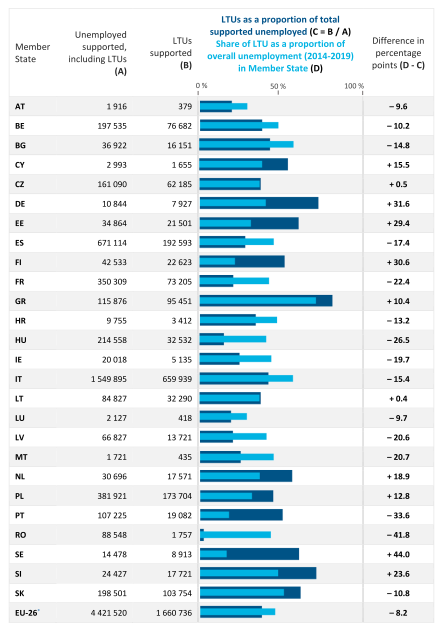
* EU-26 (DK did not allocate any EU funding for 8i).
Source: ECA, based on Commission data (table labelled “UNE_RT_A”, extracted in July 2021).
49 Our recent report on performance also pointed to an under-representation of long-term unemployed participants in ESF employment measures: in particular, it showed that the highest participation in all ESF employment operations was among individuals active or unemployed but closer to the labour market, while those more disconnected from the labour market were difficult to reach (unemployed 40 %, employed 26 %, long-term unemployed 22 %, inactive 12 %)[36].
50 Although all four selected OPs supported the long-term unemployed, we found that some of the initially planned actions specifically targeting them had either not been implemented with ESF support, or their focus had been broadened. This was the case in Ireland and Italy. In Ireland, although the OP initially contained an action directly targeting the long-term unemployed, the action was ultimately withdrawn from the OP and financed by the Member State. In Italy, despite being envisaged in the OP, the employment incentives did not specifically target the long-term unemployed, as they were open to other categories of unemployed and included the conversion of temporary contracts into permanent ones. In addition, training measures that were planned in the OP were not carried out, except as part of system actions not targeting individual long-term unemployed.
51 In Slovakia, actions defined at OP level also targeted the unemployed in general. Moreover, four of the 27 national projects that were implemented under investment priority 8i exclusively targeted the long-term unemployed. Two examples are presented in Box 5.
Example of specific ESF projects for the long-term unemployed in Slovakia
“Way out of the unemployment circle” project
This project consisted of hiring incentives for employers. Planned costs were EUR 42.5 million, while actual costs were EUR 36.5 million. Our ex-post analysis showed that the project reached 7 414 long-term unemployed with an average actual cost of EUR 5 794 per participant. The evaluated success rate of the project measured as a percentage of long-term unemployed finding employment three months after participation was 65 % in its final year (2018), while the success rate measured within six months of participation was 58 %.
“RESTART – Opportunity for the long-term unemployed to return to the labour market” project
This project targeted long-term unemployed who had been unemployed for more than 24 months. The project offered two options: a financial incentive for those who had found employment, or a contribution towards acquiring or renewing work habits. According to our ex-post analysis, planned costs were EUR 13.3 million, while actual costs were EUR 7 million. As a result of this project, 3 962 long-term unemployed found employment, and 3 799 persons acquired or renewed work habits. The evaluated success rate measured as a percentage of participants employed within six months of participating in the project was 55 %.
The link between ESF “access to employment” support and an individualised approach could not always be established
52 In addition to the ESF targeting long-term unemployment, we reviewed whether ESF support for “access to employment” used an individualised approach to meet the specific needs of the long-term unemployed (see paragraphs 16-20).
53 Ex ante conditionalities were a tool in the 2014–2020 period for ensuring that the Member States’ systems met the requirements for efficient and effective spending of EU funds. The Member States self-assessed their fulfilment based on pre-defined criteria, and this needed to be checked by the Commission at the partnership agreement and OP adoption stages. Ex ante conditionality 8.1 (“Active labour market policies are designed and delivered in the light of the Employment guidelines”), which was linked to investment priority 8i, included a criterion relating to the capacity of public employment services to apply a personalised approach. Moreover, in 2015, the Commission pointed out that “limits in individualised services are a first driver of ineffective activation design” and “effective activation design combines individualised services to jobseekers and to employers and a tailored ALMP offer”[37].
54 For the four OPs in our sample, the Member States and the Commission assessed ex ante conditionality 8.1 as having been fulfilled. This assessment was carried out only at the beginning of the programming period, as the legal basis did not require the Commission to assess whether the conditionality continued to be fulfilled when the OPs were being implemented[38]. However, we found that in subsequent country reports for two selected OPs (Ireland and Slovakia) the Commission stated that the capacities of public employment services were insufficient to deliver personalised services[39].
55 The public employment services in Ireland, Italy and Slovakia may have delivered an individualised approach for individuals registered as long-term unemployed. However, they did not communicate this information to the bodies implementing ESF actions, nor did these bodies specifically ask for them.
56 In Poland, individualised support must be used for all actions implemented under the ESF OP (see Box 6).
Individual action plan obligatory in Poland for all participants
The individualised approach is already contained in the Partnership Agreement that preceded the OP. Polish ESF OPs provide for a compulsory individual needs assessment for each participant, and this results in individual action plans being drafted. Our analysis of 18 sampled participants confirmed that each was subject to an individualised assessment.
57 In 2016, the Council issued its Recommendation advocating the use of an individualised approach to help the long-term unemployed (re)enter the labour market (see paragraph 20). We found that this Recommendation did not lead to any of the OPs we examined being modified or complemented by a related action plan, with the exception of Slovakia. A 2019 Commission study pointed out that managing authorities and intermediate bodies did not always seem to be aware of the Recommendation[40].
58 The Council’s Employment Committee (EMCO) monitors the implementation of the Council Recommendation based on the Indicator Framework. This monitoring is separate from the ESF. As regards the use of an individualised approach, most Member States reported that the COVID-19 pandemic had had a negative impact on public employment services’ ability to carry out individualised counselling or profiling due to limited access to and availability of services.
New arrangements for the 2021–2027 period under ‘ESF+’
59 The CPR for 2021–2027[41] introduces a number of steps forward, such as, enabling conditions as successors to ex ante conditionalities. For the ESF+ specific objective for “access to employment”, the criteria for the “Strategic policy framework for active labour market policies” enabling condition include arrangements for profiling jobseekers and assessing their needs.
60 A new feature of the 2021–2027 programming period is that the Member States will have to ensure that the newly introduced enabling conditions are fulfilled and applied throughout the programme period, and inform the Commission of any modifications[42]. If an enabling condition is no longer fulfilled, the Commission should not reimburse the expenditure.
61 Moreover, during the 2014–2020 period, there was no link between the content of the ex ante conditionalities and the eligibility of the selected operations. This has been changed for 2021–2027: managing authorities must now “ensure that selected operations which fall within the scope of an enabling condition are consistent with the corresponding strategies and planning documents established for the fulfilment of that enabling condition”[43].
The ESF monitoring system alone does not allow a full assessment of the measures’ achievements among the long-term unemployed
62 The Commission monitors the implementation of OPs through meetings with managing authorities, designated monitoring committees, annual review meetings, and annual implementation reports submitted by regional and national managing authorities. This includes reporting on financial data, indicators and milestones. The Commission examines the reports, and submits its observations to Member States. We examined whether the monitoring framework makes it possible to assess the effectiveness of the results of the ESF “access to employment” measures for the long-term unemployed.
Shortcomings in the 2014–2020 ESF monitoring framework limit the Commission’s ability to obtain the full picture of results
63 The monitoring framework for the 2014–2020 programme period set common output and result indicators for capturing the achievements of the investment priorities, specific objectives and actions envisaged by the OP[44]. There were two output indicators for LTU:
- the common output indicator “CO01 - Unemployed, including long-term unemployed”, which covered the unemployed in general and included the long-term unemployed as a subgroup;
- the common output indicator “CO02 – long-term unemployed”, which related directly to the long-term unemployed. The data reported under this indicator were a subset of the data reported for common indicator “CO01”.
The monitoring framework did not provide for any common result indicator(s) specific to LTU.
64 The Member States had to report annually on all common indicators, but were not required to set targets for all of them (targets for CO02 were set only for 27 ESF OPs out of 178). Member States were able to set programme-specific indicators if this was more appropriate for capturing the achievements of the intended investments.
65 We found some shortcomings in the monitoring framework that could prevent the Commission from obtaining a full picture of the achievements of ESF interventions as regards LTU-related support.
66 The 106 ESF OPs (excluding the UK programmes) that allocated funding to investment priority 8i set a total of 357 distinct output and result indicators. However, almost all of them (328) were programme-specific, and aggregate information on how many programme-specific indicators relate to LTU is not available. For the selected OPs, specific programme result indicators relating to the long-term unemployed were set in two of the four Member States we examined (Ireland and Italy).
67 Furthermore, not all Member States always use the definition of LTU (for ESF monitoring purposes) in the same way. In Italy, participants were considered to be long-term unemployed if they earned less than approximately EUR 8 000 per year. In Ireland, those in receipt of “jobseeker’s assistance” may, under the national rules, be fully unemployed or work for up to three days per week. By using different definitions of LTU, the overview that the LTU-related common output indicator provides is necessarily less precise as regards how many long-term unemployed were actually reached by the ESF at EU level.
68 The ESF Regulation did not include a common result indicator explicitly targeting the long-term unemployed. Member States report information on the results achieved for the long-term unemployed towards the targets through programme-specific result indicators on LTU, if such indicators had been defined. These indicators naturally differ between OPs. In addition, the Member States can apply different methods, defining targets either by ratios or by the absolute number of participants.
69 Commission studies had already identified difficulties in aggregating the data meaningfully, and highlighted specific weaknesses in national/OP monitoring systems that caused problems with the timeliness of information and the proper presentation of data[45]. For example, output indicators were reported in the year when participants entered an operation[46]. Participants who dropped out of an action (e.g. by not completing training) would still be reported in the indicator because costs against the ESF had been incurred. Given that some actions experienced high drop-out rates (e.g. in the case of the Polish OP), operating merely on the basis of the number of participants does not differentiate between drop-outs and successful participants, and provides an imprecise picture.
70 We analysed the investment priority 8i indicators for the four selected OPs. The Irish and Italian OPs used both common output indicators and specific result indicators. In the case of the Slovak and Polish OPs, we found that although the long-term unemployed were targeted by the common output indicator (CO02) and accounted for more than half of all participants under investment priority 8i (i.e. 70 % in the Slovak OP and more than 50 % in the Polish OP), no programme-specific result indicators were set to capture the related achievements. In absolute terms, this concerns 172 445 participating long-term unemployed in Slovakia and 27 395 in the selected OP in Poland.
71 As regards the 2021–2027 period, the legislation still does not address the long-term unemployed specifically, or include a common LTU-related result indicator. The legislative package for the 2021–2027[47] period includes a Specific Objective “Improving access to employment and activation measures for all jobseekers, in particular youth, especially through the implementation of the Youth Guarantee, for long-term unemployed and disadvantaged groups on the labour market, and for inactive people, as well as through promoting self-employment” under a wider Policy Objective “A more social and inclusive Europe by implementing the European Pillar of Social Rights”.
A few evaluations of ESF support for the long-term unemployed
72 In addition to its regular ESF monitoring based on annual implementation reports, the Commission may also carry out specific evaluations to assess the results achieved with ESF support. Timely and comprehensive evaluations make it easier to apply lessons learnt to the rest of the current programme period or to future programme periods, and to disseminate potential good practices.
73 During the 2014–2020 period, the Commission issued two studies that referred to LTU[48].
74 The studies pointed out that managing authorities carry out very few evaluations of ESF support for LTU: out of a total of 205 evaluations published in 2017, only six specifically covered such support. The situation had not improved much by the time of the audit: according to the Commission, eight evaluations covered LTU-related issues. Moreover, both studies confirmed that the ESF monitoring information was of limited use for evaluation purposes.
75 Given this situation, assessing the effectiveness of the ESF “access to employment” measures for the long-term unemployed remains a challenge. It is currently not possible to ascertain the extent to which EU measures have contributed to changes in of LTU rates, which differed significantly between Member States, including main beneficiaries of the ESF (see Annex I). This shows the need for a better understanding of whether the ESF makes a difference.
Conclusions and recommendations
76 During the 2014–2020 period, the European Social Fund (ESF) measures to support “access to employment” reached many long-term jobseekers through different types of intervention, although they did not specifically target them. As the investment priorities covered rather policy fields than target groups there was no dedicated investment priority, and the long-term unemployed were usually treated as part of a wider group of all the unemployed. In addition, the measures did not always reflect the level of long-term unemployment in the Member States (see paragraphs 35-51).
77 The implementation of ESF measures was generally not linked to an individualised approach. Although public employment services may have applied the individualised approach for individual long-term unemployed as part of their national active labour market policies, the documents containing the information were neither communicated to the bodies implementing ESF actions, nor did these bodies specifically ask to be sent them. In addition, the Council Recommendation came into force after operational programmes had initially been adopted, and operational programmes were generally not amended accordingly. Although this link was not a pre-requisite for ESF support, its absence can limit the added value of ESF-supported interventions when addressing the specific needs of the long-term unemployed (see paragraphs 52-61).
78 We identified a number of shortcomings in the 2014–2020 ESF monitoring and evaluation framework that may prevent the Commission from obtaining a full picture of the effectiveness of ESF interventions as regards long-term unemployment (LTU)-related support. In particular, there is no LTU-related common result indicator, and the LTU-related common output indicator is not always used for target setting. This makes it difficult to monitor ESF achievements for the long-term unemployed. Also, there are few evaluations relating to LTU (see paragraphs 62-75).
79 The COVID-19 pandemic may have a detrimental impact on the number and situation of the long-term unemployed. Against this background, we would make the following three recommendations, all of which refer to the new 2021–2027 programing period and aim to improve programming so as better to help the EU’s long-term unemployed.
Recommendation 1 – Target ESF “access to employment” support at the long-term unemployed where LTU is high
For the 2021–2027 programme period, the Commission should insist that the Member States target specifically long-term unemployed and their needs by means of ESF+ where national or regional LTU is high.
Timeframe: At the time of adoption (or amendment) of the 2021–2027 ESF+ programmes.
Recommendation 2 – Link ESF “access to employment” support to an individualised approach for the long-term unemployed
The Commission should insist that Member States apply an individualised approach to all the long-term unemployed when “access to employment” measures are being implemented under the new ESF+, by taking account of jobseekers’ profiles and an assessment of their needs.
Timeframe: At the time of adoption (or amendment) of the 2021–2027 ESF+ programmes.
Recommendation 3 – Evaluate the results achieved by ESF support for “access to employment” in terms of LTU
As part of the ex-post evaluation for the 2014–2020 period and the mid-term evaluation for the new 2021–2027 period, the Commission should evaluate the effectiveness of “access to employment” measures for the long-term unemployed. The conclusions of these evaluations should lead to responsive actions within its remit (such as taking them into account when assessing programme amendments after 2025 when relevant), and to good practices being disseminated between and within the national and regional authorities responsible for implementing “access to employment” measures in the Member States.
Timeframe: By the first quarter of 2025 for the ex-post and the mid-term evaluations.
This Report was adopted by Chamber II, headed by Mrs Iliana Ivanova, Member of the Court of Auditors, in Luxembourg on 28 October 2021.
For the Court of Auditors

Klaus-Heiner Lehne President
Annexes
Annex I – Number of long-term unemployed, LTU share and LTU rate in the EU, 2009–2020
Total long-term unemployed (aged 15 to 74 years old, thousands)
| 2009 | 2010 | 2011 | 2012 | 2013 | 2014 | 2015 | 2016 | 2017 | 2018 | 2019 | 2020 | |
| EU-27 | 6 507 | 8 260 | 8 971 | 10 247 | 11 445 | 11 430 | 10 404 | 9 203 | 7.951 | 6.823 | 5.891 | 5.264 |
| BE | 168 | 197 | 167 | 165 | 192 | 211 | 218 | 201 | 172 | 146 | 119 | 118 |
| BG | 103 | 162 | 210 | 226 | 250 | 232 | 187 | 146 | 114 | 101 | 81 | 76 |
| CZ | 106 | 157 | 142 | 159 | 160 | 141 | 127 | 89 | 54 | 37 | 33 | 30 |
| DK | 17 | 42 | 51 | 60 | 51 | 48 | 47 | 36 | 35 | 29 | 25 | 28 |
| DE | 1 450 | 1 333 | 1 141 | 1 003 | 968 | 919 | 851 | 723 | 675 | 601 | 520 | 489 |
| EE | 25 | 52 | 49 | 37 | 26 | 22 | 16 | 15 | 13 | 9 | 6 | 8 |
| IE | 81 | 155 | 195 | 204 | 178 | 147 | 121 | 98 | 71 | 50 | 39 | 32 |
| EL | 196 | 285 | 435 | 706 | 893 | 937 | 875 | 814 | 747 | 644 | 574 | 502 |
| ES | 989 | 1 700 | 2 085 | 2 578 | 3 006 | 2 965 | 2 609 | 2 167 | 1 742 | 1 452 | 1 229 | 1 133 |
| FR | 955 | 1 140 | 1 122 | 1 224 | 1 320 | 1 328 | 1 342 | 1 348 | 1 256 | 1 115 | 996 | 858 |
| HR | 99 | 125 | 158 | 189 | 202 | 191 | 193 | 121 | 84 | 61 | 43 | 38 |
| IT | 844 | 987 | 1 059 | 1 415 | 1 730 | 1 966 | 1 762 | 1 728 | 1 682 | 1 600 | 1 445 | 1 191 |
| CY | 2 | 5 | 7 | 15 | 26 | 33 | 29 | 24 | 19 | 12 | 9 | 10 |
| LV | 50 | 93 | 91 | 81 | 58 | 46 | 44 | 40 | 32 | 30 | 23 | 21 |
| LT | 50 | 113 | 119 | 97 | 74 | 71 | 57 | 45 | 39 | 29 | 28 | 36 |
| LU | 3 | 3 | 3 | 4 | 5 | 4 | 5 | 6 | 6 | 4 | 4 | 5 |
| HU | 173 | 230 | 222 | 214 | 214 | 163 | 140 | 109 | 77 | 66 | 51 | 52 |
| MT | 5 | 7 | 7 | 7 | 7 | 6 | 6 | 5 | 5 | 4 | 2 | 3 |
| NL | 95 | 116 | 140 | 170 | 226 | 258 | 264 | 223 | 173 | 128 | 95 | 83 |
| AT | 48 | 52 | 51 | 52 | 57 | 67 | 74 | 87 | 83 | 64 | 51 | 60 |
| PL | 428 | 513 | 617 | 706 | 761 | 669 | 512 | 372 | 262 | 177 | 120 | 107 |
| PT | 228 | 307 | 333 | 408 | 482 | 433 | 371 | 317 | 231 | 160 | 145 | 117 |
| RO | 215 | 225 | 271 | 277 | 295 | 258 | 274 | 265 | 186 | 167 | 150 | 135 |
| SI | 18 | 33 | 37 | 43 | 52 | 53 | 47 | 42 | 32 | 23 | 20 | 20 |
| SK | 175 | 249 | 248 | 254 | 271 | 252 | 207 | 160 | 140 | 111 | 92 | 87 |
| FI | 37 | 53 | 46 | 44 | 45 | 51 | 61 | 61 | 57 | 44 | 32 | 33 |
| SE | 54 | 77 | 74 | 74 | 73 | 75 | 76 | 68 | 67 | 60 | 51 | 63 |
Note: According the Commission, there was in October 2021 an important revision (downwards) for France due to methodological improvements.
Source: Eurostat (table labelled “une_ltu_a”, extracted in July 2021.
LTUs as a percentage of unemployment (aged 15 to 74 years old)
| 2009 | 2010 | 2011 | 2012 | 2013 | 2014 | 2015 | 2016 | 2017 | 2018 | 2019 | 2020 | |
| EU-27 | 34.2 | 40.6 | 43.9 | 45.4 | 48.3 | 50.4 | 49.6 | 48.0 | 46.3 | 44.4 | 41.4 | 35.4 |
| BE | 44.2 | 48.7 | 48.3 | 44.6 | 46.0 | 49.9 | 51.7 | 51.6 | 48.6 | 48.7 | 43.5 | 41.6 |
| BG | 43.3 | 46.1 | 55.7 | 55.2 | 57.3 | 60.4 | 61.2 | 59.1 | 55.0 | 58.4 | 56.6 | 45.0 |
| CZ | 30.0 | 40.9 | 40.6 | 43.4 | 43.4 | 43.5 | 47.3 | 42.1 | 35.0 | 30.5 | 30.0 | 22.1 |
| DK | 9.0 | 18.7 | 22.7 | 26.6 | 24.5 | 24.3 | 25.7 | 20.4 | 20.5 | 19.1 | 16.4 | 16.4 |
| DE | 44.9 | 46.8 | 47.6 | 45.1 | 44.4 | 44.0 | 43.6 | 40.8 | 41.7 | 40.9 | 37.8 | 29.6 |
| EE | 27.3 | 45.3 | 57.3 | 54.7 | 44.5 | 45.3 | 38.3 | 31.6 | 33.5 | 24.9 | 20.0 | 17.1 |
| IE | 27.9 | 47.3 | 56.8 | 59.3 | 57.7 | 55.1 | 53.6 | 50.5 | 44.9 | 36.3 | 32.1 | 23.6 |
| EL | 40.4 | 44.6 | 49.3 | 59.1 | 67.1 | 73.5 | 73.1 | 72.0 | 72.8 | 70.3 | 70.1 | 66.5 |
| ES | 23.8 | 36.6 | 41.6 | 44.4 | 49.7 | 52.8 | 51.6 | 48.4 | 44.5 | 41.7 | 37.8 | 32.1 |
| FR | 36.4 | 42.5 | 42.1 | 42.9 | 43.6 | 43.9 | 43.9 | 45.4 | 45.1 | 41.6 | 40.0 | 36.5 |
| HR | 55.7 | 56.3 | 61.3 | 63.7 | 63.6 | 58.3 | 63.1 | 50.7 | 41.0 | 40.2 | 35.8 | 28.1 |
| IT | 44.3 | 48.0 | 51.4 | 52.6 | 56.4 | 60.8 | 58.1 | 57.4 | 57.8 | 58.1 | 56.0 | 51.5 |
| CY | 10.4 | 20.4 | 20.8 | 30.1 | 38.3 | 47.7 | 45.6 | 44.4 | 40.6 | 31.7 | 29.1 | 28.1 |
| LV | 25.8 | 45.0 | 54.5 | 52.1 | 48.4 | 42.9 | 45.3 | 41.4 | 37.6 | 41.6 | 38.0 | 27.3 |
| LT | 23.7 | 41.7 | 52.1 | 49.2 | 42.9 | 44.7 | 42.9 | 38.3 | 37.6 | 32.2 | 30.6 | 29.0 |
| LU | 23.1 | 29.3 | 28.8 | 30.3 | 30.4 | 27.4 | 28.4 | 34.8 | 38.1 | 24.7 | 22.8 | 25.5 |
| HU | 41.5 | 48.9 | 47.6 | 45.3 | 48.6 | 47.5 | 45.6 | 46.5 | 40.4 | 38.5 | 31.9 | 26.2 |
| MT | 42.0 | 59.5 | 60.3 | 61.3 | 57.3 | 51.1 | 50.1 | 50.5 | 50.8 | 48.1 | 25.1 | 25.5 |
| NL | 25.1 | 26.8 | 32.3 | 32.9 | 34.9 | 39.2 | 42.9 | 41.5 | 39.5 | 36.6 | 30.3 | 23.2 |
| AT | 21.7 | 25.4 | 26.3 | 24.9 | 24.6 | 27.2 | 29.2 | 32.3 | 33.4 | 28.9 | 25.1 | 24.5 |
| PL | 30.3 | 31.1 | 37.2 | 40.3 | 42.5 | 42.7 | 39.3 | 35.0 | 31.0 | 26.9 | 21.6 | 20.0 |
| PT | 44.0 | 52.0 | 48.4 | 48.8 | 56.4 | 59.6 | 57.4 | 55.4 | 49.9 | 43.7 | 42.6 | 33.3 |
| RO | 31.6 | 34.5 | 41.0 | 44.2 | 45.2 | 41.1 | 43.9 | 50.0 | 41.4 | 44.1 | 42.4 | 29.9 |
| SI | 30.1 | 43.3 | 44.2 | 47.9 | 51.0 | 54.5 | 52.3 | 53.3 | 47.5 | 42.9 | 43.0 | 38.8 |
| SK | 54.0 | 64.0 | 67.9 | 67.3 | 70.2 | 70.2 | 65.8 | 60.2 | 62.4 | 61.8 | 58.2 | 47.8 |
| FI | 16.7 | 23.8 | 22.0 | 21.2 | 20.6 | 22.1 | 24.4 | 25.7 | 24.2 | 21.8 | 17.6 | 15.4 |
| SE | 13.1 | 18.1 | 19.0 | 18.3 | 17.7 | 18.2 | 19.6 | 18.3 | 18.5 | 17.2 | 13.7 | 13.9 |
Note: According the Commission, there was in October 2021 an important revision (downwards) for France due to methodological improvements.
Source: Eurostat (table labelled “une_ltu_a”, extracted in July2021).
LTUs as a percentage of the active population (aged 15 to 74 years old)
| 2009 | 2010 | 2011 | 2012 | 2013 | 2014 | 2015 | 2016 | 2017 | 2018 | 2019 | 2020 | |
| EU-27 | 3.1 | 4.0 | 4.3 | 4.9 | 5.5 | 5.5 | 5.0 | 4.4 | 3.8 | 3.2 | 2.8 | 2.5 |
| BE | 3.5 | 4.0 | 3.5 | 3.4 | 3.9 | 4.3 | 4.4 | 4.0 | 3.5 | 2.9 | 2.3 | 2.3 |
| BG | 3.0 | 4.7 | 6.3 | 6.8 | 7.4 | 6.9 | 5.6 | 4.5 | 3.4 | 3.0 | 2.4 | 2.3 |
| CZ | 2.0 | 3.0 | 2.7 | 3.0 | 3.0 | 2.7 | 2.4 | 1.7 | 1.0 | 0.7 | 0.6 | 0.6 |
| DK | 0.6 | 1.4 | 1.8 | 2.1 | 1.8 | 1.7 | 1.6 | 1.2 | 1.2 | 1.0 | 0.8 | 0.9 |
| DE | 3.5 | 3.3 | 2.8 | 2.4 | 2.3 | 2.2 | 2.0 | 1.7 | 1.6 | 1.4 | 1.2 | 1.1 |
| EE | 3.7 | 7.6 | 7.1 | 5.5 | 3.8 | 3.3 | 2.4 | 2.1 | 1.9 | 1.3 | 0.9 | 1.2 |
| IE | 3.5 | 6.9 | 8.8 | 9.2 | 8.0 | 6.6 | 5.3 | 4.2 | 3.0 | 2.1 | 1.6 | 1.3 |
| EL | 3.9 | 5.7 | 8.8 | 14.5 | 18.5 | 19.5 | 18.2 | 17.0 | 15.6 | 13.6 | 12.2 | 10.9 |
| ES | 4.3 | 7.3 | 8.9 | 11.0 | 13.0 | 12.9 | 11.4 | 9.5 | 7.7 | 6.4 | 5.3 | 5.0 |
| FR | 3.3 | 3.9 | 3.9 | 4.2 | 4.5 | 4.5 | 4.6 | 4.6 | 4.2 | 3.8 | 3.4 | 2.9 |
| HR | 5.1 | 6.6 | 8.4 | 10.2 | 11.0 | 10.1 | 10.2 | 6.6 | 4.6 | 3.4 | 2.4 | 2.1 |
| IT | 3.4 | 4.0 | 4.3 | 5.6 | 6.9 | 7.7 | 6.9 | 6.7 | 6.5 | 6.2 | 5.6 | 4.7 |
| CY | 0.6 | 1.3 | 1.6 | 3.6 | 6.1 | 7.7 | 6.8 | 5.8 | 4.5 | 2.7 | 2.1 | 2.1 |
| LV | 4.5 | 8.8 | 8.8 | 7.8 | 5.7 | 4.6 | 4.5 | 4.0 | 3.3 | 3.1 | 2.4 | 2.2 |
| LT | 3.3 | 7.4 | 8.0 | 6.6 | 5.1 | 4.8 | 3.9 | 3.0 | 2.7 | 2.0 | 1.9 | 2.5 |
| LU | 1.2 | 1.3 | 1.4 | 1.6 | 1.8 | 1.6 | 1.9 | 2.2 | 2.1 | 1.4 | 1.3 | 1.7 |
| HU | 4.2 | 5.5 | 5.2 | 5.0 | 4.9 | 3.7 | 3.1 | 2.4 | 1.7 | 1.4 | 1.1 | 1.1 |
| MT | 2.9 | 4.1 | 3.9 | 3.8 | 3.5 | 2.9 | 2.7 | 2.4 | 2.0 | 1.8 | 0.9 | 1.1 |
| NL | 1.1 | 1.3 | 1.6 | 1.9 | 2.5 | 2.9 | 3.0 | 2.5 | 1.9 | 1.4 | 1.0 | 0.9 |
| AT | 1.2 | 1.2 | 1.2 | 1.2 | 1.3 | 1.5 | 1.7 | 1.9 | 1.8 | 1.4 | 1.1 | 1.3 |
| PL | 2.5 | 3.0 | 3.6 | 4.1 | 4.4 | 3.8 | 3.0 | 2.2 | 1.5 | 1.0 | 0.7 | 0.6 |
| PT | 4.2 | 5.7 | 6.2 | 7.7 | 9.3 | 8.4 | 7.2 | 6.2 | 4.5 | 3.1 | 2.8 | 2.3 |
| RO | 2.2 | 2.4 | 2.9 | 3.0 | 3.2 | 2.8 | 3.0 | 3.0 | 2.0 | 1.8 | 1.7 | 1.5 |
| SI | 1.8 | 3.2 | 3.6 | 4.3 | 5.2 | 5.3 | 4.7 | 4.3 | 3.1 | 2.2 | 1.9 | 1.9 |
| SK | 6.5 | 9.2 | 9.2 | 9.4 | 10.0 | 9.3 | 7.6 | 5.8 | 5.1 | 4.0 | 3.4 | 3.2 |
| FI | 1.4 | 2.0 | 1.7 | 1.6 | 1.7 | 1.9 | 2.3 | 2.3 | 2.1 | 1.6 | 1.2 | 1.2 |
| SE | 1.1 | 1.6 | 1.5 | 1.5 | 1.4 | 1.4 | 1.5 | 1.3 | 1.2 | 1.1 | 0.9 | 1.1 |
Note: According the Commission, there was in October 2021 an important revision (downwards) for France due to methodological improvements.
Source: Eurostat (table labelled “une_ltu_a”, extracted in July 2021.
Annex II – Transition rates to employment
Annual transition rates (%) to employment for the short-term unemployed (STUs) and the long-term unemployed (LTUs)
| Member State | 2013 | 2020 | ||
|---|---|---|---|---|
| STUs | LTUs | STUs | LTUs | |
| BE | - | - | 31 | 6 |
| BG | 14 | 5 | 20 | 6 |
| CZ | 20 | 9 | 25 | 7 |
| DK | 38 | 27 | 36 | 29 |
| EE | 21 | 14 | 29 | 16 |
| IE | 20 | 7 | 29 | 11 |
| EL | 7 | 2 | 15 | 3 |
| ES | 20 | 8 | 27 | 9 |
| FR | 26 | 13 | 27 | 12 |
| HR | 14 | 7 | 19 | 12 |
| IT | 20 | 7 | 22 | 7 |
| CY | 18 | 8 | 28 | 11 |
| LV | 27 | 13 | 25 | 13 |
| LT | 17 | 8 | 21 | 6 |
| HU | 24 | 11 | 34 | 11 |
| NL | 22 | 14 | 33 | 16 |
| AT | 32 | 14 | 32 | 13 |
| PL | 14 | 9 | 26 | 12 |
| PT | 21 | 15 | 30 | 18 |
| RO | 13 | 5 | 17 | 7 |
| SI | 22 | 14 | 29 | 11 |
| SK | 11 | 5 | 20 | 4 |
| FI | 28 | 15 | 31 | 14 |
| SE | 27 | 14 | 25 | 16 |
| EU* | 21 | 11 | 25 | 11 |
* Unweighted average for the EU, calculated without data for Germany, Luxembourg, Malta and the UK.
Source: ECA, based on Eurostat experimental data (table labelled “lfsi_long_e01”, extracted in May 2021)
Annex III – ESF allocation to investment priority 8i, and implementation rate
Investment priority 8i allocation and implementation by Member State – 2020 (euro)
| Member State | Planned EU amount | EU eligible costs - selected | EU eligible expenditure declared |
|---|---|---|---|
| BE | 191 903 026 | 190 193 535 | 91 593 488 |
| BG | 238 079 679 | - | - |
| CZ | 627 949 296 | 669 094 561 | 472 560 439 |
| DE | 43 899 353 | 49 987 988 | 31 250 981 |
| EE | 203 605 301 | 201 506 275 | 108 493 852 |
| IE | 137 020 369 | 137 020 369 | 69 252 967 |
| EL | 689 350 453 | 794 455 737 | 458 807 042 |
| ES | 1 165 396 613 | 1 403 342 253 | 713 153 320 |
| FR | 367 899 226 | 359 611 511 | 245 119 000 |
| HR | 249 084 283 | 224 992 196 | 50 968 076 |
| IT | 1 520 782 811 | 1 768 843 027 | 968 963 837 |
| CY | 9 255 000 | 11 448 330 | 9 254 166 |
| LV | 94 139 809 | 86 913 527 | 63 560 140 |
| LT | 355 400 146 | 358 753 273 | 294 828 926 |
| LU | 4 461 245 | 5 427 330 | 3 247 649 |
| HU | 1 013 454 498 | 833 491 384 | 602 099 375 |
| MT | 16 000 000 | 17 239 651 | 9 130 739 |
| NL | 25 146 085 | 27 923 935 | 12 878 687 |
| AT | 15 099 649 | 12 814 761 | 6 572 665 |
| PL | 1 625 458 684 | 1 387 268 530 | 1 027 041 808 |
| PT | 618 925 842 | 452 338 709 | 345 569 403 |
| RO | 527 453 819 | 517 392 594 | 237 369 693 |
| SI | 162 066 573 | 201 538 688 | 78 947 785 |
| SK | 1 218 722 796 | 933 919 506 | 531 679 661 |
| FI | 163 663 349 | 148 844 521 | 96 398 659 |
| SE | 130 371 130 | 186 072 279 | 101 043 073 |
| EU | 11 414 589 036 | 10 980 434 469 | 6 629 785 433 |
Source: ECA, based on Commission data (extracted in July 2021).
Acronyms and abbreviations
ALMP: Active labour market policy
CO: Common output indicator
CPR: Common Provisions Regulation
DG EMPL: Directorate-General for Employment, Social Affairs and Inclusion
EMCO: Employment Committee
ESF: European Social Fund
ESF+: European Social Fund Plus
ETB: Education and Training Board
LTU: Long-term unemployment
LTUs: Long-term unemployed
NUTS 2: Nomenclature of territorial units for statistics
OECD: Organisation for Economic Co-operation and Development
OP: Operational programme
STUs: Short-term unemployed
SURE: European instrument for temporary support to mitigate unemployment risks in an emergency
Glossary
Available to work but not seeking: According to the Eurostat definition, persons “available to work but not seeking” are “persons aged 15–74 neither employed nor unemployed who want to work, are available for work in the next two weeks but do not seek work”. This indicator covers jobless people who do not qualify to be recorded as unemployed because they are not actively looking for a job. It includes “discouraged” jobseekers and those prevented from looking for a job by personal or family circumstances.
Cohesion Policy: One of the biggest policy areas on which the EU budget is spent. It aims to reduce development disparities between different regions, restructure declining industrial areas and diversify rural areas, and encourage cross-border, transnational and interregional cooperation. It is funded from the European Regional Development Fund (ERDF), the European Social Fund (ESF) and the Cohesion Fund (CF).
Council Recommendation: An instrument of indirect action that aims to prepare legislation in Member States. Recommendations differ from regulations, directives and decisions in that they are not binding on Member States. Though without legal force, they do have political weight.
Country-Specific Recommendations (CSRs): Documents prepared by the European Commission for each country that analyse its economic situation and provide recommendations on measures it should adopt over a period of 12 to 18 months.
Creaming effect: The effectiveness of ALMPs can be undermined by the creaming effect, in which only those workers with high employment probabilities are selected for participation. This is particularly relevant if case workers assign workers to ALMPs, and have an incentive to show that their clients have a good re-employment rate.
Employment Committee (EMCO): The Council’s main advisory committee for Employment and Social Affairs in the employment field.
Eurofound: An EU Agency whose role is to provide information, advice and expertise in the field of EU social policy on the basis of comparative information, research and analysis.
Europe 2020 Strategy: The EU’s growth strategy to recover from the crisis for the next 10 years, split into five headline targets covering: employment; research and development; climate/energy; education; social inclusion and poverty reduction.
European Semester: A cycle of economic and fiscal policy coordination within the EU. It is part of the European Union’s economic governance framework, with a focus on the six-month period from the beginning of each year, hence its name: the ‘semester’. During the European Semester, the Member States align their budgetary and economic policies with the objectives and rules agreed at the EU level.
European Social Fund (ESF): Aims to strengthen economic and social cohesion within the European Union by improving employment and job opportunities (mainly through training measures), encouraging a high level of employment, and creating more and better jobs.
Ex ante conditionalities: Conditions, based on pre-defined criteria stipulated in the CPR, which are regarded as prerequisites for the effective and efficient use of EU funding for all ESI funds. When preparing ERDF, CF and ESF OPs under the 2014–2020 programme period, Member States had to assess whether these conditions were fulfilled. If they had not been, action plans needed to be prepared to ensure the conditions had been fulfilled by 31 December 2016.
Monitoring Committee: A committee which monitors the implementation of an OP. It consists of “representatives of the relevant Member State authorities” (e.g. representatives of the managing, certifying and audit authorities, implementing bodies, employer or employee organisations, and civil society). The Commission also has an observer role.
Operational Programme (OP): The basic framework for implementing EU-funded cohesion projects in a set period, reflecting the priorities and objectives laid down in partnership agreements between the Commission and individual Member States. The projects within an OP must contribute to a certain number of objectives specified at the EU level of the OP’s priority axis. OP funding may come from the ERDF, CF and/or ESF. An OP is prepared by a Member State and has to be approved by the Commission before any payments from the EU budget can be made. OPs can only be modified during the programme period if both parties agree.
Output indicators: Values used to measure the outputs of supported operations or outputs at operational programme level.
Public Employment Services: National organisations responsible for implementing active labour market policies and providing quality employment services in the public interest. They may be part of relevant ministries, public bodies or corporations falling under public law.
Result indicators: Values used to measure the results generated by supported projects, or the results achieved at operational programme level.
Shared management: A method of implementing the EU budget in which the Commission delegates implementation to the Member States, while retaining final responsibility.
Replies of the Commission
Audit team
The ECA’s special reports set out the results of its audits of EU policies and programmes, or of management-related topics from specific budgetary areas. The ECA selects and designs these audit tasks to be of maximum impact by considering the risks to performance or compliance, the level of income or spending involved, forthcoming developments, and political and public interest.
This performance audit was carried out by Audit Chamber II Investment for cohesion, growth and inclusion spending areas, headed by ECA Member Iliana Ivanova. The audit was led by ECA Member Lazaros S. Lazarou, supported by Johan Adriaan Lok, Head of Private Office, and Agathoclis Argyrou, Private Office Attaché; Pietro Puricella, Principal Manager; Fernando Pascual Gil, Head of Task; Aleksandra Klis‑Lemieszonek, Deputy Head of Task; Marjeta Leskovar, Marija Grgurić, Zuzana Gullova and Petra Karkosova, Auditors. Mark Smith, Miłosz Aponowicz, Tomasz Surdykowski and Paola Magnanelli provided linguistic support.

Endnotes
[1] European Commission, ‘The feasibility of developing a methodology for measuring the distance travelled and soft outcomes for long-term unemployed people participating in Active Labour Market Programmes’, Final report, 2019.
[2] Bertelsmann Stiftung, ‘Long-term Unemployment in the EU: Trends and Policies’, 2016.
[3] Council Recommendation of 15 February 2016 on the integration of the long-term unemployed into the labour market (2016/C 67/01).
[4] European Commission, ‘The feasibility of developing a methodology for measuring the distance travelled and soft outcomes for long-term unemployed people participating in Active Labour Market Programmes’, Final report, 2019.
[5] Eurostat glossary of terms.
[6] Belgium, Bulgaria, Greece, France, Italy, Slovenia and Slovakia.
[7] Bulgaria, Ireland, Greece, Spain, Croatia, Italy, Malta, Portugal, Slovenia and Slovakia.
[8] European Commission, ‘Employment and Social Developments in Europe’, September 2019.
[9] Treaty on the Functioning of the European Union, Article 149.
[10] European Commission, ‘Europe 2020 - A strategy for smart, sustainable and inclusive growth’, COM(2010) 2020 final.
[11] European Commission, ‘An Agenda for new skills and jobs: A European contribution towards full employment’, COM(2010) 682 final.
[13] European Commission, ‘The feasibility of developing a methodology for measuring the distance travelled and soft outcomes for long-term unemployed people participating in Active Labour Market Programmes’, Final report, 2019.
[14] European Commission, ‘European Semester Thematic Factsheet – Active Labour Market Policies’, November 2017.
[15] Based on data for 26 Member States, not including the UK and Malta.
[16] European Pillar of Social Rights, ‘Principle 4: Active support to employment’.
[17] Council Decision of 21 October 2010 on guidelines for the employment policies of the Member States, 2010/707/EU, Annex, Guideline 7: Increasing labour market participation of women and men, reducing structural unemployment and promoting job quality. Council Decision (EU) 2015/1848 of 5 October 2015 on guidelines for the employment policies of the Member States for 2015, Annex, Guideline 6: Enhancing labour supply, skills and competences. Council Decision (EU) 2018/1215 of 16 July 2018 on guidelines for the employment policies of the Member States.
[18] Council Recommendation of 15 February 2016 on the integration of the long-term unemployed into the labour market (2016/C 67/01).
[19] European Commission, ‘Report from the Commission to the Council, Evaluation of the Council Recommendation on the integration of the long – term unemployed into the labour market’, COM(2019) 169 final.
[20] Regulation (EU) No 1304/2013 of the European Parliament and of the Council of 17 December 2013 on the European Social Fund and repealing Council Regulation (EC) No 1081/2006.
[21] Regulation (EU) No 1303/2013 of the European Parliament and of the Council of 17 December 2013 laying down common provisions on the European Regional Development Fund, the European Social Fund, the Cohesion Fund, the European Agricultural Fund for Rural Development and the European Maritime and Fisheries Fund and laying down general provisions on the European Regional Development Fund, the European Social Fund, the Cohesion Fund and the European Maritime and Fisheries Fund and repealing Council Regulation (EC) No 1083/2006.
[22] Investment priority 9i (“Active inclusion, including with a view to promoting equal opportunities and active participation, and improving employability”) also supports the long-term unemployed, but generally provides a different type of assistance with a broader focus on social inclusion.
[23] Council Regulation (EU) 2020/672 of 19 May 2020 on the establishment of a European instrument for temporary support to mitigate unemployment risks in an emergency (SURE) following the COVID-19 outbreak, OJ L 159, 20.5.2020, p. 1.
[24] ECA review 06/2020, ‘Risks, challenges and opportunities in the EU’s economic policy response to the COVID-19 crisis’. OECD ‘Job retention schemes during the COVID-19 lockdown and beyond’, updated 12 October 2020.
[25] OECD, ‘Employment Outlook 2020’. European Commission, ‘European Economic Forecast, Spring 2021’, Institutional paper 149, May 2021.
[26] Ireland (Programme for Employability, Inclusion and Learning 2014–2020), Italy (National Operational Programme on Systems for Active Employment Policies), Poland (Regional Operational Programme of the Voivodship of Silesia 2014–2020) and Slovakia (Operational Programme Human Resources 2014–2020).
[27] European Commission, ‘Study for the Evaluation of ESF support to Employment and Labour Mobility’, June 2020, p. 26.
[28] Regulation (EU) No 1303/2013 of the European Parliament and of the Council of 17 December 2013 laying down common provisions and Regulation (EU) No 1304/2013 of the European Parliament and of the Council on the European Social Fund.
[29] Based on Commission data.
[30] Belgium, Croatia, France, Germany, Greece, Ireland, Italy, Lithuania, Poland, Portugal, Romania, Slovenia, Slovakia and Spain.
[31] European Commission, ‘Thematic note on the ESF and YEI support to long-term unemployed (LTU) and the implementation of Council Recommendation on integration of LTU into the labour market’, January 2019.
[32] European Commission, Ismeri, IES and Ecorys,: ‘Pilot and feasibility study on the sustainability and effectiveness of results for European Social Fund participants using Counterfactual impact evaluations’, July 2019.
[33] European Commission, ‘The feasibility of developing a methodology for measuring the distance travelled and soft outcomes for long-term unemployed people participating in Active Labour Market Programmes’, Final report, July 2019.
[34] European Commission, ‘Thematic note on the ESF and YEI support to long-term unemployed (LTU) and the implementation of Council Recommendation on integration of LTU into the labour market’, January 2019.
[35] Silesian Voivodship, 'Evaluation of the OPs contribution to achieving the objectives of Priority Axis VII: Regional Labour Market', July 2020.
[36] 2020 Report of the European Court of Auditors on the performance of the EU budget – Status at the end of 2020, paragraph 3.45.
[37] European Commission Staff Working Document, ‘Analytical Supporting Document accompanying the document Proposal for a Council Recommendation’, SWD(2015) 176 final.
[38] ECA Special report 24/2021 “Performance-based financing in Cohesion policy: worthy ambitions, but obstacles remained in the 2014–2020 period”, paragraph 26.
[39] European Commission Staff Working Document ‘Country Report Ireland 2015 Including an In-Depth Review on the prevention and correction of macroeconomic imbalances’, SWD(2015) 27 final; Commission Staff Working Document, ‘Country Report Slovakia 2018’, COM(2018) 120 final; Commission Staff Working Document, ‘Country Report Slovakia 2020’, COM(2020) 150 final.
[40] European Commission, ‘Thematic note on the ESF and YEI support to long-term unemployed (LTU) and the implementation of Council Recommendation on integration of LTU into the labour market’, January 2019.
[41] Regulation (EU) 2021/1060 of the European Parliament and of the Council of 24 June 2021 laying down common provisions on the European Regional Development Fund, the European Social Fund Plus, the Cohesion Fund, the Just Transition Fund and the European Maritime, Fisheries and Aquaculture Fund and financial rules for those and for the Asylum, Migration and Integration Fund, the Internal Security Fund and the Instrument for Financial Support for Border Management and Visa Policy of 24 June 2021.
[42] Regulation (EU) 2021/1060, Article 15.
[43] Regulation (EU) 2021/1060, Article 73.2(b).
[44] Regulation (EU) No 1304/2013 of the European Parliament and of the Council of 17 December 2013 on the European Social Fund and repealing Council Regulation (EC) No 1081/2006, Annex.
[45] European Commission, ‘Study on the monitoring and evaluation systems of the ESF, Final report’, May 2018.
[46] European Commission, ‘Guidance document: Annex D - Practical guidance on data collection and validation’, May 2016.
[47] Regulation (EU) 2021/1060 and Regulation (EU) 2021/1057 of the European Parliament and of the Council establishing the European Social Fund Plus (ESF+) and repealing Regulation (EU) No 1296/2013, of 24 June 2021.
[48] European Commission, ‘Thematic note on the ESF and YEI support to LTU and the Council Recommendation on integration of LTU into the labour market’ of January 2019; and European Commission, ‘Study for the evaluation of ESF support to employment and labour mobility’ of June 2020.
Contact
EUROPEAN COURT OF AUDITORS
12, rue Alcide De Gasperi
1615 Luxembourg
LUXEMBOURG
Tel. +352 4398–1
Enquiries: eca.europa.eu/en/Pages/ContactForm.aspx
Website: eca.europa.eu
Twitter: @EUAuditors
More information on the European Union is available on the internet (https://europa.eu).
Luxembourg: Publications Office of the European Union, 2021
| ISBN 978–92-847–7047-2 | ISSN 1977–5679 | doi:10.2865/730350 | QJ-AB-21–025-EN-N | |
| HTML | ISBN 978–92-847–7029-8 | ISSN 1977–5679 | doi:10.2865/369330 | QJ-AB-21–025-EN-Q |
COPYRIGHT
© European Union, 2021.
The reuse policy of the European Court of Auditors (ECA) is implemented by Decision of the European Court of Auditors No 6–2019 on the open data policy and the reuse of documents.
Unless otherwise indicated (e.g. in individual copyright notices), the ECA’s content owned by the EU is licensed under the Creative Commons Attribution 4.0 International (CC BY 4.0) licence. This means that reuse is allowed, provided appropriate credit is given and changes are indicated. The reuser must not distort the original meaning or message of the documents. The ECA shall not be liable for any consequences of reuse.
You are required to clear additional rights if a specific content depicts identifiable private individuals, e.g. in pictures of the ECA’s staff or includes third-party works. Where permission is obtained, such permission shall cancel and replace the above-mentioned general permission and shall clearly indicate any restrictions on use.
To use or reproduce content that is not owned by the EU, you may need to seek permission directly from the copyright holders.
Software or documents covered by industrial property rights, such as patents, trade marks, registered designs, logos and names, are excluded from the ECA’s reuse policy and are not licensed to you.
The European Union’s family of institutional Web Sites, within the europa.eu domain, provides links to third-party sites. Since the ECA has no control over them, you are encouraged to review their privacy and copyright policies.
Use of European Court of Auditors’ logo
The European Court of Auditors logo must not be used without the European Court of Auditors’ prior consent.
GETTING IN TOUCH WITH THE EU
In person
All over the European Union there are hundreds of Europe Direct Information Centres. You can find the address of the centre nearest you at: https://europa.eu/european-union/contact_en
On the phone or by e-mail
Europe Direct is a service that your questions about the European Union. You can contact this service
- by freephone: 00 800 6 7 8 9 10 11 (certain operators may charge for these calls),
- at the following standard number: +32 22999696 or
- by electronic mail via: https://europa.eu/european-union/contact_en
FINDING INFORMATION ABOUT THE EU
Online
Information about the European Union in all the official languages of the EU is available on the Europa website at: https://europa.eu/european-union/index_en
EU Publications
You can download or order free and priced EU publications at: https://op.europa.eu/en/web/general-publications/publications. Multiple copies of free publications may be obtained by contacting Europe Direct or your local information centre (see https://europa.eu/european-union/contact_en)
EU law and related documents
For access to legal information from the EU, including all EU law since 1951 in all the official language versions, go to EUR-Lex at: https://eur-lex.europa.eu/homepage.html?locale=en
Open data from the EU
The EU Open Data Portal (https://data.europa.eu/euodp/en/data) provides access to datasets from the EU. Data can be downloaded and reused for free, both for commercial and non-commercial purposes.