

Promoting the labour force participation and employment of older people in the EUs
Annex 3.1: selected graphs
Graph 3.16: Education and training participation rates of working-age and older people in 2007 and 2022 (%)
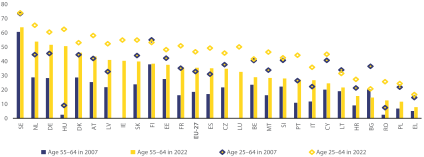
Note:
Education and training participation rates reflect the share of individuals who report having participated in either formal education (usually leading to a recognised qualification) or non-formal training (such as workshops or short courses) over the past 12 months.
Source:
Eurostat, Adult Education Survey.
Graph 3.17: Average instruction hours of participants in education and training – working-age and older people in 2007 and 2022

Note:
Average instruction hours represent the mean number of hours of education and training completed over the past 12 months per participant.
Source:
Eurostat, Adult Education Survey.
Graph 3.18: Amount of education and training completed by individuals aged 55 to 64 and transition rates from unemployment to employment
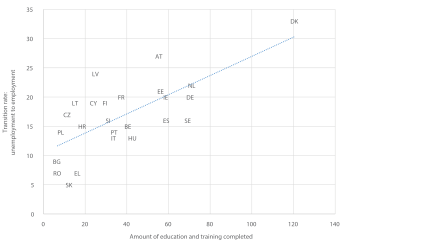
Note:
The amount of education and training is the product of the participation rate index and an average instruction hours index for the group aged 55 to 64. Baseline: ages 25 to 64 in the EU in 2022 = 100. The transition rate is the annual average of quarterly shares of a transition from unemployment to employment for the group aged 55 to 74 in 2023, expressed as a percentage of the unemployed in the initial quarter. The use of non-identical age groups is due to data availability.
Sources:
Eurostat, Adult Education Survey and Labour Force Survey.
Graph 3.19: Digital skills of older people in 2023: share of older people (aged 55 to 74) with at least basic digital skills, by education level

Note:
The digital skills measure is based on a composite indicator that covers selected activities related to internet or software use in five specific areas: information and data literacy, communication and collaboration, digital content creation, safety, and problem solving. Low formal education refers to levels of International Standard Classification of Education (ISCED) 0 (less than primary education), ISCED 1 (primary education) and ISCED 2 (lower secondary education). Medium formal education refers to ISCED 3 (upper secondary education) and ISCED 4 (post-secondary non-tertiary education). High formal education refers to ISCED 5 (short-cycle tertiary education), ISCED 6 (bachelor’s or equivalent level), ISCED 7 (master’s or equivalent level) and ISCED 8 (doctoral or equivalent level).
Source:
Eurostat, Digital Skills Indicator.
Graph 3.20: Skills mismatches and changes in the workplace in 2023

Note:
(a) Measures of vertical skills mismatch are based on a regrouping of ISCED categories into three levels (low, medium and high). (b) Respondents were asked to answer the following question: ‘In the last 12 months / since you started your main job, did any of the following changes take place in your workplace?’.
Source:
Cedefop, European Skills and Jobs Survey.
Table 3.4: Statutory retirement ages across Member States in 2022 by gender

Note:
Note: Countries where the statutory retirement age is legislated to increase in line with life expectancy are marked with an “*”. Reported retirement ages are calculated based on life expectancy in the Eurostat population projections.
Source:
European Commission: Directorate-General for Economic and Financial Affairs (2024).