

General labour market conditions in the EU and its Member States
Main drivers of recent labour market developments
The strong labour market performance is due to favourable developments in labour demand and supply, as well as improved matching.
After the pandemic recession, labour demand (the sum of employment and vacancies), grew more rapidly than supply, which continued to expand despite adverse demographic trends. However, with the economic slowdown of 2023, labour demand began to ease, dropping from a growth rate of 4 % in the first quarter of 2022 to 0.7 % in the fourth quarter of 2023, while supply continued to increase at a steady rate. Despite easing labour market tightness, labour shortages remained relatively high. In this context, the stable low unemployment probably reflects improved job matching. The next subsection will explore the factors behind the resilience of labour supply and demand.
Labour supply has been sustained mainly by third country nationals
A notable post-pandemic feature is the resilience of the EU activity rate compared to the United States.
The activity rate remained strong and continued to improve through 2023 (Graph 1.4). By the first quarter of 2024, the EU activity rate was 0.3 pps above its pre-pandemic trend (0.4 pps for the euro area), while the US activity rate remained well below. Since the activity rate can rise with a declining working-age population, it is more informative to look at the labour force as the measure of activation.
Graph 1.4: Activity rate (15-74) in the EU and the United States
Note:
The activity rate is the share of the population aged 15-74 who are either employed or actively searching for a job
Source:
Eurostat, Labour Force Survey (LFS)(lfsi_emp_q) and US BLS.
The rise in the labour force has underpinned the growth in employment.
For the third consecutive year, the expansion of the labour force has been the primary driver of employment growth (Graph 1.6 a). Post-pandemic, the labour force grew nearly 1 % annually between 2022 and 2023, up from 0.3 % from 2015 to 2019 . Since 2020, employment has risen by nearly 9 million people due to a 6.9 million increase in the labour force and a 2 million decrease in unemployment. The rising participation rate also suggests continued job searching despite the slowdown . The labour force increase was broad-based across countries, but was notably strong in the Baltic countries, Ireland, Greece, Spain, France, Italy, and Romania (see map in Graph 1.5). By early 2024, the labour force had only declined in Croatia, Latvia, and Slovakia .
Graph 1.5: Growth of the labour force from 2019 to the first quarter of 2024 relative to 2015-2019 average (pps changes)

Note:
The chart shows the quantile of the distribution of the growth rates relative to the 2015-2019 trend.
Source:
Own calculations based on Labour Force Survey (LFS).
Until 2019, the rise in participation among older workers was the only contributor to labour force growth but, since then, young people have also contributed.
Between 2010 and 2019, older workers (aged 55-64) added 11.2 million to the labour force, while the number of young and prime-age workers declined by 2.3 and 3.5 million respectively. During this period, the overall labour force grew primarily due to the increased participation of older workers (Graph 1.6 b). From 2019 to 2023, older workers remained the main driver of labour force growth – adding about 1.2 million people yearly (Graph 1.6 b). This growth more than offset the decline in the labour force of prime age workers, which decreased by 280 000 people per year during this period, a slight improvement compared to the annual decline of 390 000 per year recorded between 2010 and 2019. As for young workers, a turning point occurred as from 2021, as their labour force began to grow likely driven by increased migration flows, reaching 19.3 million in 2023 compared to 17.6 million in 2020. As a result of these developments, by the last quarter of 2023, the participation rate for the 20-64 age group reached its highest level since the first quarter of 2000, at 80.2 %.
Graph 1.6: Employment, unemployment, and the labour force (yearly changes in thousands)

Source:
Eurostat, Labour Force Survey (LFS) (lfsi_emp_a).
The surge of non-EU citizens in the labour force has been an important driver of the overall increase in the EU labour force.
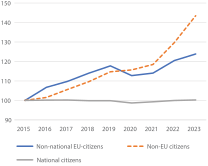
As in many other advanced economies, migration flows in the EU reached all-time high levels in 2022 (latest available year) . On average at the national level, total inflows of working-age individuals were primarily driven by non-EU nationals, at 49 %, followed by EU mobile workers at 27 % and returning nationals at 23 % . Consequently, in 2023 non-EU nationals accounted for 64.1 % of the total increase in the EU labour force, while foreign EU residents and nationals contributed by 10.7 % and 24 % respectively . The increase in the labour force of non-EU citizens between 2019 and 2023 was mostly driven by prime age workers . Before the pandemic, the labour force of non-EU citizens was growing faster than that of national citizens, which was largely stagnant. This trend accelerated after the pandemic, driven primarily by non-EU citizens (Graph 1.7), with no significant differences between the EU and the euro area. This increase partly reflects the resurgence of migration flows after the pandemic, particularly the large influx of Ukrainian refugees, who were mostly women .
Graph 1.7: Labour force by country of citizenship (2015=100), yearly data
Note:
Active population (15-64) (lfsa_agan). The LFS provides the following aggregates: 1) EU27 except reporting country; 2) non-EU27 countries nor reporting country; 3) reporting country; 4) stateless. Following Eurostat explanatory notes, we call 1) and 2) respectively non-national EU-citizens and non-EU citizens.
Source:
Eurostat, Labour Force Survey (LFS).
The increase in participation of highly educated people was higher among the foreign-born population than in the domestic population.
Low- and medium-skilled non-national EU citizens (individuals born in one Member State and employed or looking for a job in another) generally have higher participation rates than national citizens. In contrast, medium- and, especially, high-skilled non-EU citizens have lower activity rates. This highlights the challenges of integrating people with migrant backgrounds into the labour market . For EU citizens, higher activity rates reflect the significant number of mobile workers in countries with strong labour markets, such as Germany, and high demand in seasonal activities such as tourism and construction . Aggregate figures mask differences by level of education (Table 1.2). The activity rates are similar for highly educated individuals, regardless of origin, but lower for national individuals with secondary education compared with those born in another EU country. Conversely, the activity rate for low-skilled national citizens is almost 10 pps lower than for the equivalent group born abroad.
Table 1.2: Activity rates by level of education and citizenship

Source:
Eurostat, Labour Force Survey (LFS) lfsa_argaedn).
The increase in the labour supply of foreign workers was matched by a significant rise in their employment rates.
In 2023, there were 7.7 million non-national EU citizens and 12.9 million non-EU citizens in the labour force, accounting respectively for 3.6 % and 6 % of the total. In 2010, these figures were 2.5 % and 4.4 % of the total labour force. The employment rate for non-national EU workers increased sharply from an average of 71 % in 2009-2019 to 77.6 % by the end of 2023, and the rate for non-EU citizens rose from 57 % to 63 %. All Member States, with the exception of Greece, and Hungary, saw the employment rate of non-EU nationals exceed its pre-pandemic average in the last quarter of 2023 (Graph 1.8). The gap in employment rate between foreign-born and native-born individuals narrowed significantly in 16 Member States . Most of the Ukrainian refugees had relatively better labour market outcomes than most other refugee groups (Box 1.1) .
Graph 1.8: Employment rate for non-EU citizens

Source:
Eurostat, Labour Force Survey (LFS) (lfsq_ergan).
Employment of foreign-born individuals is expanding in occupations where employment of native-born workers is also growing, but it is doing so at a faster pace.
According to the International Standard Classification of Occupations , employment growth among foreign-born individuals is higher in occupations such as professionals, service and sales workers, and technicians and associate professionals. These categories include 20 of the 42 occupations with persistent labour shortages listed in the draft EU talent pool regulation . Employment growth is also strong in these occupations among the native population, indicating significant complementarities between foreign- and native-born employment in occupations with persistent labour shortages (Graph 1.9) . However, in other high-shortage occupations - such as plant and machine operators, crafts and related trades, and elementary occupations - foreign-born employment has risen while native-born employment has declined. The share of employment in shortage occupations is high in craft and related trades, elementary occupations and plant and machine operators; in these sectors, the difference in employment growth between foreign-born and native-born is most pronounced.
This outcome may derive from multiple mechanisms at play.
Foreign-born workers may fill positions where demand exceeds the supply of native workers. This could occur if an influx of foreign labour lowers wages in certain occupations, making them less attractive to native workers . Alternatively, low and stagnant wages in some sectors may prompt nationals to seek opportunities elsewhere, regardless of foreign labour supply changes. Moreover, in many EU countries, wages are governed by multi-year collective agreements that limit short-term adjustment of wages to labour market changes. Finally, the differing growth patterns between nationals and non-nationals in elementary and craft-related occupations reflect broader trends, such as rising education levels among nationals and the concentration of non-nationals in lower-skilled jobs, even when they are relatively qualified .
Graph 1.9: Employment growth (2021-2023) for native born and foreign population: 2021-2023 and employment share in shortages occupations (2023)

Note:
The percentages refer to the share of employment in 2023 in occupations with persistent labour shortages (at 4-digit) as identified in the draft EU talent pool regulation (as a percentage of total employment in the respective 1-digit occupational category).
Source:
Eurostat, Labour Force Survey (LFS) (lfsa_egaisedm).
Box 1.1: Labour market outcomes of people who have fled the war in Ukraine to the EU
As of June 2024, the EU had over 4.3 million temporary protection beneficiaries, corresponding to about 1 % of total EU population. Around 2.5 million are aged 18-64, mostly women, often with children, or people over 60 since men aged between 18 and 60 are generally unable to leave the country. Women make up 70 % of Ukrainian beneficiaries in this aged group . Germany, Poland and Czechia, host 61.4 % of the total, with 31.1 %, 22 % and 8.3 % (based on June data), respectively.
Ukrainian refugees generally have better integration prospects than previous groups. This is due to their relatively higher levels of education, strong social networks, and immediate access to employment. In some host countries, over 60 % have a tertiary education. However, many work in hospitality, manufacturing, retail, construction and administrative roles often below their qualifications.
Employment rates among working-age temporary protection beneficiaries vary widely across the EU . According to the latest EMN-OECD report, in September 2023 over 40 % of the beneficiaries were employed in countries like Lithuania (66 %), Estonia (54 %), Czech Republic (48 %), the Netherlands (55 %) , and Luxembourg (41 %). In Germany, the rate was 25 % while in Poland the employment rate exceeded 60% earlier in the year. Belgium and Croatia had employment rates below 20 %.
Barriers to the integration of Ukrainians in the EU labour force remain. A 2023 survey by the International Organization for Migration found that 48 % of those not employed and not looking for a job are out of the labour market due to caregiving duties. Among the jobseekers, language barriers are the most common issue, followed by a lack of local jobs, difficulties in reconciling family duties and working arrangements, health conditions, qualification mismatches and discrimination.
The inflow of displaced Ukrainians has contributed to increase the EU labour force. Currently, the Labour Force Survey lacks reliable data as it focuses on private households, which do not yet fully capture Ukrainian refugees. Estimates, based on pre-displacement activity, suggest 70 % of working-age Ukrainians were active in the labour market before leaving. After displacement, labour market participation dropped slightly to 66 %. Applying these figures to temporary protection beneficiaries suggests that about 1.6 million Ukrainians were in the EU labour force in the first quarter of 2024. An earlier OECD estimate indicated that about 1.2 million Ukrainians contributed to the EU labour force by the end of 2022.
- Related note aSource: Eurostat
- Related note bTo facilitate the entry and stay of Ukrainians fleeing the war, the Temporary Protection Directive has been enacted for the first time. Beneficiaries receive residence permit for the duration of the protection and the right to work and access vocational training.
- Related note cPeople from Ukraine represented 98 % of those benefiting from temporary protection by the end of December 2023.
- Related note dIn the Netherlands data refer to beneficiaries of Temporary Protection aged between 15 and 65 years old.
- Related note eGermany collects data on all Ukrainian nationals, not only on beneficiaries of Temporary Protection.
Labour demand has loosened but shortages remain high
Labour demand started to decline recently, but without a notable decrease in employment growth.
Between the second quarter of 2022 and the fourth quarter of 2023, employers responded to the economic slowdown by closing some unfilled vacancies or delaying new job openings. Consequently, the total number of vacancies, representing unmet labour demand, decreased by 16 %, while employment grew by 1.5 % (Graph 1.10). The percentage of new hires also dropped from 4.6 % of total employment in the second quarter of 2022 to 4 % in the first quarter of 2024 (and for the euro area from 5 % to 4.4 %). This indicates that firms have effectively lowered their recruitment intensity. Overall, employers seem to have maintained their existing employment relationships while adjusting to the slowdown by closing or delaying new vacancies or postponing hiring. However, given the relatively low number of unemployed people, the slight drop in the chances of finding a job had little impact on the overall unemployment rate .
Graph 1.10: The components of labour demand

Note:
Job vacancies cover the whole business economy aggregate (NACE Rev.2 sectors B-S). For Denmark and Estonia data refer to the whole economy (B-N). For Italy data are computed from the job vacancy rate and the occupied post available on ISTAT. New hires represent those individuals who started their employment in the last 3 months. Q1: first quarter.
Source:
Eurostat, Labour Force Survey (lfsi_emp_q) and job vacancy statistics; ISTAT.
Labour shortages have eased but the labour market remains tight.
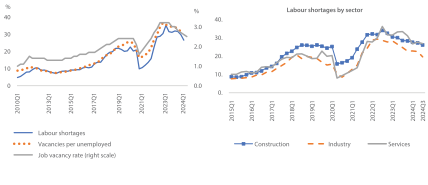
In the first half of 2024, labour shortages declined across all sectors, particularly in services where about 27 % of firms reported such shortages, down from 32.3 % a year earlier. In construction and industry, these percentages were 27 % and 23 % compared with 30.3 % and 27 % of the first half of 2023. However, these figures are still above the pre-pandemic averages (Graph 1.11 right panel), indicating that the labour market remains overall tight. This is further confirmed by other indicators, such as the job vacancy rate or the vacancies per unemployed person (Graph 1.11 left panel). Generally, countries that had high labour shortages before the pandemic continue to experience high shortages. In the fourth quarter of 2023, the job vacancy rate was high in Belgium, Czechia, Germany, the Netherlands and Austria, and low in Bulgaria, Estonia, Ireland, Spain, Croatia, Poland, Romania and Slovakia (Graph 1.20 in the Annex). Compared with the post-pandemic peak, the job vacancy rate fell in Czechia, Denmark, Luxembourg and Finland. Conversely, it remained at the peak in Greece, Italy, Cyprus, Lithuania and Malta. There are no differences between the evolution of labour shortages in the EU and the euro area aggregate. In 2021 labour shortages in construction grew more rapidly in the euro area than in the EU, but later declined at a similar rate, ultimately leaving the euro area with overall larger labour shortages than in 2019.
Graph 1.11: Measures of labour market tightness (%)
Note:
Labour shortages are represented by the average across sectors of the proportion of firms reporting that labour is a factor limiting their production. The vacancy rate is calculated as the number of job vacancies divided by the sum of occupied posts and job vacancies. Q1: first quarter; Q2: second quarter; Q3: third quarter.
Source:
Business and consumer’s surveys. Eurostat Labour Force Survey (LFS), Job Vacancy Statistics.
Employment growth was stronger in sectors with relatively high labour shortages (Graph 1.12).
This suggests that employment growth in sectors with labour shortages partly results from labour supply expansion and job reallocation towards high-shortage sectors. The persistence of shortages in sectors marked by high employment growth indicates an untapped potential for further employment gains, including in sectors or occupations complementary to those facing labour shortages. This emphasises the need to boost labour market participation to sustain labour supply and offset population ageing.
Graph 1.12: Employment growth for sectors with high and low labour shortages: 2022Q2-2024Q1

Note:
NACE sectors at 2-digits level. Criteria used to define high and low labour shortages: the sectoral distribution of shortages in the second quarter of 2024; and the criteria used in European Commission (2023a) (ESDE 2023) to identify persistent labour shortages in specific sectors or occupations.
Source:
Own Calculations on Labour Force Survey (LFS) and Business and Consumer Survey and European Commission (2023a).
Has the functioning of the labour market improved?
Some of the recent trends point to a structural improvement in labour market functioning, resulting in a lower structural unemployment rate.
Since the third quarter of 2022, the vacancy rate has dropped without a corresponding change in unemployment (Graph 1.13 left panel). This potential inward shift of the Beveridge curve suggests a structural change that could be attributed to a reduction in the rate at which people lose their jobs and/or to improved matching efficiency .
The decline in the transition rate from employment to unemployment that had started in 2013 continued in the post-pandemic period.
This suggests that employment relationships have become more stable, contributing to a lower unemployment rate. Graph 1.13 (right panel) illustrates this trend showing a decrease in the inflow rate from employment into unemployment after the 2013 recession peak, while Box 1.3 in the Annex provides an econometric analysis of the determinants of the job separation rate . As discussed in Chapter 3, the ageing of the workforce and the extension of the working life as a result of pension reforms have probably contributed to longer job tenures among older workers. Moreover, higher levels of education among workers reduce job loss probability, as educated individuals face lower unemployment risks than their less educated peers . Finally, amidst widespread labour shortages, firms face greater replacement needs, potentially reducing lay-offs and further stabilising employment .
Graph 1.13: Beveridge curve (left panel), job finding and separation rates and matching efficiency (right panel)

Note:
The vacancy rate is proxied by the number of firms that declare labour a factor limiting their production, as a percentage of the labour force. The job finding rate is computed from the structure of unemployment by duration (Elsby et al. 2015). The matching efficiency is the residual of a linear regression of the job finding rate (in logs) on labour market tightness (in logs). Q1: first quarter; Q2: second quarter; Q3: third quarter; Q4: fourth quarter.
Source:
Eurostat, Labour Force Survey (LFS).
Recent shifts in the Beveridge curve appear related to improvements in job-matching efficiency.
Increased outflows from unemployment, driven by better matching of unemployed individuals with vacant jobs is another factor contributing to an inward shift of the Beveridge curve . Graph 1.13 (right panel) shows improved matching efficiency after the pandemic recession, coinciding with a surge in the probability of finding a job to unprecedented levels. One explanation is that the policy response during the pandemic prevented the scarring effects of unemployment, maintaining the probability of finding a job, as evidenced by the long-term unemployment rate being at its lowest level (2.1 % in 2023). Another factor is reduced discrepancy between job seekers’ skills and employers’ needs . This reduction enhances the job finding probability irrespective of the labour demand. The remainders of this section will detail a mismatch measure using sectoral-level data on vacancies and unemployment.
The rise in matching efficiency has been accompanied by a decline in sectoral mismatches between vacancies and unemployment .
In 2010, nearly half of unemployment originated from construction and manufacturing, while vacancies in these sectors accounted for less than one quarter of the total (Graph 1.14 upper panel) . By 2023, this imbalance had decreased. Although there were relatively more unemployed individuals than vacancies in wholesale and hospitality than in 2010, this was largely due to voluntary quits driven by job quality concerns , rather than a deterioration in matching. Meanwhile, sectors linked to the twin transition, such as professional, scientific and technical activities and ICT, showed a surplus of vacancies . This surplus primarily reflects the strong demand for new tasks driven by structural shifts related to the digital and the green transitions. The imbalance stems from a shortage of workers relative to the job openings, many requiring specialised skills, and is further exacerbated by population ageing. Unlike mismatches caused by economic shocks, where sectoral contractions lead to excess labour supply of specific skills and rising long-term unemployment (e.g. the burst of demand after a boom in the construction sector) this reflects a broader, long-term shift in labour market dynamics . The reduction in sectoral mismatches coincides with greater labour reallocation across sectors, in stark contrast to the 2008 crisis (Graph 1.14 lower panel). This suggests that firms and workers have adjusted job vacancies and job searches to the structural changes accelerated by the pandemic, notably digitalisation .
Graph 1.14: Unemployment by sector of last job and vacancies by sector, mismatch and reallocation index

Note:
The mismatch index measures the percentage of hires lost due to imbalances between vacancies and unemployment by sector; See Box 1.5 in the Annex for data sources, methodology and limitations.
Source:
Eurostat job vacancy statistics by sector and extraction of unemployment by sector of origin from Labour Force Survey (LFS) microdata.