
Comparative report
Annex
|
* |
Target proposed in the Union of Skills Communication |
|
◊ |
EU-level target originated in the 2021 Council Resolution on a strategic framework for European cooperation in education and training towards the European Education Area (EEA) and reaffirmed in the Union of Skills Communication |
|
† |
Target suggested in the interim evaluation of the 2021-2030 European Education Area Strategic Framework |
|
‡ |
Existing EEA target that could be reaffirmed in EEA 2026-2030 |
|
● |
Target originated in the 2021 Council Conclusions on a new European agenda for adult learning 2021-2030 |
Sectoral targets
Early childhood education and care
By 2030, at least 96% of children between 3 years old and the starting age for compulsory primary education should participate in early childhood education and care. The latest figure is 94.6%. ‡
94.6% (2023)

Early school leaving
By 2030, the share of early leavers from education and training should be less than 7%, stepping up the ambition from the original of 9% target, set in the 2021 EEA strategic framework Resolution. The latest figure is 9.4%. ‡
9.4% (2024)

Tertiary educational attainment
By 2030, the share of 25-34-year-olds with tertiary educational attainment should be at least 50%, stepping up the ambition from the original target of 45%, set in the 2021 EEA strategic framework Resolution. The latest figure is 44.2%.‡
44.1% (2024)

Adult learning
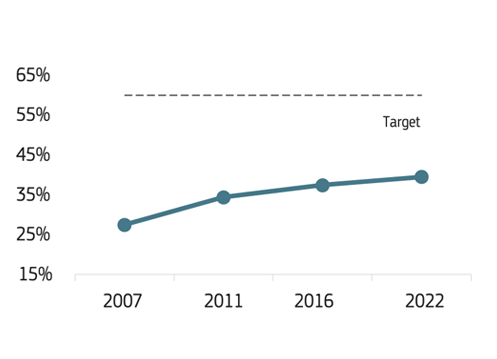
By 2030, at least 60% of adults should have participated in learning during the last 12 months. The latest figure is 39.5%. ●
39.5% (2022)
Thematic targets
Basic skills
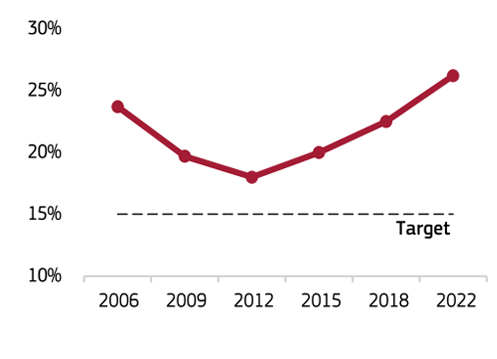
By 2030, the share of underachievement in reading, mathematics and science should be less than 15%. The latest figures are 26.2%, 29.5% and 24.2% respectively. ◊
Underachievement in reading 26.2% (2022)
Underachievement in mathematics 29.5% (2022)
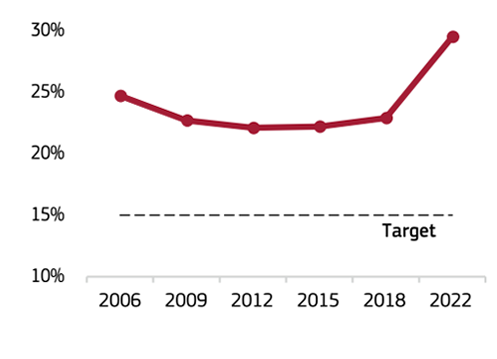
Underachievement in science 24.2% (2022)

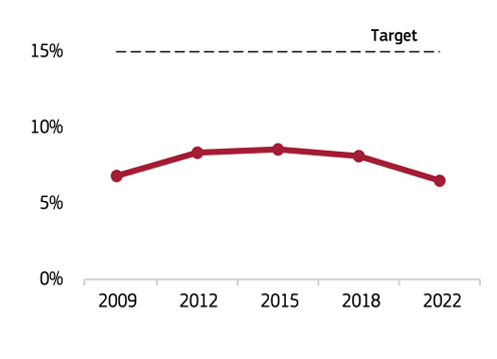
The share of top performance in reading, mathematics and science should be at least 15% by 2030. The latest figures are 6.5%, 7.9% and 6.9% respectively. *
Top performance in reading 6.5% (2022)
Top performance in mathematics 7.9% (2022)
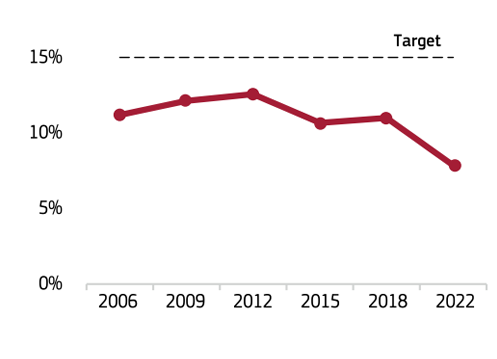
Top performance in science 6.9% (2022)

By 2030, the share of underachievement in computer and information literacy should be less than 15%. The latest figure is 42.5% (no comparable trend is available). ◊
42.5% (2023)
By 2030, the share of adequate performance in civic knowledge should be at least 85%. The latest figure is 63.1% (no comparable trend is available). †
63.2% (2022)
STEM
By 2030, the share of students enrolled in STEM fields at initial medium-level VET should be at least 45%, with at -0 1 out of every 4 students female. The latest STEM enrolment rate is 36.3%, with 15.4% women (out of the total). *
Total: 36.3% (2023)
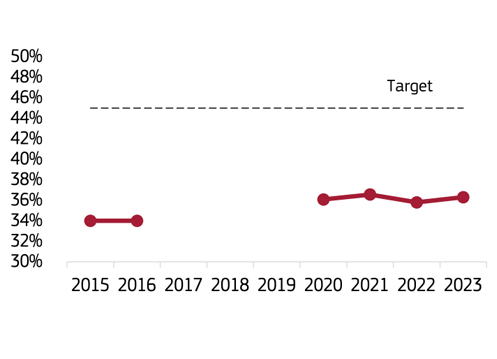
Women (out of total): 15.4% (2023)

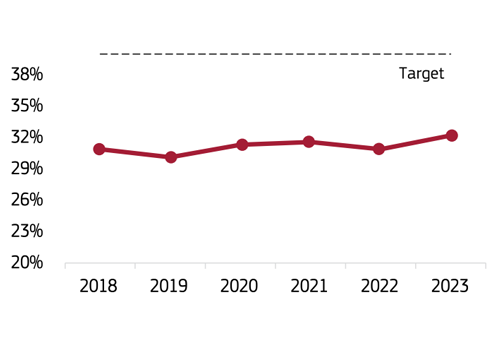
By 2030, the share of students enrolled in STEM fields at tertiary level should be at least 32%, with at least 2 out of every 5 students female. The latest STEM enrolment share is 26.9%, with 32.2% women (out of the total). *
Total: 26.9% (2023)

Women (out of total): 32.2% (2023)
By 2030, the share of students enrolled in ICT PhD programmes should be at least 5%, with at least one out of every three students female. The latest ICT enrolment share is 3.8%, with 24.3% women (out of the total). *
Total: 3.8% (2023)

Women (out of total): 24.3% (2023)

International attractiveness
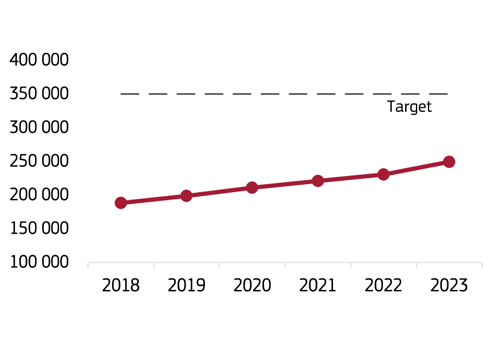
By 2030, the number of inward degree mobile tertiary graduates from outside the EU should be at least 350 000. The latest figure is 249 340. *
249 340 (2023)
Equity
By 2030, the share of learners from disadvantaged socio-economic backgrounds with a good achievement in at least one domain (reading, mathematics or science) should be at least 25%. The latest figure is 16.3%. †
16.3% (2022)

Questions? Suggestions? Get in touch!
Did you find this content interesting?
Subscribe to our newsletter to receive the latest information directly in your email.