 Special Report

Resolution planning in the Single Resolution Mechanism
About the report: In 2014, the EU established the Single Resolution Mechanism (SRM) to ensure orderly resolution of failing banks with minimal burden to taxpayers, avoiding costly bail-outs. We assessed the appropriateness of the policy framework and organisational set-up of resolution planning, as well as the quality and timing of the resolution plans adopted for banks. We found that the SRM has made progress, but some key elements are missing and further steps are needed. In particular, the set of policies did not yet address all relevant areas or revealed weaknesses. Certain shortcomings such as funding in resolution or harmonisation of national insolvency proceedings for banks have to be resolved by the legislators. We recommend that the SRB improve its policies for resolution planning, ensure timely adoption and full compliance of resolution plans with the legal requirements and assign sufficient staff to oversee resolution planning of national resolution authorities for less significant banks. We invite the legislators to set up more objective and quantified thresholds for triggering early intervention measures.
ECA special report pursuant to Article 287(4), second subparagraph, TFEU.
 |
Executive summary
IIn 2014, the EU adopted a legal framework for dealing with failing banks, the Single Resolution Mechanism (SRM), the second pillar of the European Banking Union. It applies to banks in euro area Member States. It brings together the Single Resolution Board (SRB) - the resolution authority responsible for significant banks, and cross-border banks irrespective of their significance - and the national resolution authorities (NRAs), which are responsible for less significant banks in their respective jurisdictions.
IIThe purpose of the mechanism is to protect financial stability and ensure the orderly resolution of failing banks with minimal cost to taxpayers and the real economy. To that end, the framework provides tools for resolving banks that are failing or likely to fail, once the resolution authority has decided that the bank cannot go through normal insolvency proceedings under national law. In order to prepare, the authorities are required to draft resolution plans for every bank and, as a general rule, update them annually.
IIIIn 2017, we published our first audit report assessing whether the SRB was equipped to carry out the resolution of significant banks effectively. In order to inform policymakers and stakeholders of the current state of preparedness of the SRM, we carried out this second audit to address the SRB’s oversight of resolution plans for less significant banks and follow-up of our previous audit results.
IVTo that end, we examined whether the policy framework and organisational set-up were appropriate, and progress had been made in terms of the quality and timing of the resolution plans adopted. The audit work took place from April 2019 to January 2020 and we looked at a sample of resolution plans adopted between 2019 and 2020.
VWe note that there are certain shortcomings that only the legislators can resolve, such as (i) funding in resolution and (ii) the fact that national insolvency proceedings are not harmonised. In addition, we note that the rules on burden sharing vary according to whether a bank is resolved or receives State aid in the context of insolvency proceedings.
VIOur overall conclusion is that the SRM has made progress over the last years, but some key elements are missing and further steps are needed in resolution planning for banks. In particular, we found that the policies did not yet address all relevant areas or revealed weaknesses. The policies (with some exceptions) were not addressed to the NRAs for banks under their remit until August 2020, but they could serve as a point of reference. In August 2020, a first set of guidelines applicable to NRAs for banks under their remit was adopted.
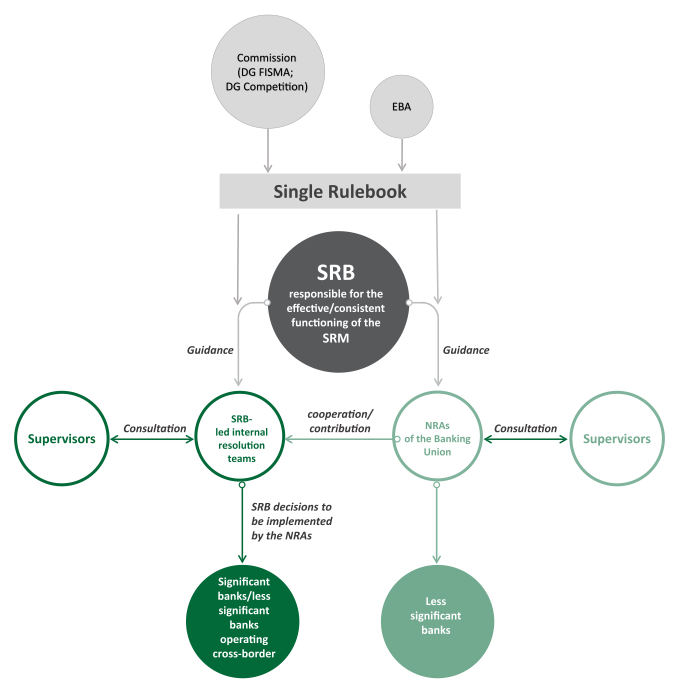
VIIWith specific regard to impediments to resolvability, the SRB has not yet determined substantive impediments. The SRB opted for a step-by-step approach, whereby it identifies potential impediments before determining substantive impediments. In so doing, banks have time to resolve pending issues. As a result, the administrative procedure for ensuring the removal of substantive impediments that is provided for in the legal framework is not initiated. As long as there is no conclusion as to the nature of impediments, there will be no conclusion as to a bank’s resolvability.
VIIIWe found that the quality of the resolution plans had improved in that the percentage of Single Rulebook requirements that had been met had increased to 60 % in the case of a sample of 2018 plans, in contrast with just 14 % in a sample of 2016 plans. Nevertheless, the SRB was late adopting the 2018 resolution plans and updated only a limited number of plans in 2019. The NRAs also made progress in adopting their resolution plans, but some did not meet their targets and/or postponed their plans for more complex banks.
IXThe SRB interacted well with the NRAs. The same is true of the interaction between the Board and the European Central Bank (ECB) in its role as bank supervisor. However, effective resolution depends on the supervisor deciding well in advance on “early intervention measures” to be taken by banks, and on whether a bank is failing or likely to fail. The current legal base does not stipulate objective and quantified criteria for triggering such decisions.
XThe staffing situation at the SRB has improved, but the oversight of the resolution plans for less significant banks submitted by NRAs is still hampered by lack of staff. The staffing situation at the level of the NRAs varies significantly. We also found that the share of staff from the SRB assigned to significant banks and to banks operating cross-border had increased. At the same time, the NRAs slightly reduced their staff contribution.
XIIn order to enhance the preparedness of the SRM, we would recommend that the SRB:
- improve its set of policies that guide the SRM’s resolution planning;
- ensure timely adoption and full compliance of resolution plans with legal requirements;
- improve the organisational set-up of the SRM;
- together with the Commission, invite the legislators to set up objective and quantified criteria for timely supervisory action.
Introduction
Single Resolution Mechanism - background
01Prior to the financial crisis that erupted over 2007-2008, failing banks were wound up under national insolvency law. Where banks were considered too big to fail, national authorities reverted to using taxpayers’ money to prevent their collapse. Failure of a cross-border bank could also pose additional risks. As the crisis revealed that authorities lacked procedures and tools to wind up banks in an orderly manner, the EU set up the SRM in 2014, the second pillar of the European Banking Union.
02The SRM brings together the SRB, Council, Commission, and the NRAs of the participating Member States. It is supported by the Single Resolution Fund (SRF), which is financed by banks in the euro area.
03The SRM provides a framework for the orderly winding-up of banks1. Its purpose is to avoid significant adverse effects on financial stability, protect covered depositors, and safeguard public funds by minimising reliance on extraordinary public financial support. Resolution is a last resort intended to allow a bank’s critical functions to continue. Critical functions are bank activities, services or operations whose discontinuance is likely to lead to the disruption of financial stability, or services that are essential to the real economy. Indeed, if a bank has no critical functions and its failure would not result in a risk to financial stability, the bank would be wound up under national insolvency law.
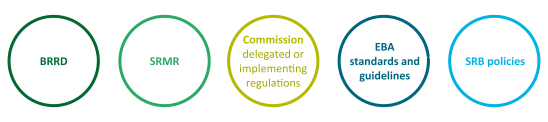
04Over the last years, the EU has been developing a set of harmonised rules for the supervision and resolution of banks. These are known conceptually as the ‘Single Rulebook’. With regard to resolution, the Single Rulebook mainly comprises the Bank Recovery and Resolution Directive (BRRD2), the Single Resolution Mechanism Regulation (SRMR3), Commission delegated or implementing regulations and European Banking Authority (EBA) standards and guidelines. Moreover, in order to prepare for resolution, the resolution authorities develop manuals and guidance notes laying down the policies to be applied (see Figure 1).
Figure 1
Rules and policies
Source: ECA.
Cooperation under the Single Resolution Mechanism
The role of the SRB and the NRAs
05Since January 2015, the SRB has been responsible for the resolution, where necessary, of all significant banks in the euro area, and less significant banks operating across borders4. As of end-2019, the SRB has covered 128 banks accounting for approximately 85 % of total banking assets in the euro area.
06Responsibility for all other banks, i.e. less significant banks (2 249 according to the SRB’s 2020 work programme, see Figure 2), lies with the NRAs. However, the SRB is responsible for the effective and consistent functioning of the SRM and has therefore been tasked with overseeing euro area NRAs’ resolution planning. Moreover, where necessary to ensure the consistent application of resolution standards, the SRB can decide, or an NRA may ask it, to exercise all its powers directly over banks originally within the NRA’s remit.
Figure 2
Less significant banks by Member State in the euro area

Source: ECA, based on the SRB’s 2020 work programme.
A bank must meet at least one of the criteria in Table 1 to qualify as significant, otherwise, it is classified as less significant.
Table 1
Significance criteria for banks
| Criterion | Explanation |
| Size | The total value of the bank's assets exceeds €30 billion |
| Economic importance | To the country concerned or the EU economy as a whole |
| Cross-border activities | The total value of the bank's assets exceeds €5 billion and the ratio of its cross-border assets/liabilities in more than one other participating Member State to its total assets/liabilities is above 20 % |
| Direct public financial assistance | The bank has requested or received funding from the European Stability Mechanism or the European Financial Stability Facility |
| Other | A supervised bank is considered significant if it is one of the three most significant banks established in a particular country |
Source: ECB.
In order to be prepared for the possible failure of a bank, the resolution authority:
- draws up resolution plans for all banks under its remit;
- sets the minimum level of liabilities and own funds with loss-absorbing capacity in the event of resolution (a safety buffer known as the minimum requirement for own funds and eligible liabilities (MREL)).
The tasks related to the actual implementation of a resolution (crisis management) are not described here, as they do not fall within the scope of this audit.
09Resolution plans are to be reviewed and updated at least annually. The time from the drafting of a plan to its adoption is known as the planning cycle. A resolution plan is a comprehensive document that should, among other things, detail the bank’s characteristics, determine its critical functions, identify and address any impediments to its resolvability, and set the bank’s MREL. It should reach a conclusion on (i) the preferred resolution strategy, i.e. whether the bank should be wound up under national insolvency law, or apply for resolution, and (ii) whether the bank is resolvable (i.e. safe to fail) (see paragraph 03).
10If the resolution authority considers that a bank should be subject to resolution, the plan should describe which of the resolution tools is to be applied (see Figure 3). It should also detail the entities in the bank group (parent company and/or subsidiaries) to which the resolution tools are to be applied, i.e. the so-called "point of entry" (a single or a multiple point of entry).
Figure 3
Resolution tools provided for in the legislative framework

Source: Adapted from the SRB.
The SRB takes its decisions in Executive Sessions and Plenary Sessions. The latter are attended by a representative from each NRA (see Annex I for further details). Resolution plans for banks under the remit of the SRB are submitted to the Executive Session for approval.
Interaction with other EU and national authorities
12The SRB works in close cooperation with the NRAs, the Commission, the EBA and the supervisors responsible for euro area banks (the ECB and national competent authorities) (see Figure 4). For example, resolution plans for significant banks are drafted by internal resolution teams (IRTs) headed by the SRB that are staffed from the SRB and the relevant NRA. The main practical arrangements for the cooperation between the SRB and NRAs are laid down in a cooperation framework agreement adopted in 2016 and amended in 2018.
Figure 4
Roles and responsibilities in resolution planning under the SRM
Source: ECA based on the SRMR.
Cooperation between the resolution authority and bank supervisor involves, among other things, the following:
- the supervisor providing feedback on the draft resolution plan;
- the resolution authority providing feedback on the bank’s recovery plan assessed by the supervisor. The recovery plan includes the measures the bank plans to take where certain indicators are breached.
Cooperation and information exchange between the SRB and ECB are based on a memorandum of understanding, which was revised in May 2018.
14The EBA is responsible for, inter alia:
- developing draft regulatory and implementing technical standards and guidelines, such as the content of a fully-fledged resolution plan;
- developing templates e.g. for MREL reporting and disclosure;
- monitoring resolution authorities, on the basis of periodical reviews, to ensure they have the expertise, resources and operational capacity to carry out their resolution activities.
The EBA also needs to be notified when the SRB or an NRA conclude that a bank is not resolvable.
16The Commission is responsible for periodically reviewing the application of the Single Rulebook. In April 2019, it published the report of its first review, and concluded that it was too early to design and adopt legislative proposals5. Regulatory and implementing technical standards developed by the EBA are adopted by the Commission in the form of delegated/implementing regulations.
Audit scope and approach
Scope and methodology
17In 2017, the ECA audited the SRB for the first time, focusing on its resolution planning for significant banks6. As the SRB was only set up in 2015, and given that our initial audit had found that the SRB still had a long way to go, we decided to carry out a further audit, looking at the resolution planning for less significant banks and following up on the previous audit. We sought to shed light on the current state of play in terms of the SRM’s preparedness for the resolution of banks.
18To examine whether the SRM was well prepared to deal with the resolution of banks, we assessed whether:
- the SRB had an appropriate policy framework to ensure that the resolution plans drawn up for banks under the SRB’s remit were of optimal quality;
- the preparation of the resolution plans for significant and less significant banks was on the right track;
- the organisational set-up of the SRM was appropriate.
For the purposes of the audit, we examined documentation available at the SRB and conducted interviews with SRB staff. We assessed a sample of resolution plans from the 2018 cycle (see paragraph 09). The 2018 cycle was based on banks’ 2017 year-end financial data and ended in 2020, when the last plans were adopted. Our sample consisted of six plans concerning banks that had no resolution college and two plans relating to banks that did. We also reviewed a sample of three assessments made by the SRB covering 16 plans for less significant banks submitted by NRAs, and a sample of two simplified resolution plans also submitted by NRAs.
20We interviewed staff at the Commission (Directorate-General for Financial Stability, Financial Services and Capital Markets Union (DG FISMA)) and the EBA. We also went on information visits to four NRAs (in Germany, Italy, Latvia and Luxembourg) which either were responsible for a large number of banks or already had experience in the resolution of banks. Lastly, we conducted a survey among the 19 NRAs of the European Banking Union.
21The audit field work was performed between April 2019 and January 2020 and thus completed prior to the outbreak of COVID-19. Therefore, unless otherwise stated, this report does not take account of any policy developments or changes that occurred in response to the pandemic.
Access to audit evidence and confidentiality issues
22The audit rights and mandate for this performance audit emanate from the general provisions of Article 287 TFEU7, which grants the ECA full access to all documentation that is necessary for the audit task. However, referring to confidentiality reasons, the SRB staff redacted documents by blacklining all information and data that would allow us to identify the bank to which the resolution plan in the sample related. We were therefore unable to reconcile MREL calculations (related to ECB data, see paragraph 23), assess the criticality of bank functions or examine the consistency of the SRB’s assessments of the criticality of bank functions across the resolution plans. Nevertheless, compared to the previous audit, access to information improved, as full resolution plans were made available instead of just selected chapters.
23In addition, we did not obtain access to the following documents that originate with the ECB but are also held on file by the SRB: (i) bank recovery plans and (ii) the ECB’s feedback on the SRB’s draft resolution plans. We had asked the SRB for these documents since the very beginning of the audit. By the time the SRB informed us that the ECB had agreed we could access the documents in a physical data room at the SRB’s premises, the COVID-19 pandemic-related confinement measures were in force, which prevented us from reviewing the documents. The SRB, after consulting the ECB, informed us that there was no agreement to make such documents available in a virtual data room owing to data security reasons.
24Otherwise, for the observations and conclusions presented in this report, we had the necessary evidence.
Observations
Policy framework strengthened but deficiencies persist in certain crucial areas
25The SRB has developed detailed policies to ensure the quality and consistency of resolution plans for banks under the SRB’s remit and of the potential resolution actions therein. The policies, which are adopted by the SRB’s Executive Session, are laid down in the resolution planning manual, the SRB’s internal policy document, as well as in horizontal technical notes. The content of these notes, issued between 2016 and 2019, was incorporated at the time of the 2019 update of the manual, albeit in less detail. Separate policy documents relating to the MREL were also drawn up, and in April 2020 the SRB issued a document detailing its “Expectations for Banks” (see Figure 5).
Figure 5
Universe of the SRB’s policies

Source: ECA.
Except in the case of the MREL, in the period covered by our audit, NRAs did not need to adhere to these policies when drafting the plans for less significant banks. Nevertheless, given the relevance to all categories of banks, they could be used as a point of reference for NRAs in developing their own policies.
27The SRB grouped its policies around eight areas reflecting the process of resolution planning (see Figure 6). The policies were developed in close cooperation with the NRAs.
Figure 6
Process of resolution planning
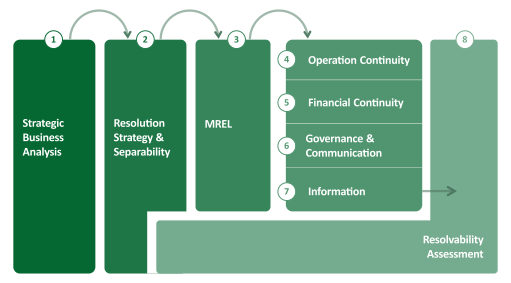
Note: The resolution planning manual devotes a specific chapter to each of these eight areas.
Source: SRB.
In our 2017 special report, we concluded that the SRB did not have a complete system of policies for resolution planning. We recommended (i) making the resolution planning manual binding, (ii) the drawing-up of clear and consistent policies on substantive impediments and the MREL, and (iii) including guidance in respect of all resolution scenarios.
29We therefore assessed whether:
- the SRB had adopted all the relevant policies needed to prepare resolution plans for banks under its remit;
- the policies developed were of satisfactory quality.
A number of important policies applicable to banks under the SRB’s remit are still missing
30The policies laid down in the manual are intended to guide the IRTs in their drafting of the resolution plans for significant banks. This manual was not made binding. We also learned that IRTs are not required to justify any deviation from the manual in the resolution plan and, indeed, we found no such justification in any of the plans in our sample.
31We reviewed the SRB’s policies and found that, as at April 2020, several were missing. Firstly, there was no policy on “financial continuity”. Ensuring funding once a resolution process has begun is crucial, as a bank may have difficulty accessing the liquidity needed to refinance its liabilities as they fall due, for example, owing to uncertainty regarding its viability. To highlight the importance of this issue the failure of Hypo Real Estate serves as an example: German public authorities had to provide liquidity of €145 billion in 2008. The SRB considers that policy development for this area is a multi-year project that it does not expect to see finalised before 2022. Lastly, the SRB’s “Expectations for Banks” (see paragraph 25) provides that banks are to prove their capabilities in the area of financial continuity by 2023.
32An aspect closely linked to financial continuity in resolution is the public sector backstop mechanism. Such a backstop mechanism could be used temporarily by the SRB to ensure funding in the resolution of a bank that was declared failing or likely to fail. In December 2019, the Eurogroup agreed in principle that the European Stability Mechanism would provide a backstop of around €65 - €70 billion. The intended change to the Treaty establishing the European Stability Mechanism8 has not yet been signed. The backstop is meant to replace the Direct Recapitalisation Instrument, for which the European Stability Mechanism had earmarked €60 billion. Experts claim that the provision of the backstop could prove insufficient to meet the funding needs in resolution, in particular as regards liquidity provision, and call for additional measures9.
33Secondly, there was no policy on “governance and communication” for resolution. This concerns, for example, the governance structure needed to ensure data provision, as well as effective oversight and decision-making, during resolution planning and in a crisis. As many decisions need to be taken within an extremely short timeframe, a solid governance and communication structure is critical.
34Thirdly, there was no overarching policy on “information requirements”. This relates, for example, to data that banks are required to provide to the SRB for the execution of resolution tools or to support asset valuations in the event of resolution. “Accurate valuation reports are essential for the overall success of a bank resolution. If valuation reports are inaccurate they can drag out the financial distress or prompt shareholders and creditors to file suit and ask for compensation”10.
35Lastly, the resolution planning manual did not include a policy laying down the entities within a group to which resolution actions would be applied (the so-called point of entry, see paragraph 10). The point of entry determines how many resolution authorities will exercise powers and apply resolution tools. A single point bestows the powers on just one authority, whereas a multiple point of entry involves more than one resolution authority.
36The SRB intends to issue or to update its policies in a number of areas in 2020. As a first step, at the end of April 2020, it published a document laying down its “Expectations for Banks”. However, this document does not yet provide detailed policies on the aspects described above.
Policies provided suffer from some weaknesses
37We assessed the quality of the policies that applied during the period audited and found weaknesses relating to three areas: (i) the public interest assessment, (ii) the determination of substantive impediments to resolvability, and (iii) the application of the MREL requirement and the bail-in tool.
Public interest assessment
38One of the conditions for a resolution to occur, where a bank is declared as failing or likely to fail, is that it is in the public interest, i.e. the resolution objectives would not be met to the same extent if the bank were wound up under national insolvency law. Examples of such resolution objectives are:
- ensuring the continuity of a bank’s critical functions;
- avoiding significant adverse effects on financial stability;
- protecting covered deposits;
- protecting public funds.
For this reason, the resolution authority concerned must carry out a public interest assessment. According to a study carried out at the Commission’s request, several stakeholders stated that this assessment should be made more consistent throughout the EU11. Some stakeholders also do not agree with the SRB’s view that “resolution is for the few, not the many”. Indeed, considering the universe of Eurozone banks, the SRB is of the opinion that, because of the public interest assessment, resolution actions will eventually only apply to a few banks, as most banks will be wound up under national insolvency law12.
40We found with regard to the assessment of whether certain functions within a bank are critical (see paragraph 03) that the SRB policy does not set out clearly defined thresholds (such as percentage of market share). Based on our survey and interviews with the NRAs, as well as our review of SRB documents, we conclude that there are inconsistencies between the IRTs’ assessments of critical functions. As result of these inconsistencies and a lack of clear guidance there is a risk that the SRB does not flag a function as critical although the real economy would be negatively impacted in the event of the bank’s failure.
41With regard to the resolution objective of protecting covered deposits, we found the following: when it is judged that the funding of national deposit guarantee schemes set up at Member State level is inadequate to deal with a crisis, this implies that covered deposits are not well protected. However, this is not sufficient reason for the SRB to consider that resolution of the bank concerned would be in the public interest.
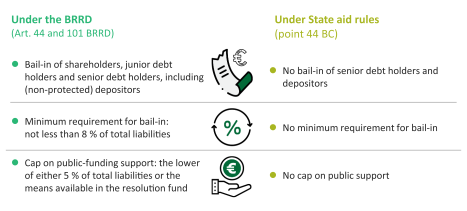
42With regard to the protection of public funds, we note that the rules on burden sharing between (i) shareholders and certain creditors and (ii) the public sector differ, depending on whether resolution or a national insolvency proceeding is applied (see Figure 7):
- in line with the legal base, public support in resolution via the SRF may only take place when a bank’s losses have been covered by a bail-in of at least 8 % of the bank’s total liabilities and own funds. The SRF’s contribution is, in principle, limited to 5 % of the bank’s total liabilities and own funds13. The International Monetary Fund has suggested introducing a financial stability exemption14, i.e. an exemption to be used only in times of euro area-wide or countrywide crisis. According to our survey, the majority of NRAs (60 %) agree with this suggestion;
- if a bank is wound up under national insolvency law, Member States may also consider it necessary to grant public support. In line with the Commission’s Banking Communication (BC)15, burden sharing requirements apply to shareholders and holders of subordinated instruments: they have to contribute in full to the cost of the measures. Contrary to the resolution scenario, senior debt holders are not required to contribute. The International Monetary Fund has recommended establishing stricter burden sharing principles under State aid rules16.
Figure 7
Bail-in requirements in resolution (BRRD) and under State aid (BC)17
Source: ECA, based on the legal base cited.
As the third line of Figure 7 shows, more public support (State aid) may be provided under national insolvency proceedings than in resolution, based on the Commission’s current policy on State aid, as reflected in its BC. This is not without importance when it comes to deciding what is in the public interest. There are two types of assessment, one carried out by the SRB and the other by the Commission:
- in line with the resolution objectives (see paragraph 38), the SRB should assess whether the failure of a bank would have significant adverse effects on financial stability, and should minimise the provision of extraordinary public financial support provided;
- the Commission - before approving State aid that Member States would provide in the course of the liquidation of a bank under national insolvency proceedings - should assess whether this aid would be necessary to remedy a serious disturbance in the economy of a Member State. In a previous audit, we noted that the Commission considered that Member States were best placed to make an initial assessment of whether an uncontrolled market exit of a particular bank would threaten financial stability (or cause other serious disturbance in the Member State). We also found that the Commission did not contest Member States’ assertions that a potential bank failure constituted a threat to financial stability18.
In recent cases of bank failures, the SRB determined that the banks could be wound up under normal insolvency proceedings without causing significant adverse effects on financial stability, and therefore concluded that there was no public interest justifying the use of resolution tools. However, the Commission later approved State aid, as it considered that winding up these banks under normal insolvency proceedings would constitute a serious disturbance in the economy. The IMF concludes that “aligning burden sharing requirements applicable in case of an insolvency proceeding with those applicable in case of resolution after alternative flexibility with a financial stability exemption has been introduced in the framework, would reduce uncertainty and diminish current incentives for Member States to find ways to deal with failing significant institutions under national insolvency proceedings”19. Lastly, the European Parliament, in its 2020 resolution on Banking Union, noted “the need to ensure a level playing field and the consistent application of the public interest test”20 .
45We note that another issue, which has become increasingly relevant in the policy debate, is that of the harmonisation of national insolvency laws regarding banks21. 14 of the 18 NRAs that replied to our survey stated that it would be helpful or very helpful if national bank insolvency regimes were harmonised. For example, “the triggers to initiate national insolvency regimes are in most countries not aligned with the triggers to initiate resolution, and particularly the conditions that justify a determination that a bank is failing or likely to fail”22. However, achieving harmonisation is a difficult process, as it involves areas of law that remain within the remit of the Member States (such as corporate law).
46Lastly, a resolution plan should take into consideration relevant scenarios, including that the failure may be idiosyncratic (bank-specific) or occur at a time of broader financial instability or system-wide events. However, the SRB is of the opinion that the SRMR (Art. 8) does not prescribe that such events be taken into account at the stage where the public interest assessment is carried out in cases where the preferred strategy is that of applying national insolvency law. Therefore, the SRB’s resolution planning manual does not clarify this aspect (see paragraph 28). There are NRAs that interpret the law differently. The Commission admits that there is some leeway for interpretation.
Guidance on the determination of substantive impediments to resolvability
47Pursuant to the Single Rulebook, the SRB is required to assess whether a bank is resolvable or not. A bank is deemed resolvable if it is feasible and credible to either liquidate the bank under normal insolvency law or resolve it by applying resolution tools and exercising resolution powers. For this reason, the resolution authority must assess whether there are obstacles, i.e. impediments to the resolution of a bank. The resolution authority must also notify the EBA in a timely manner when a bank is deemed unresolvable.
48Once the SRB has concluded that an impediment is substantive in nature, an administrative procedure is launched to ensure the bank in question remedies the situation (see Figure 8). The administrative process involves several stakeholders. It can take 12 months or more until the bank submits the final implementation plan intended to remedy the substantive impediment.
Figure 8
Steps in addressing substantive impediments for banks under the SRB’s remit
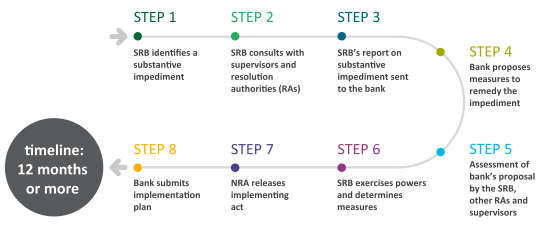
Source: ECA adapted from the SRB.
Following a recommendation made in our special report 23/2017 (see paragraph 28), in September 2018 the SRB issued its policy on identifying and addressing impediments to resolvability. The SRB applied this policy to just a minority of the resolution plans drafted in 2019. The SRB is working on refining its guidance to the IRTs and, in particular, on how to apply its methodology in practice.
50According to the 2018 policy, as a first step, the IRTs should identify potential impediments. The IRTs should then assess, on a scale of low to high, (i) the impact of such potential impediments on the resolution strategy and (ii) the likelihood of their occurrence. While the policy provides a matrix indicating when such assessments should conclude that an impediment is substantive, it is, in fact, only indicative. For example, potential impediments rated high in terms of impact and likelihood of occurrence are not automatically deemed substantive impediments.
51Thus, the nature of the assessments is such that they involve considerable judgement and discretion on the part of IRTs. In addition, the SRB takes a number of elements into account before declaring an impediment substantive. For example, where a bank has a credible plan in place to address potential impediments identified, the impediment does not necessarily have to be considered substantive. In fact, the SRB sees the removal of impediments to resolvability as a step-by-step process between banks and the SRB, which can take some time.
52This policy is confirmed in the SRB’s document entitled “Expectations for Banks” (see paragraph 25): it provides for a phase-in whereby banks are expected to build up their capabilities in all seven dimensions23 addressed in the document by the end of 2023, at the latest, irrespective of the banks’ risk level, size or complexity. Subject to agreement, a bank may also build up its capabilities beyond 2023. By comparison, banks under the Bank of England’s remit follow tighter timelines, as they should all be resolvable by 1 January 202224.
53“Working together” is the principle guiding these expectations, i.e. the SRB and banks work together to achieve resolvability. Banks are expected to produce a work plan and a self-assessment of the progress made thereunder, to ensure timely implementation. 17 of the 18 NRAs that replied to our survey consider this an appropriate approach. However, there is a risk that a bank’s motivation to work with the SRB to address impediments may be limited, particularly where business models are involved, e.g. if the SRB planned to apply the “sale of business” tool (see Figure 3).
54Moreover, the Single Rulebook does not provide for such transition periods. It requires a clear conclusion as to whether a bank is resolvable (see paragraph 09) which requires prior determination of substantive impediments, if any. This is confirmed by a 2018 EBA decision, which states that identifying potential impediments without determining whether they are substantive, is not in line with the Single Rulebook. The EBA concluded that any resolution plan adopted must include a detailed description of the assessment of resolvability. That detailed description must include any identified substantive impediments to resolvability25.
55As a result of the step-by-step process chosen by the SRB which led to the non-determination of substantive impediments, the SRB has not yet submitted any notifications to the EBA (see paragraph 47), and the NRAs have not submitted any notifications regarding the less significant institutions.
56A paper issued by the Economic Governance Support Unit of the European Parliament26 at the end of 2019 concluded that, as of October 2019 none of the resolution plans had contained a fully developed assessment of impediments to resolvability. It stated, “this raises concerns about the banks’ readiness for potential resolution in the years to come”.
Guidance on the MREL and bail-in
57One of the key instruments for enhancing banks’ resolvability is the legal requirement that all banks meet the MREL targets set by their resolution authority (see paragraph 08). Banks must maintain specific volume of equity and other eligible liabilities to enable them to absorb losses and restore their capital position without recourse to public funds.
58In line with the Single Rulebook, banks have until 2024 to meet their MREL targets in full, but must meet an intermediate target by January 2022, as it can be challenging for banks to issue MREL-type securities.
59The SRB and NRAs are legally obliged to issue a formal MREL decision for every bank. Eight of the 18 NRAs (44 %) that replied to our survey consider that such formalism does not make sense when the MREL requirement equals the prudential capital requirements, as is generally the case when a bank is to be wound up under national insolvency law. The eight NRAs include those with the highest number of banks. It creates an administrative burden for all parties involved (the SRB, the NRAs and the banks).
60The SRB published the MREL policy applicable to the 2018 resolution planning cycle in November 2018, and updated it in January 2019 (see paragraph 28). It also published the MREL policy applicable to the 2020 resolution planning cycle in May 2020. Most of the changes made (see Annex II for a comparison) stem from the revised SRMR27. It is not yet known how these legislative changes will affect the MREL targets in the short and medium-to-long term. The SRB also announced that it intends to assess the potential impact of the COVID-19 pandemic on transition periods needed to eventually meet the MREL (see paragraph 58).
61Some of the changes resulting from the revised legal framework are as follows:
- it is no longer mandatory to include a market confidence charge in the calculation of the MREL target. However, the SRB intends to continue applying such a charge;
- the revised BRRD28 introduces a mandatory fixed MREL for three categories of banks29;
- the revised BRRD requires a minimum level of sub-ordination (8 % of total liabilities and own funds). Sub-ordination implies that part of the MREL target needs to be met by subordinated liabilities, hence not just by senior debt. The cost of issuing subordinated debt is generally higher.
As a result of optional provisions or absence of provisions in the legal base, EU resolution authorities’ practices for determining the MREL vary (see Box 1).
Box 1
Examples of varying practices for MREL determination
The 2020 EBA quantitative MREL report30 shows that, owing to the absence of a mandatory subordination requirement, subordination practices differ among resolution authorities in the EU. Some require the MREL target to be met fully by subordinated liabilities, whereas the SRB requires a minimum subordination level of 12 % to 16 % of the total risk exposure, depending on the bank’s complexity. A mandatory requirement for some categories of banks was introduced recently with the revision of the BRRD.
According to the same report, the Czech resolution authority does not set a default level for the market confidence charge. The Swedish resolution authority does not calibrate the MREL in the event of asset transfers. The Romanian resolution authority does not allow deposits to count towards the MREL. The Polish resolution authority does not consider own funds and liabilities held by retail investors eligible to meet the MREL31, but the SRB does.
When a bank fails, irrespective of whether it will be wound up under national insolvency law or resolved, retail investors could be affected. The recent cases of the failing banks Veneto Banca, Banco Popolare di Vicenza and Banca Popular led to a public debate on whether retail investors should be bailed in. The senior and subordinated debt EU banks placed with retail investors in the euro area in 2018 was estimated at €262 billion, mainly with bondholders in Italy (51 %) and Germany (19 %)32.
64The SRB’s policy on the bail-in tool describes operational issues regarding the bail-in of securities (shares and bonds). However, operational issues relating to other eligible liabilities, e.g. deposits, are not included. Moreover, the SRB’s guidance does not set a time limit by which a bail-in must be completed. In comparison, the German resolution authority requires banks under its remit to implement the bail-in in their books within 24 hours, and be ready to trigger the external execution applicable to bondholders/shareholders within 12 hours.
65According to the Single Rulebook, the resolution authority’s assessment of the feasibility and credibility of the preferred resolution strategy (i.e. the tool to be used, see Figure 3) is to include an assessment of any variant strategy proposed as part of that strategy. This is particularly important in cases where funding in resolution is not ensured (see paragraph 31), as there is a risk that resolution will fail. However, in the case of application of the bail-in tool, the SRB’s policy does not sufficiently highlight the need for IRTs to assess variant strategies.
Progress made in resolution planning but still some way to go before it is in line with the legal requirements
66The resolution plans drawn up by the resolution authorities should comply fully with the Single Rulebook, and the SRB is required to determine the date by which the first resolution plans are to be drawn up. According to the SRMR, as a general rule, resolution plans should be updated at least annually.
67As mentioned in paragraph 06, the SRB is responsible for overseeing NRAs’ work relating to less significant banks. To that end, the SRB is entitled to issue guidelines and general instructions on the tasks the NRAs are to perform. In line with the cooperation framework agreed between the SRB and the NRAs, the SRB should also assess the resolution plans drafted by the NRAs.
68We assessed whether:
- compared to the results of our previous audit, the quality of the resolution plans adopted by the SRB had improved, i.e. whether the number of Single Rulebook requirements met by the plans had increased;
- the SRB approved resolution plans for banks within its remit in a timely manner;
- the SRB’s analysis of the plans for less significant banks submitted by the NRAs was consistent.
Quality of resolution plans for banks under the SRB’s remit has improved
69Based on our sample of six resolution plans from the 2018 cycle, we assessed whether they complied with requirements laid down in the Single Rulebook. We did so by selecting 179 such requirements, which we grouped by area (see Figure 6), and checked whether they had been met.
70Our results show that 60 % of the requirements had been met (see Table 2). This is an improvement compared to our previous audit results regarding a sample of plans from the 2016 cycle, where only 14 % had been met. Alongside this result, 30 % of the requirements had not been met (2017: 64 %) and 10 % had been partially met (2017: 22 %).
Table 2
Audit results by area
| Requirements met (by area)? | Yes (in %) | No (in %) | Partially (in %) |
|---|---|---|---|
| Strategic business analysis | 65 % | 23 % | 13 % |
| Resolution strategy | 78 % | 16 % | 6 % |
| MREL | 70 % | 27 % | 2 % |
| Financial and operational continuity | 47 % | 39 % | 13 % |
| Communication and information | 32 % | 39 % | 30 % |
| Resolvability assessment | 51 % | 40 % | 9 % |
| Management summary | 57 % | 38 % | 5 % |
| Sum (2018 plans) | 60 % | 30 % | 10 % |
Source: ECA.
The situation regarding the plans in the sample varied significantly, ranging from 80 % (plan 1) to 40 % (plan 6) of requirements being met, as shown in Table 3.
Table 3
Audit results by resolution plan
| Requirements met (by plan)? |
Yes (in %) | No (in %) | Partially (in %) |
| Plan 1 | 80 % | 16 % | 4 % |
| Plan 2 | 65 % | 28 % | 6 % |
| Plan 3 | 60 % | 24 % | 15 % |
| Plan 4 | 58 % | 33 % | 10 % |
| Plan 5 | 53 % | 42 % | 5 % |
| Plan 6 | 40 % | 41 % | 19 % |
| Sum (2018 plans) | 60 % | 30 % | 10 % |
Source: ECA.
In Table 4, we provide examples of requirements in the Single Rulebook that had not been met by the resolution plans in our sample.
Table 4
Examples of legal requirements not met
| Requirements by area | Examples |
| Strategic business analysis | None of the resolution plans demonstrated how the critical functions and core business lines could be separated. |
| MREL | The MREL was determined solely at consolidated level, not at individual entity level. This gives rise to the risk that the MREL will not be allocated to or built up in the relevant entities of a banking group. This is even more relevant in the case of banks operating cross-border. |
| Financial and operational continuity | None of the plans included the funding needs implied by the resolution strategy. See also paragraph 31. |
| Communication and information | None of the plans included a satisfactory description of the arrangements for ensuring that information pursuant to Article 11 of the BRRD is up to date and available when required. |
| Resolvability assessment | None of the plans reported on any impediments regarding short-term stabilisation of the bank, or regarding a business reorganisation. Three out of four plans33 did not state clearly whether the resolution strategy could be applied in a timely and effective manner. None of the plans provided a satisfactory description of the impact of the resolution tools on creditors, counterparties, customers and employees. Three out of six plans did not contain a clear statement as to whether the bank was resolvable or not at the time concerned. |
| Management summary | Five out of six plans did not contain a timeframe for executing material aspects of the plan. All plans revealed weaknesses in the arrangements for both cooperation and coordination between the relevant authorities, and for information exchange. |
Source: ECA.
In addition to the examples of shortcomings listed in the table above:
- in none of the resolution plans in the sample did we find evidence of a bank test of the bail-in tool, although we recommended this in our 2017 special report. In fact, according to the SRB’s latest policy document, “Expectations for Banks”, banks have until 2022 to set up the necessary infrastructure to generate the data needed to carry out such a test;
- with regard to the 2018 and 2019 cycles, the SRB determined only "potential" impediments (hence there was no assessment of whether they were substantive or not), although for the majority of plans the related policy to determine substantive impediments was available (see paragraph 49). With regard to the 2020 resolution planning cycle, the SRB will only identify potential impediments. As mentioned in paragraphs 51 and 52, the SRB sees the determination of impediments as an iterative process. Another result of the current non-determination of substantive impediments is that, to date, the SRB has not set higher MREL targets as a result of impediments, which is an option under the legal framework. As at November 2019, the SRB had determined MREL targets at a consolidated level for 85 banks, while decisions concerning some 32 banks were outstanding. 48 banks, mainly concentrated in five Member States (France, Greece, Italy, the Netherlands and Spain), fall short of the MREL by €137 billion. The SRB did not adopt any internal MREL34 decisions under the 2018 cycle.
Lastly, we assessed two plans (see paragraph 19), adopted later than those in our first sample, with respect to the determination of substantive impediments, as they should have been more advanced in this regard. We checked whether the SRB’s own policy had been applied:
- in the case of one of the plans, we found that the guidance had only been applied to a limited extent. Neither substantive nor potential impediments had been determined. Instead, only a list of points for attention that could turn into potential impediments had been identified;
- in the other case, we found deficiencies in the application of the guidance. In particular, the IRT had departed from the policy-note suggestions concerning the evaluation of likelihood and occurrence (see paragraph 50) by exercising discretion, i.e. taking into account certain mitigating factors. For example, the bank had needed to work further on reducing the time it would take to deliver valuation data in the event of resolution, and the fact that it was working on solutions was considered sufficient for the impediment not to be rated important.
We found that the SRB’s internal control system could not detect the weaknesses or the resultant differing levels of quality of the resolution plans (paragraphs 69-74). In fact, one unit within the SRB (responsible for resolution policy, processes and methodology) performed quality checks by verifying whether the resolution plans drafted under the responsibility of other units complied with SRB policies and the Single Rulebook. The resource constraints within the unit meant that the time available for this check was limited. Moreover, the control activities were not recorded systematically.
Delays in the adoption of resolution plans under the SRB’s remit
76While resolution plans were drawn up for the first time under the 2016 cycle, and the latest plans still reveal shortcomings in their compliance with the Single Rulebook (see paragraphs 69-75), the SRB has never set a date for the completion of each bank’s resolution plan (see paragraph 66). We made a similar observation in our special report 23/2017. In its 2018 multiannual work programme, the SRB merely indicated that 2020 was the target for completing the drafting of resolution plans. However, given the transition periods granted to banks under the “Expectations for Banks” document (see paragraphs 31 and 52), it is unlikely that all 2020 plans will be fully compliant with the Single Rulebook.
77As regards the 2018 and 2019 planning cycles, the SRB incurred delays in adopting the resolution plans. The delays are shown in Table 5, where we compared the planned finalisation dates with the actual ones. While the SRB intends to adopt all plans under the 2020 cycle within 12 months, we consider the risk of slippage high. In addition to the delays incurred by previous plans, the reasons for this risk are as follows:
- alignment of the process with the ECB’s supervisory process: the SRB takes into account the outcome of the supervisory review and evaluation process (SREP), as well as the ECB’s assessment of the recovery plans submitted by the banks;
- the time needed to consult the ECB on the draft resolution plans;
- the number of unfinished policy documents (see paragraph 31);
- the implementation of new regulatory requirements (revised SRMR and revised BRRD); and
- the COVID-19 pandemic.
Table 5
Resolution planning for the 2018 and 2019 cycles
| Type of banks | Planned date of finalisation | Actual date of finalisation (adoption of the last resolution plan) | Resolution plans to be adopted | Resolution plans adopted | |
|---|---|---|---|---|---|
| 2018 planning cycle | |||||
| 1 | Banks with no resolution college | December 2018 | November 2019 | 76 | 76 |
| 2 | Banks with a resolution college | August 2019 | July 2020 | 40 | 40 |
| 3 | Banks with no plan | n/a | n/a | 3 | n/a(1) |
| 4 | Total | 119 | 116 | ||
| 2019 planning cycle | |||||
| 5 | Priority banks with no resolution college | April 2020 | April 2020 | 31 | 31 |
| 6 | Banks with no plan/no update | n/a | n/a | 82 | n/a |
| 7 | Total | 113 | 31 | ||
Note:
(1)The SRB had decided not to prepare plans, as one bank was about to change in size (and would no longer be under the SRB’s remit) and two banks were undergoing material changes in their business and organisational structure, and financial position.
Source: ECA, based on SRB data.
The finalisation of the 2018 planning cycle was delayed compared to the initial planning. A number of reasons explain this delay:
- inefficiencies in the preparation process;
- addition of a quality-review layer (see paragraph 75);
- lack of resources, in particular within the IRTs;
- inclusion of certain administrative procedures, such as the right-to-be-heard procedure allowing banks to comment on the MREL target.
As a consequence of this delay, the SRB decided not to adopt updated resolution plans for all banks in the 2019 resolution planning cycle, even though an annual update is legally required (see paragraph 66); instead it adopted resolution plans for just 30 out of 113 banks.
80With regard to the 2018 planning cycle, the SRB prioritised, in terms of timing, resolution plans for banks with no resolution college, rather than those with one. This was not in line with the spirit of the SRMR35, which requires the prioritisation of systemically important banks. Since these banks under the 2018 cycle were the last to have their plans approved, (i.e. the last being in mid-2020 (see Table 5)), they were not amongst those whose plans were updated during the 2019 cycle.
Plans of less significant banks were not all subject to the same level of quality control by the SRB
81As at the end of the first quarter of 2020, the NRAs had prepared 1 916 resolution plans out of 2 260 (85 %). The plans yet to be drawn up (15 %) relate to 13 NRAs. 8 out of 19 NRAs had not been able to meet the targets stipulated in the SRB’s 2019 work programme. In some cases, targets were met by prioritising the more simply structured banks, leaving the most complex banks until later.
82We examined whether the SRB had issued guidance to the NRAs responsible for less significant banks to ensure the consistent functioning of the SRM (see paragraph 06). We also examined whether it had provided a timely opinion on the resolution plans for less significant banks submitted by the NRAs.
83We found that it was only in August 2020 that the SRB issued a first set of guidelines to the NRAs. In order to issue such guidelines, the SRB needs the NRAs’ cooperation and the approval of the SRB’s Restricted Executive Session (once account has been taken of the views reached at the Plenary Session, see Annex I).
84Under certain circumstances, resolution authorities do not have to prepare fully-fledged resolution plans but can opt for a simplified version. In 2016, a policy note on the so-called simplified obligations for less significant banks was adopted by the SRB Executive Session and presented at its Plenary Session. The latter expressed reservations with regard to the policy. In August 2020 (four years later), a new version of this policy note was adopted by the Executive Session. This time the majority of the Plenary Session expressed general support for the policy.
85We learned from interviews conducted at the EBA, which published guidelines in this regard36, that there has been no appetite so far within the NRAs, which also take part in the SRB's Plenary Session, to develop further guidelines on simplified resolution plans (i.e. on the content of such plans), the aim being to maintain sufficient flexibility to reflect the specificities of the domestic banking sectors.
86Although the SRB policy note was only applicable to banks under its remit, we benchmarked two NRA simplified resolution plans (less significant banks) against this note. While the NRAs cannot apply the simplified approach unless the bank achieves a minimum score under the applicable eligibility criteria, the plans did not indicate the score obtained. In both cases, we found shortcomings in respect of the information provided on (i) the management information system, (ii) communication with the various stakeholders and (iii) communication with the public.
87The SRB has to assess and may express its view, i.e. unbinding opinion, on the resolution plans submitted by the NRAs. As a result, it has to complete its assessments by a given deadline, which involves a significant workload, as there are 2 260 such plans (end-2019 data). It therefore decided to group these plans into three clusters, depending on their size and complexity. We found that the level of detail of the assessments depended on the cluster, with the first cluster receiving more attention. We examined a sample of three assessments covering 16 resolution plans. In the case of 12 plans, the SRB had chosen not to express a view on 11 of them, despite its doubts as to the credibility of the resolution strategy chosen, while an MREL target was missing for the remaining plan.
88The SRB also did not comment on the absence of determination of substantive impediments. Indeed, 15 of the 18 NRAs that replied to our survey stated that they did not determine substantive impediments for banks under their remit. The remaining three NRAs concluded that there were no impediments for their banks.
89With regard to meeting the deadlines, five of 18 NRAs that replied to our survey stated that the SRB was not always able to meet them.
Organisational set-up under the SRM not yet optimal
90In our 2017 special report, we concluded that (i) the distribution of operational tasks between NRAs and the SRB, including the division of responsibilities, was unclear and (ii) the memorandum of understanding between the SRB and the ECB in its supervisory role did not ensure that the SRB received all necessary information in a timely manner.
91In the same report, we concluded that the SRB had insufficient human resources. In order to deliver on its tasks in respect of the resolution plans for significant banks, it is also dependent on the staff NRAs make available to work within the IRTs.
92In order to ensure readiness at SRM level, and considering the high number of less significant banks that fall within the remit of the NRAs (see paragraph 06), an appropriate staffing level is required.
93We therefore assessed whether:
- cooperation with the NRAs and the ECB, in its role of supervisor, had improved;
- compared to the results of our previous audit, staffing at the level of the SRB and the IRTs had increased;
- the NRAs had a comparable number of full-time equivalents for each bank.
Good stakeholder interaction but resolution authorities dependent on supervisors’ timely reaction
94The cooperation between the SRB and the NRAs was clarified in a cooperation framework adopted in 2016 and amended in 2018, which is publicly available37. This regards both the role of NRA staff in the IRTs dealing with significant banks, and the cooperation with regard to the plans for less significant banks. Furthermore, high-level principles and a target operating model detailing the distribution of work, and internal arrangements governing, for example, the day-to-day work of IRTs, were adopted in 2017 and 2018. These documents are not publicly available. For the vast majority of the NRAs we surveyed (83 %), the distribution of tasks within the IRTs is clear.
95In line with the cooperation framework, the SRB should regularly carry out ex-post assessments of the IRTs' work to ensure an appropriate level of consistency among them. To date, only some aspects have been assessed by means of a cross-cutting analysis. There is as yet no complete assessment, in line with the cooperation framework.
96On the positive side, 13 of the 18 NRAs that replied to our survey stated that they had been fully informed by the SRB about lessons learnt from SRB decisions regarding failing banks.
97The memorandum of understanding with the ECB was revised in May 201838. We found the provisions regarding the exchange of information comprehensive. The SRB staff also expressed satisfaction with the procedure.
98The memorandum of understanding includes, among other things, provisions on the exchange of information in the event that early intervention measures are initiated by the ECB, which it can do when a number of triggers are prompted. Such information is necessary to allow the SRB to update the relevant resolution plan and prepare for the possible resolution of a bank and for the valuation of its assets and liabilities.
99The Commission concluded in 2019 that the application of early intervention measures by bank supervisors had thus far been extremely limited39. In our special report on the ECB’s crisis management40, we concluded that early intervention assessments are performed mainly in the context of the annual Supervisory Review and Evaluation Process (SREP), and not as a reaction to evidence of a material deterioration in a bank’s financial conditions. We also concluded that the ECB’s guidance on crisis identification, including early intervention, was underdeveloped and did not specify objective criteria. While it is important that such early intervention measures are used effectively and triggered well in advance to reduce, insofar as possible, the risk and impact of a possible resolution, this issue has not yet been resolved by amendments to the legal framework. This is important because these measures would, for example, grant the SRB the right to instruct the bank to approach potential purchasers of its business. We note that the EBA launched a consultation on the application of early intervention measures on 26 June 2020.
100In order to ensure that resolution measures are applied while a bank still has substantial liquidity at its disposal, it is important that the decision declaring a bank as failing or likely to fail be taken in sufficient time. It is up to the bank’s supervisor to take such a decision. However, according to the SRMR, the SRB may also declare a bank as failing or likely to fail “on its own initiative”, i.e. in the absence of such a declaration by the ECB. In order to reach such a decision, the authority must assess both the bank’s actual situation and its situation in the near future. Neither the Single Rulebook nor the SRB’s policy defines what “near future” means. Moreover, the definition of “failing or likely to fail” used in the BRRD leaves considerable room for discretion41. Nevertheless, the SRB has not approached the legislators to advocate for the establishment objective and quantified criteria.
Staffing at SRM level increased but the NRAs slightly reduced their contribution
101At the end of March 2020, the SRB employed 358 staff measured as full time equivalents (FTEs), excluding national experts. At the end of March 2020, there is still an approximate 11 % shortage in relation to the establishment plan adopted in September 2019 (400 FTE).
102As the SRB unit responsible for resolution policy, processes and methodology (see also paragraph 75) did not have enough staff, the above-mentioned establishment plan included an additional five FTEs for it (representing an increase of 31 % compared to 2018). Our 2017 audit had also pointed out that this unit was understaffed. The SRB’s unit responsible for the oversight of plans submitted by NRAs for less significant banks had 8.5 FTEs at the end of 2018. As this number does not allow all plans to be assessed with the same level of scrutiny, the unit had to set priorities (see paragraph 87). In spite of this situation, no additional posts were included in the above-mentioned establishment plan.
103In 2019, close to 40 % of the SRB’s resources were allocated to the IRTs responsible for drafting the resolution plans for significant banks. Between 2016 and 2019 (see Table 6), the SRB significantly increased the resources for the IRTs whereas the NRAs reduced theirs slightly. As a result, the SRB provided more staff than all the NRAs put together. Thus, the SRB to NRA staff ratio had increased and corresponded to 4:3 by the end of 2019, and is expected to remain at this level in 2020. By comparison, in the joint supervisory teams under the Single Supervisory Mechanism the ratio of ECB staff to staff from the national competent authorities stood at 1:342 in 2016.
Table 6
Staffing of the IRTs43
| 2016 | 2019 | |||
| SRB | NRAs | SRB | NRAs | |
| Total staff working in IRTs (expressed in FTEs) | 60 | 116 | 171 | 105 |
| To be deducted: time spent by staff assigned to IRTs on SRB horizontal tasks (e.g. policy drafting) (expressed in FTEs) | -15 | n/a | -32 | n/a |
| Actual (net) time worked by staff in IRTs (expressed in FTEs) | 45 | 116 | 139 | 105 |
| FTE per bank | 0.4 | 0.9 | 1.1 | 0.8 |
Source: ECA, based on SRM data.
We found that there were significant variations in the NRA staff contributions to IRTs: in relation to the number of significant banks, in 2019, the range went from 0.4 FTE per bank to 3.25 FTEs per bank44. The SRB has no control over the number of staff that NRAs contribute to the IRTs. Indeed, the cooperation framework only stipulates that the SRB and NRAs must consult each other and agree on the use of NRA resources.
105The SRB has not established a standard composition for IRTs (i.e. numbers, share between SRB and NRA staff and qualifications). This allows flexibility and increases the probability of heterogeneously staffed IRTs.
Significant variations with regard to staffing at NRA level
106While the SRB is in charge of overseeing the NRA’s resolution planning (see paragraph 06), it has no legal powers to influence the staffing level at the NRAs necessary for the preparation of plans for less significant banks. This remains within the remit of the national budgetary authorities. We found that there were significant variations between the NRAs in the number of FTEs made available by bank, ranging from 0,005 FTE per bank to 0,375 FTE per bank. We acknowledge that these are average figures that are not weighted to take account of the size and complexity of individual banks.
107The EBA is in charge of monitoring, through periodical reviews, whether the resolution authorities (i.e. the SRB and the NRAs) have the necessary expertise, resources and operational capacity. It uses different tools for that purpose, including bilateral meetings and participation in resolution colleges. In 2017, the EBA also carried out a survey limited to taking stock of the resources available. The results of the latter were not published. The date of the next review has not yet been determined.
Conclusions and recommendations
108Our overall conclusion is that the SRM put in place in 2015 has made progress over the last years but some key elements are missing and further steps are needed in resolution planning for banks. A number of reasons explain this some of which pertain to legislators, others to budgetary authorities (national and EU), as well as the work carried out by the SRB and NRAs. The SRB has made progress in establishing policies and improving the quality of resolution plans. We found that the SRB had not followed up on some of the recommendations (see for instance paragraphs 28, 30 or 76) made in our 2017 special report.
109There are, in particular, two key issues, which pertain to the legislators: (i) funding in resolution (see paragraph 32) and (ii) better alignment between the resolution framework and the various national insolvency frameworks (see paragraph 45). In addition, we note that the rules on burden sharing and State aid differ according to whether resolution or insolvency is the option chosen to deal with a failing bank (see paragraphs 42-44).
110These issues have an impact on resolution planning and the choice of resolution tool. In particular, the SRM has not adopted a policy on “financial continuity”, which is linked to the above-mentioned funding in resolution. Other areas where a policy stance is missing are "governance and communication" and “information” (see paragraphs 31-36).
111Moreover, the achievement of consistent treatment of banks under the SRB’s remit is hampered as practices across the IRTs vary, owing to weaknesses in the respective policies (see paragraphs 38-41, 47-51 and 57-65). Such variation is due to, for example, (i) the discretion IRTs have to identify and determine the substantive nature of impediments and (ii) a lack of benchmarks or specific criteria for the assessment of both critical functions and the public interest. Lastly, the SRB’s policies, as reflected in the resolution planning manual, have thus far not been binding on the IRTs (see paragraph 30) and deviations therefore need not be justified (i.e. need not follow the comply-or-explain approach) in the resolution plans.
112In April 2020, the SRB also issued a document on its “Expectations for Banks”: they should build up their capabilities in all relevant dimensions of resolvability by the end of 2023 at the latest, but may even go beyond this date subject to individual agreement. The legislators have not provided for such a timeline for banks to become fully resolvable. The fact that the SRB has so far refrained from determining substantive impediments and starting the process to ensure their removal is not in line with the Single Rulebook (see paragraphs 52-56 and 73).
Recommendation 1 – Improve the SRM’s policiesIn order to ensure consistent treatment of banks under the SRM, and taking into account the current legal framework, the SRB should:
- establish the missing policies, i.e. on financial continuity, governance, and communication and information;
- resolve weaknesses in existing policies and/or their application, i.e. relating to the public interest assessment, the determination of substantive impediments to resolvability, and bail-in. In particular, it should comply with the Single Rulebook by determining substantive impediments to resolvability in each resolution plan and follow due process for their removal;
- require IRTs to apply a comply-or-explain approach when deviating from the policies established in the resolution planning manual. Deviations should be communicated to the Executive Session when adopting the resolution plans.
Timeframe: for (a) and b), March 2022; and for (c), end of 2021
113The SRB has not yet determined the precise date for the completion of resolution plans for every single bank. The time needed to achieve completion is likely to be affected by the application of the “Expectations for Banks” (see paragraph 112). Compared with our audit results on the 2016 planning cycle, progress has been made in the quality of the resolution plans. Indeed, under the 2018 planning cycle, 60 % of the Single Rulebook requirements had been met in the sample of resolution plans we audited. Even though an internal control system is in place, there are insufficient resources to carry out quality control. We found that 10 % of the requirements had only been partially met, while 30 % had not been met at all (see paragraphs 69-71 and 75).
114The areas in which the number of requirements met is lowest are those where the SRB has yet to establish a policy stance (funding in resolution, communication and information) or the policies revealed weaknesses. Moreover, in half of the cases in our sample, there was no clear statement on the resolvability of the bank concerned (see Table 2 and paragraphs 69-74).
115The SRB incurred delays in adopting the plans of the 2018 planning cycle. It did not give priority to systemically important banks, in terms of timing (i.e. their plans were the last to be adopted), which was not in line with the preamble of the SRMR. Consequently, it decided that the 2019 cycle should only cover a limited number of banks, while 2020 is planned to be a full cycle. However, leaving aside any impact of the COVID-19 pandemic, and considering the procedures in place, some of which are time-consuming, there is a risk that the target of finalising all the plans in the 2020 cycle by March 2021 will not be met (see paragraphs 76-80).
Recommendation 2 – Ensure full compliance and timely adoption of resolution plansIn order to ensure the timely adoption of compliant resolution plans, the SRB should:
- improve the quality of the plans in order to achieve full compliance with the Single Rulebook;
- streamline and address the time-consuming nature of procedures so as not to compromise the objective of adopting all plans in a one-year cycle.
Timeframe: for (a), for the 2021 cycle (March 2022); for (b), for the 2020 cycle (March 2021)
116The NRAs made progress with regard to the number of resolution plans adopted for less significant banks. However, eight NRAs did not meet their targets. A first set of guidelines that ensure consistent application of resolution standards to less significant banks was only issued in August 2020, including guidance on the application of "simplified obligations" (see paragraphs 81-85).
117While the SRB assessed the quality of each of the plans submitted by the NRAs, it had difficulty doing so within the deadlines set. The depth of assessment varied according to the size of the bank and the resolution strategy chosen. This was due to a lack of resources in the relevant SRB unit. The SRB also chose not to express a view on all plans where shortcomings were noted (see paragraphs 87-89 and 102).
118Apart from that, at the beginning of 2020, the SRB was close to reaching the staffing level needed to carry out its tasks (89 %). However, the SRB has not yet determined the standard composition of an IRT (i.e. numbers, share between SRB and NRA staff, and qualifications). We also noted that, over time, the share of SRB staff increased (see paragraphs 101-105).
119The SRB has no legal powers with regard to the staffing level of the NRAs, which remains within the remit of national budgetary authorities. We found that the number of staff by bank varied significantly from one NRA to another. The EBA, however, is tasked to monitor the expertise, resources and operational capacity of the NRAs. Yet, to date, it has not published any comprehensive evaluation of these aspects, as it has approached the task using various tools (see paragraphs 106-107). Failing to provide appropriate resources commensurate with the objectives of an organisation could lead to growing discrepancies between the objectives and the situation on the ground.
Recommendation 3 – Improve the organisational set-up of the SRM- In order to improve the SRB’s oversight of resolution planning at NRA level, it should assign sufficient staff to the unit responsible for overseeing less significant banks, and express clear views on the quality of resolution plans for less significant banks where it detects shortcomings.
- In order to ensure an appropriate staff composition in IRTs, the SRB and NRAs should agree on standard criteria.
Timeframe: 2021 planning cycle (March 2022)
120The division of roles between the SRB and the NRAs was clarified in a cooperation agreement adopted in 2016 and amended in 2018 (see paragraphs 94-95). A comprehensive memorandum of understanding governs the exchange of information between the SRB and the supervisor, the ECB.
121However, effective resolution depends on the bank supervisor (i) triggering early intervention measures well in advance and applying them effectively and (ii) reaching a decision regarding a bank that is failing or likely to fail sufficiently early on the basis of clear, objective and quantified thresholds. Although early intervention measures have rarely been used and the legal framework does not lay down objective and quantified criteria for declaring that a bank is failing or likely to fail, the SRB has not approached legislators in this respect (see paragraphs 97-100).
Recommendation 4 – Set up objective and quantified criteria for timely supervisory actionIn order to ensure that supervisory action is taken sufficiently early, the SRB and the Commission should approach the legislators and the ECB, in its role as supervisor, and advocate for objective and quantified thresholds for triggering early intervention measures, and reaching the decision that a bank is failing or likely to fail.
The Court invites the European Parliament and the Council to consider how best to provide for the above clarifications in the legal framework.
Timeframe: end 2021
This Report was adopted by Chamber IV, headed by Mr Alex Brenninkmeijer, Member of the Court of Auditors, in Luxembourg on 24 November 2020.
For the Court of Auditors

Klaus-Heiner LEHNE
President
Annexes
Annex I — The SRB’s governing bodies
Depending on the tasks, the SRB convenes in different compositions (see Figure 9 below). The composition of the “restricted” Executive Session comprises the Chair and four further full-time Board Members. The Vice-Chair participates in the “restricted” Executive Session as a non-voting member, but carries out the functions of the Chair in their absence.
Where the Executive Session deliberates on a specific bank, the Executive Session is extended ("extended" Executive Session) to include the Board Members that represent the relevant NRAs. Hence, the composition of the "extended" Executive Session depends on the individual bank at issue. If the "extended" Executive Session is unable to reach a joint consensus agreement, the Chair and the four other full-time Board Members take a decision by simple majority.
The Plenary Session is composed of the Chair, the four other full-time Board Members and the Board Members representing all NRAs. As in the Executive Session, the Vice-Chair participates as a non-voting member, but carries out the functions of the Chair in their absence.
The Commission and the ECB have permanent observer status in all meetings of the Executive and Plenary Sessions of the SRB. Where relevant, other observers may be invited on an ad hoc basis to the Executive and Plenary Sessions. Where the "extended" Executive Session deliberates on a bank that has subsidiaries or significant branches in non-participating Member States, the resolution authorities of those Member States are invited to participate in the meeting.
Figure 9
Governing bodies of the SRB
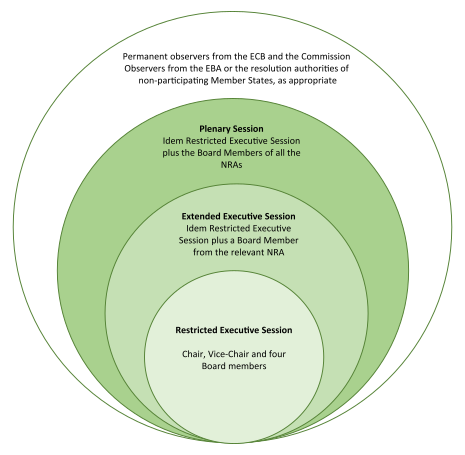
Source: ECA, based on an SRB diagram.
Annex II — The SRB’s MREL targets
In May 2020, the SRB published its 2020 MREL policy following a public consultation. The table below shows the various components of an MREL target for the 2018 and 2020 resolution planning cycles. Differences between the two are marked in green.
| SRB’s 2018 MREL policy | SRB’s 2020 MREL policy | |
|---|---|---|
| Expressed in total risk exposure amount (TREA) | ||
| MREL target | Loss-absorption amount (LAA) + recapitalisation amount (RCA) | Loss-absorption amount (LAA) + recapitalisation amount (RCA) |
| LAA | (Pillar 1+Pillar 2+combined capital buffer requirements45)*total risk exposure amount (TREA) | (Pillar 1+Pillar 2)*total risk exposure amount (TREA) |
| RCA46 | (Pillar 1+Pillar2+market confidence charge (MCC))*TREA | (Pillar 1+Pillar 2+market confidence charge (MCC47))*TREA |
| MCC | Combined capital buffer requirements – 1.25 % | Combined capital buffer requirements – countercyclical buffer |
| Expressed in leverage ratio exposure (LRE) | ||
| Default MREL requirement | n/a | Loss-absorption amount (LAA) + recapitalisation amount (RCA) |
| LAA | n/a | Leverage ratio*leverage exposure |
| RCA | n/a | Leverage ratio*leverage exposure |
Source: ECA, adapted from SRB data.
In the case of banks that are expected to follow normal insolvency proceedings, the MREL corresponds generally to the capital requirements under the Capital Requirements Regulation (CRR), which comprises only the loss-absorption amount (LAA).
Under the new rules, the MREL TREA (total risk exposure amount) for the LAA is no longer required to include the combined buffer requirements, nor, moreover, is a market confidence charge (MCC) required, but the SRB may still adjust the RCA by applying an MCC.
In this case, the 1.25 % deduction from the MCC as per the SRB’s 2018 MREL policy will be replaced by deduction of the countercyclical buffer. The countercyclical buffer comprises part of the combined buffer requirements. A deduction offsets a previous add-on to the combined buffer requirements.
The new banking package transposing Basel III requirements introduced a leverage ratio of 3 %. As a result, the SRB introduced a second MREL measure based on leverage ratio exposure.
Acronyms and abbreviations
BC: Banking Communication
BRRD: Bank Recovery and Resolution Directive
EBA: European Banking Authority
ECB: European Central Bank
FTE: Full-time equivalent
IRT: Internal resolution team
LAA: Loss-absorption amount
MCC: Market confidence charge
MREL: Minimum requirement for own funds and eligible liabilities
NRA: National resolution authority
SRB: Single Resolution Board
SREP: Supervisory review and evaluation process
SRF: Single Resolution Fund
SRM: Single Resolution Mechanism
SRMR: Single Resolution Mechanism Regulation
TFEU: Treaty on the Functioning of the European Union
Glossary
Bail-in tool: a mechanism that allows debt, with some exceptions such as covered deposits, to be written down or converted into equity in the event of resolution of a financial institution. Any liabilities potentially subject to the bail-in tool are termed “bail-inable”.
Core business line: business lines or associated services which represent material sources of revenue, profit or franchise value for an institution or for a group of which an institution forms part.
Critical functions: bank activities, services or operations which, if interrupted, are likely to lead to the disruption of financial stability or services that are essential to the real economy.
Deposit guarantee scheme: a deposit guarantee scheme protects depositors from losses up to a certain ceiling and within certain limits in the event of a bank failure.
European Banking Union: the European Banking Union is the transfer of responsibility for banking policy from the national to the EU level. At present, it consists of the Single Supervisory Mechanism and Single Resolution Mechanism, which are based on the EU's Single Rulebook. Member States of the euro area participate in the European Banking Union.
Internal resolution teams: under Article 83 of the SRMR, the Single Resolution Board may establish internal resolution teams composed of its own staff and staff of the national resolution authorities, including, where appropriate, observers from Member States outside the euro area. Internal resolution teams are key to cooperation and communication between the SRB and the NRAs on the preparation of resolution plans. These teams are set up for all banks under the SRB’s remit and are headed by coordinators appointed from the SRB's senior staff.
Minimum requirement for own funds and eligible liabilities: a requirement that banks need to comply with at all times by holding easily "bail-inable" instruments in order to ensure that losses can be absorbed and the banks recapitalised if they get into financial difficulty and are subsequently placed in resolution.
Prudential capital requirements: prudential capital requirements concern the amount of capital banks hold. The goal of these rules is to strengthen their resilience, while ensuring that banks continue to finance economic activity and growth.
Recovery plan: recovery plans ensure that banks are prepared to restore their viability even in periods of severe financial stress.
Resolution: resolution is the orderly winding-up of a failing bank to ensure the continuity of its essential functions and to preserve financial stability. It also aims to protect public funds by minimising reliance on extraordinary public financial support (see Article 2 of the BRRD).
Resolution college: resolution colleges are the bodies that ensure cooperation between all the parties, such as resolution authorities, central banks, relevant ministries or the EBA at all stages of the resolution planning and the process of resolving a failing bank.
Resolution plan: a resolution plan is a comprehensive document, which details the characteristics of a bank and describes the preferred resolution strategy for that bank, including which resolution tools to apply to which entities. It identifies and addresses any impediments to the resolution of the bank and sets the bank’s MREL.
Senior debt: senior debt is prioritised for repayment in the event that a bank fails. Due to this prioritisation, senior debt implies lower risks compared to subordinated debt or equity.
Subordinated instruments/liabilities: subordinated debt has a lower priority than senior debts but a higher priority compared to equity, in the event that a bank fails.
Substantive impediments: serious obstacles that could hamper the winding-up or resolution of a bank that are identified by resolution authorities during the assessment of banks’ resolvability. Resolution authorities have far-reaching powers to require banks to address or remove any such impediments within a given timeframe. For example, the SRB might require a bank to divest specific assets, limit its activities or change its legal or operational structures.
Supervision: banking supervision is the act of monitoring the financial performance and operations of banks by public authorities in order to ensure that they are operating safely and soundly and following rules and regulations.
Valuation: the Single Rulebook provides for a formal procedure with three valuations, respectively, to determine whether a bank is failing or likely to fail (valuation 1), to inform about the use of the resolution tools including bail-in (valuation 2), and to ensure that the "no creditor worse off" condition is respected (valuation 3).
Audit team
The ECA’s Special Reports set out the results of its audits of EU policies and programmes, or of management-related topics from specific budgetary areas. The ECA selects and designs these audit tasks to be of maximum impact by considering the risks to performance or compliance, the level of income or spending involved, forthcoming developments and political and public interest.
This performance audit was carried out by Audit Chamber IV Regulation of markets and competitive economy, headed by ECA Member Alex Brenninkmeijer. The audit was led by ECA Member Rimantas Šadžius, supported by Mindaugas Pakštys, Head of Private Office and Tomas Mackevičius, Private Office Attaché; Marion Colonerus, Principal Manager; Helmut Kern, Head of Task; Marion Schiefele, Satu Levelä-Ylinen, Christian Detry, Rafal Migasiewicz, Auditors. Cathryn Lindsay and Victoria Gilson provided linguistic support.

Endnotes
1 The term ‘bank’ in this report refers to the entities mentioned in Article 2 of Regulation (EU) No 806/2014 of the European Parliament and of the Council of 15 July 2014 establishing uniform rules and a uniform procedure for the resolution of credit institutions and certain investment firms in the framework of a Single Resolution Mechanism and a Single Resolution Fund and amending Regulation (EU) No 1093/2010, OJ L 225 of 30.7.2014, p. 1.
2 Directive (EU) 2014/59/EU of the European Parliament and of the Council of 15 May 2014 establishing a framework for the recovery and resolution of credit institutions and investment firms and amending Council Directive 82/891/EEC, Directives 2001/24/EC, 2002/47/EC, 2004/25/EC, 2005/56/EC, 2007/36/EC, 2011/35/EU, 2012/30/EU and 2013/36/EU, and Regulations (EU) Nos 1093/2010 and 648/2012 of the European Parliament and of the Council, OJ L 173/190 of 12.6.2014 p. 190.
3 Regulation (EU) No 806/2014 as mentioned in footnote 1.
4 A cross-border less significant bank consists of a parent company established in the euro area and at least one subsidiary established in a different euro area Member State.
5 Report from the European Commission to the European Parliament and the Council on the application and review of Directive 2014/59/EU (Bank Recovery and Resolution Directive) and Regulation 806/2014 (Single Resolution Mechanism Regulation), COM(2019) 213 final of 30.04.2019, p. 12.
6 ECA special report No 23/2017: Single Resolution Board: Work on a challenging Banking Union task started, but still a long way to go (www.eca.europa.eu).
7 Consolidated Version of the Treaty on the functioning of the European Union, C 202 of 7.6.2016 p. 1.
8 Treaty Establishing the European Stability Mechanism between the Kingdom of Belgium, the Federal Republic of Germany, the Republic of Estonia, Ireland, the Hellenic Republic, the Kingdom of Spain, the French Republic, the Italian Republic, the Republic of Cyprus, the Republic of Latvia, the Republic of Lithuania, the Grand Duchy of Luxembourg, Malta, the Kingdom of the Netherlands, the Republic of Austria, the Portuguese Republic, the Republic of Slovenia, the Slovak Republic and the Republic of Finland, signed on 2.2.2012.
9 See, for example: Providing funding in resolution: Unfinished business even after Eurogroup agreement on EMU reform, Demertzis and Wolff, Bruegel, 7 December 2018 or Banking Union: Towards new arrangements for the provision of liquidity in resolution, by Deslandes and Magnus, European Parliament, PE 624.402, July 2019.
10 In-depth analysis requested by the ECON Committee, Valuation reports in the context of banking resolution: What are the challenges?, by Willem Pieter de Groen, European Parliament, PE 624.418, June 2018.
11 Study on the differences between bank insolvency laws and on their potential harmonisation, VVA, Grimaldi & Bruegel, November 2019.
12 https://srb.europa.eu/en/node/622.
13 It may exceed 5 % if certain conditions are met, as specified in Article 27(10) of the SRMR.
14 2018 Euro Area Policies Financial Sector Assessment Program Technical Note – Bank Resolution and Crisis management, International Monetary Fund, July 2018, p. 7.
15 Communication from the Commission on the application, from 1 August 2013, of State aid rules to support measures in favour of banks in the context of the financial crisis (”Banking Communication”), OJ C216 of 30.7.2013, p. 1.
16 2018 Euro Area Policies Financial Sector Assessment Program, Technical Note, Bank Resolution and Crisis management, International Monetary Fund, July 2018, p. 7.
17 ECA Special Report 21/2020 “Control of State aid to financial institutions in the EU: in need of a fitness check” (www.eca.europa.eu).
18 ECA Special Report 21/2020 Control of State aid to financial institutions in the EU: in need of a fitness check, paragraphs 66 and 68 (www.eca.europa.eu).
19 2018 Euro Area Policies Financial Sector Assessment Program, Technical Note, Bank Resolution and Crisis management, International Monetary Fund, July 2018, p. 21.
20 European Parliament resolution of 19 June 2020 on Banking Union – annual report 2019 (2019/2130(INI)), P9_TA(2020)0165, point 49.
21 See, for example, Eurofi Article by Elke König – Why we need an EU liquidation regime for banks, 5.9.2018 (www.srb.europa.eu/en/node/622).
23 These dimensions are as follows: governance; loss absorption and recapitalisation capacity; liquidity and funding in resolution; operational continuity and access to financial market infrastructure services; information systems and data requirements; communication; separability and restructuring.
24 Bank of England, Policy Statement: The Bank of England’s approach to assessing resolvability, July 2019.
25 Decision of the European Banking Authority on the settlement of a disagreement, addressed to the Single Resolution Board and Banca Naţională a României, 27 April 2018.
26 In-depth analysis requested by the ECON Committee, Impediments to resolvability of banks? Banking Union Scrutiny, by Willem Pieter de Groen, Economic Governance Support Unit of the European Parliament, PE 634.358, December 2019.
27 Regulation (EU) 2019/877 of the European Parliament and of the Council of 20 May 2019 amending Regulation (EU) No 806/2014 as regards the loss-absorbing and recapitalisation capacity of credit institutions and investment firms, OJ L 150 of 7.6.2019, p. 226, applicable from 28 December 2020 onwards.
28 Directive (EU) 2019/879 of the European Parliament and of the Council of 20 May 2019 amending Directive 2014/59/EU as regards the loss-absorbing and recapitalisation capacity of credit institutions and investment firms and Directive 98/26/EC, OJ L 150 of 7.6.2019, p. 296.
29 Resolution authorities have to classify banks into four categories. These are (i) global systemically important banks, (ii) top tier banks, (iii) other systemic entities, and (iv) all those not in the previous three categories. The mandatory fixed MREL applies to the first three categories.
30 Annex 5 to EBA’s quantitative MREL report EBA/Rep/2020/07.
31 Idem.
32 Statement of the EBA and ESMA on the treatment of retail holdings of debt financial instruments subject to the Bank Recovery and Resolution Directive, May 2018.
33 In two of the six cases in the sample, the plan had concluded that the bank would be wound up under national insolvency law.
34 External MREL securities are issued by the entity to which the resolution authority intends to apply the bail-in tool. They are issued to external subscribers. Internal MREL securities are subscribed to by other group entities belonging to the same resolution unit.
35 Recital 47 of the SRMR.
36 In 2015, the EBA published guidelines on how authorities should assess whether an institution is eligible for simplified obligations (now repealed and replaced by the regulatory technical standards on the same topic) and prepared an implementing technical standard on the transmission of relevant information to the EBA.
37 Decision of the Single Resolution Board of 17 December 2018 establishing the framework for the practical arrangements for the cooperation within the Single Resolution Mechanism between the Single Resolution Board and National Resolution Authorities (SRB/PS/2018/15).
38 Memorandum of understanding between the Single Resolution Board and the European Central bank in respect of cooperation and information exchange. https://srb.europa.eu/sites/srbsite/files/mou_with_the_single_resolution_board_on_cooperation_and_information_exchange_2018_.pdf.
39 Report from the European Commission to the European Parliament and the Council on the application and review of Directive 2014/59/EU (Bank Recovery and Resolution Directive) and Regulation 806/2014 (Single Resolution Mechanism Regulation), COM(2019) 213 final of 30.04.2019, p. 6.
40 ECA’s special report 02/2018: The operational efficiency of the ECB’s crisis management for banks, paragraph 125 (www.eca.europa.eu).
41 Understanding Bank Recovery and Resolution in the EU: A guidebook to the BRRD, World Bank Group, Financial Sector Advisory Centre, April 2017, p. 106.
42 ECA special report 29/2016: Single Supervisory Mechanism - Good start but further improvements needed, paragraph 110 (www.eca.europa.eu).
43 The SRB’s numbers include assistants but not seconded national experts. The SRB provided FTE data for 2019 and a forecast for 2020 for all NRAs, other than those of Portugal and Slovakia, where we have used 2017 data.
44 The range was similar when measured in relation to banks’ total assets.
45 Art. 92 (1) of the Capital Requirements Regulation (CRR), Regulation (EU) No 575/2013 of the European Parliament and of the Council of 26 June 2013 on prudential requirements for credit institutions and investment firms and amending Regulation (EU) No 648/2012, OJ L 176 of 27.6.2013, p. 1 (CRR); Art. 104a and Art. 128 of the Capital Requirements Directive (CRD), Directive 2013/36/EU of the European Parliament and Council of 26 June 2013 on access to the activity of credit institutions and the prudential supervision of credit institutions and investment firms, amending Directive 2002/87/EC and repealing Directives 2006/48/EC and 2006/49/EC, OJ L 176 of 27.6.2013, p. 338.
46 Applicable only to banks where the resolution strategy provides for resolution actions and the application of resolution tools.
47 According to the SRB’s 2020 MREL policy (p. 12), the RCA may be adjusted by the MCC, which is a change compared to the SRB’s 2018 MREL policy (p. 10), which made this mandatory in the case of banks to which the SRB intended to apply resolution tools and powers. The SRB has also introduced transition periods for the MCC in its 2020 MREL policy.
48 Guidelines on the interpretation of the different circumstances when an institution shall be considered as failing or likely to fail under Article 32(6) of Directive 2014/59/EU.
Timeline
| Event | Date |
| Adoption of Audit Planning Memorandum (APM) / start of audit | 9.4.2019 |
| Official sending of draft report to Commission (or other auditee) | 27.7.2020 |
| Adoption of the final report after the adversarial procedure | 24.11.2020 |
| SRB's official replies received in all language | 16.12.2020 |
| Commission’s official replies received in all languages | 21.12.2020 |
Contact
EUROPEAN COURT OF AUDITORS
12, rue Alcide De Gasperi
1615
Luxembourg
LUXEMBOURG
Tel. +352 4398-1
Enquiries: eca.europa.eu/en/Pages/ContactForm.aspx
Website: eca.europa.eu
Twitter: @EUAuditors
More information on the European Union is available on the internet (http://europa.eu).
Luxembourg: Publications Office of the European Union, 2021
| ISBN 978-92-847-5537-0 | ISSN 1977-5679 | doi:10.2865/873 | QJ-AB-21-001-EN-N | |
| HTML | ISBN 978-92-847-5531-8 | ISSN 1977-5679 | doi:10.2865/24 | QJ-AB-21-001-EN-Q |
COPYRIGHT
© European Union, 2021.
The reuse policy of the European Court of Auditors (ECA) is implemented by the Decision of the European Court of Auditors
Unless otherwise indicated (e.g. in individual copyright notices), the ECA’s content owned by the EU is licensed under the Creative Commons Attribution 4.0 International (CC BY 4.0) licence. This means that reuse is allowed, provided appropriate credit is given and changes are indicated. The reuser must not distort the original meaning or message of the documents. The ECA shall not be liable for any consequences of reuse.
You are required to clear additional rights if a specific content depicts identifiable private individuals, f. ex. as on pictures of the ECA’s staff or includes third-party works. Where permission is obtained, such permission shall cancel the above-mentioned general permission and shall clearly indicate any restrictions on use.
To use or reproduce content that is not owned by the EU, you may need to seek permission directly from the copyright holders.
Software or documents covered by industrial property rights, such as patents, trade marks, registered designs, logos and names, are excluded from the ECA’s reuse policy and are not licensed to you.
The European Union’s family of institutional Web Sites, within the europa.eu domain, provides links to third-party sites. Since the ECA does not control them, you are encouraged to review their privacy and copyright policies.
Use of European Court of Auditors’ logo
The European Court of Auditors logo must not be used without the European Court of Auditors’ prior consent.
GETTING IN TOUCH WITH THE EU
In person
All over the European Union there are hundreds of
Europe Direct Information Centres. You can find the address of the centre nearest
you at: https://europa.eu/european-union/contact_en
On the phone or by e-mail
Europe Direct is a service that your
questions about the European Union. You can contact this service
- by freephone: 00 800 6 7 8 9 10 11 (certain operators may charge for these calls),
- at the following standard number: +32 22999696 or
- by electronic mail via: https://europa.eu/european-union/contact_en
FINDING INFORMATION ABOUT THE EU
Online
Information about the European Union in all the official
languages of the EU is available on the Europa website at: https://europa.eu/european-union/index_en
EU Publications
You can download or order free and priced EU
publications at: https://op.europa.eu/en/web/general-publications/publications. Multiple
copies of free publications may be obtained by contacting Europe Direct or your
local information centre (see https://europa.eu/european-union/contact_en)
EU law and related documents
For access to legal information
from the EU, including all EU law since 1952 in all the official language versions,
go to EUR-Lex at: http://eur-lex.europa.eu/homepage.html?locale=en
Open data from the EU
The EU Open Data Portal (https://data.europa.eu/euodp/en/home) provides access to datasets from the
EU. Data can be downloaded and reused for free, both for commercial and
non-commercial purposes.