

Framework
What is the European Commission?
The European Commission is the executive arm of the European Union. Alongside the European Parliament and the Council of the European Union, it is one of three main institutions that govern the Union, and by far the largest. The Commission’s activities are steered by 27 Commissioners, assisted by over 30 000 civil servants and other staff working in 34 Directorates-General (DGs), 16 services/offices and departments all over the world. Each Commissioner takes responsibility for a particular area of policy and heads one or more entities that are generally known as DGs.
The Commission’s primary role is to propose and enact legislation, and to act as ‘Guardian of the Treaties’, which involves responsibility for initiating infringement proceedings at the European Court of Justice against Member States and others whom it considers to be in breach of the EU Treaties and other Community law. The Commission also negotiates international agreements on behalf of the EU in close cooperation with the Council of the European Union.
The Commission’s headquarters are in Brussels (Belgium), but it also has offices in Luxembourg, Grange (Ireland), Geel (Belgium), Ispra (Italy), Karlsruhe (Germany), Petten (The Netherlands), Seville (Spain) and many other places, agencies in several Member States and representations in all EU countries (About - European Commission, open in a new tab). On 1st December 2009, the Treaty of Lisbon entered into force giving the Commission the institutional tools needed for the various enlargements and for meeting the challenges of an EU of 27 Member States.
Activities at the EMAS sites

Below, a blue-toned map of Europe highlights locations with two types of markers: orange pins for main sites and yellow pins for representations.
Main sites (orange) are shown in: Seville, Ispra, Karlsruhe, Geel, Petten, Brussels, Luxembourg, and Grange.
Representations (yellow) are shown in: Copenhagen, The Hague, Vienna, Budapest, Sofia, Valletta, and Nicosia.
A small legend on the right explains the color coding for sites and representations. The overall design uses shades of blue for the map background, with city labels in colored boxes next to each marker.
The Commission's main sites are registered under its Eco Management and Audit Scheme (EMAS).
Brussels is the main site, the Commission's administrative centre, with a range of buildings dominated by offices but including conference centres, catering facilities, storage depots, print shops, childcare, medical and sports facilities.
The Luxembourg site is of a similar nature, though smaller but also hosts the main data centres of the Commission and a small radiation protection laboratory operated by the DG for Energy.
The five Joint Research Centre (JRC) sites outside Brussels are all incorporated under EMAS. In contrast to Brussels and Luxembourg, these scientific sites mainly comprise unique research and technical infrastructures. More details on the different JRC sites can be found here and a summary is presented below.
- JRC Geel (Belgium) is recognised worldwide, both for being a major certified reference material (CRM) producer as well as for its nuclear activities with its two nuclear accelerators Gelina and Monnet. The site is also known for its expertise in metrology and standardisation in several fields (nuclear, health and food, transport and border security).
- JRC Ispra (Italy) is considered one of Europe's leading research campuses with many laboratories and research infrastructures, including a power plant, a fire station and a water treatment facility as well as over 100 heated buildings. There are also several nuclear installations on the site as follows:
- Nuclear activities in long term shutdown, i.e. interrupted and included in the decommissioning programme (ESSOR – ESSais ORgel, Cyclotron, LCSR - Laboratorio Caldo Studi e Ricerche, STRRL - Stazione Trattamento Rifiuti Radioattivi Liquidi). The ECO-FARO Esperienza Critica ORGEL Fuel Assemblies melting Oven installation was dismantled in 2014.
- Installations where activities functional to the decommissioning programme are performed, e.g. radioactive waste management (Stazione Gestione Rifiuti Radioattivi, Stazione Trattamento Effluenti Liquidi, Tank farm, Intermim Storage Facility, Dry Wells) and nuclear fuel dismantling (Atelier Démantèlement Eléments Combustible).
- Laboratories where research activities connected to nuclear safety and safeguards are performed (PERLA: PERformance LAboratory, PUNITA: PUlsed Neutron Interrogation Test Assembly).
- JRC Karlsruhe (Germany) is a self-contained site located in a research campus (KIT Campus Nord) on the outskirts of Karlsruhe, and the core of the JRC research for Nuclear Safety and Security. Research activities are conducted only in the nuclear field within the framework of the EURATOM treaty. They cover the following: fundamental properties and applications, safety of nuclear fuels and fuel cycle, nuclear waste management and decommissioning, monitoring of radioactivity in the environment, nuclear safeguards, nuclear non-proliferation and security (including trainings e.g. EUSECTRA).
- JRC Petten (The Netherlands) executes and manages institutional and competitive research activities to support European policy-making for energy, mobility and climate. In particular, for energy - ensuring sustainable, safe, secure and efficient energy production, distribution and use); for mobility - fostering sustainable and efficient mobility in Europe; and for climate - providing scientific and technical analysis to support to integrated air quality, climate and related policies.
- JRC Seville (Spain) provides socio-economic and techno-economic support for the conception, development, implementation and monitoring of EU policies. It has advanced computing infrastructure. As an administrative building, it is similar in nature to the EMAS sites of Brussels and Luxembourg, with the added complexity of occupying rented premises.
DG SANTE site at Grange, Ireland is a purpose-built low level wooden clad structure dating from 2002 and set in countryside 45km north-west of Dublin. It accommodates Directorate F, Health and Food Audits and Analysis, but was previously known as the Food and Veterinary Office (FVO). Many staff members are inspectors or auditors and travel frequently, and typically up to half may be away from the office at any one time.
The activities of the Houses of Europe are typically administrative, communication and public outreach activities, augmented by additional functions such as conference and meeting organisation, and supporting the local activities of European Parliament Members. EMAS in 2021 started with the sites of Vienna (Austria) and Valletta (Malta). In 2022 the sites Budapest (Hungary) and Nicosia (Cyprus) were added. In 2023 the sites The Hague (the Netherlands), Copenhagen (Denmark) and Sofia (Bulgaria) were added. These sites are jointly managed with the European Parliament's Liaison Offices in buildings known as the Houses of Europe (HoE), specific data for the HoE are included in a separate Annex as a standalone document, but the total of the Commission is incorporated in the present document and added to other sites' data.
What was new in 2024?
In 2024, the Commission continued to advance the Communication outlining the path to achieving climate neutrality by 2030.
The primary changes since in 2024 in the management system include:
- conducting a Progress Review of the Commission's Greening initiative involving key stakeholders and forming specialized focus groups;
- standardizing the reporting of Green Public Procurement to monitor all relevant purchasing procedures in line with the Greening Communication;
- developing an IT tool for data collection, monitoring, and reporting, which is currently in a trial phase;
- creating an HTML webpage to facilitate public access and comprehension, with last year's statement available at: Environmental Statement 2024 - results 2023 | Directorate-general of Human Resources and Security (DG HR). (https://op.europa.eu/webpub/hr/ec-environmental-statement-2024/index.html, open in a new tab)
- considering all the Commission's working places for reporting missions' emissions
- site-specific targets have been defined for Houses of Europe where energy efficiency audits were completed, allowing for an informed approach to setting ambitious, yet realistic targets.
- reporting aggregate data for DG COMM's Representations in Member States as an additional site in the Environmental Statement, making a total of 9 reporting sites
Actions identified as directly contributing to the objectives of the Greening Communication form a significant portion of the EMAS actions. Approximately 300 actions were identified in the 2023 Global Annual Action Plan, increasing to nearly 400 in 2024 and reaching 476 in 2025.
The scope of the EMAS system remains stable with seven Commission Representations in Member States.
While the number of individual sites within the Commission's registration remained stable, the total surface area covered by buildings registered in the system decreased, mainly due to the removal of some buildings in the Brussels portfolio. Since the EMAS system reached relative maturity in 2014 when it included the eight major Commission sites, there has been in recent years a reduction in total surface area, which has been accompanied, in 2024, by also a reduction in staff number.
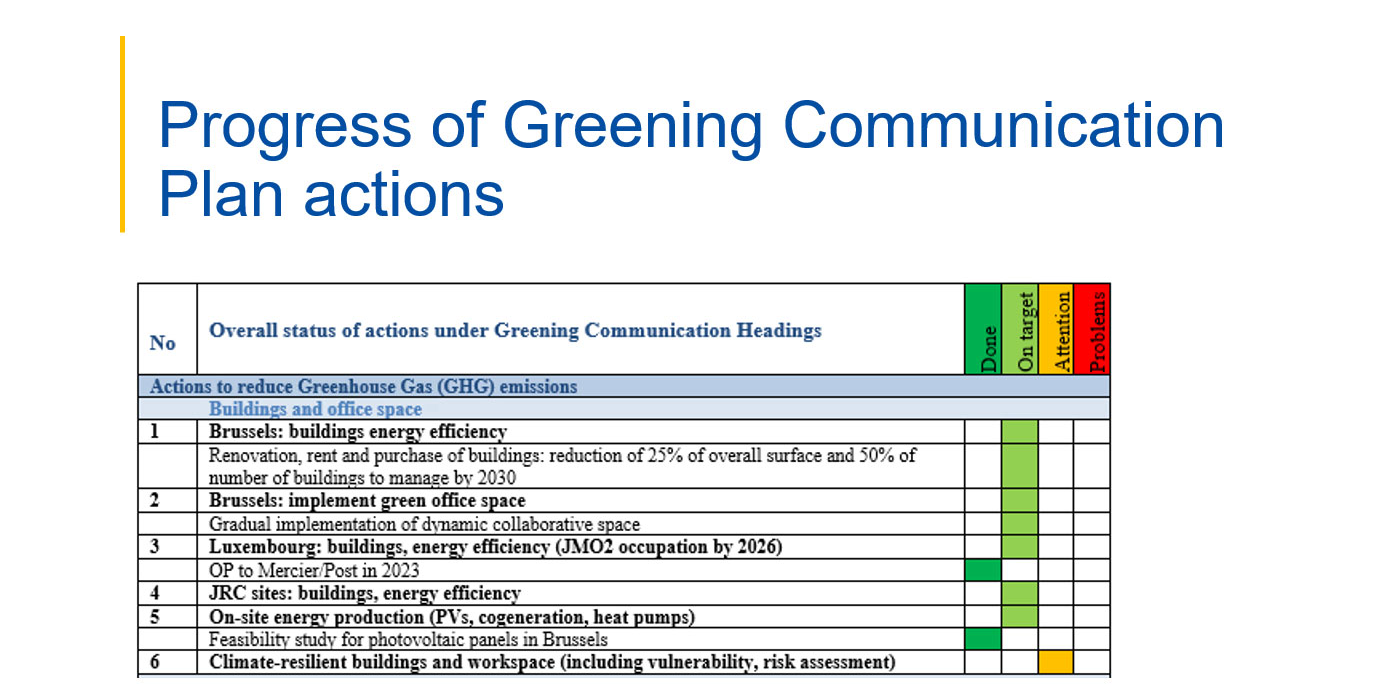

The figure above represents the number of actions per Greening heading in the Global Annual Action Plan (GAAP). The largest proportion of actions is attributed to buildings and office space reflecting the long history of site management in EMAS and efforts to reduce energy consumption and emissions. Similarly, the large number of staff participation and communication actions is particularly indicative of EMAS requirements and is reinforced by the Greening Communication.
In 2024, the Commission continued implementing actions from the Greening initiative by, for example:
- Finalisation of the new Guide to Missions
- About 10 500 colleagues in dynamic collaborative space
- 92% corporate car fleet low or zero emissions: target exceeded
- Decision to sublet part of JMO2 and vacation of LACC in Luxembourg
- Continuation of developments in JRC sites including new/upgraded buildings (Seville)
- Greening the real estate park: abandoning old buildings with low energy efficiency (23 buildings sales procedure completed); negotiations started for the occupation of five new energy efficient buildings, in addition to the existing L107, L51, SB34, C-46, MO34 and T211 buildings
- Genève Pole abandoned in 2024
- Brussels biodiversity study/strategy resulted in two biodiversity projects at buildings B-28 and ORBAN/L-41 ongoing study for the courtyards and surroundings of CSM1 and BERL
- Development of new green roofs projects in CHAR and ORBAN completed in 2024.
- Project of installing photovoltaics panels in DAV1, L-15, SB34, CO46 and geothermal heat pumps in SB34 and CO46
- Further optimisation of energy consumption in Commission buildings (e.g. energy saving actions in the summer and at the end of the year)
Environmental policy
The Commission updated its Environmental policy in 2022 to incorporate the European Green Deal that Commission President Ursula von der Leyen introduced in 2019. Following the Commission's adoption of the Communication on Greening the Commission in April 2022, it is now working towards its headline objective of achieving carbon neutrality in 2030.
Under EMAS individual sites may develop their own environmental policy. The policies, corporate and site level, are displayed at the entrance to all Commission buildings. For instance, JRC Ispra's site policy is displayed at the main entrance and at the entrance of the buildings hosting considerable quantity of staff (e.g. the canteen, cafeteria and Club House).

Governance structure
Corporate coordination of the EMAS system
A College of Commissioners Decision ensures EMAS implementation at a high level. DG.HR's Director General chairs the EMAS Steering Committee (ESC) which meets twice a year. It defines environmental policy, adopts the Global Annual Action Plan, sets environmental objectives and monitors progress. In addition, and due to the Commission's decentralised organisation, management and line managers not directly involved in the ESC or without formally defined EMAS roles also participate in the system. The Commission’s Management Board established a working group to encourage closer links particularly between Directorates General (DGs) HR, SG and BUDG. The ESC comprises the following services: BUDG, CLIMA, DIGIT, ENER, ENV, HR, JRC, MOVE, SG, SANTE, MARE, RTD, SCIC, OIB and OIL, COMM, PMO and the Executive Agencies.
The EMAS coordination team based in Brussels within HR.D7, the Greening, Safety & Buildings Unit of DG HR, assumes day to day coordination. The EMAS Management Representative is responsible to Management for EMAS implementation and is the contact point for external organisations such as IGBE (Brussels Environment) and other EU Institutions. Five full time staff members work predominantly on system coordination including communication and training and are assisted occasionally by a trainee.
The Commission's size and geographic spread requires the EMAS coordination team to work with a network of over 40 staff across the Commission services whose job descriptions include their EMAS responsibilities. The network includes staff dedicated specifically to EMAS site coordination and to raising staff awareness.
EMAS site coordination
The EMAS Site Coordinators at each of the eight sites are EMAS coordination's team’s main contacts and responsible for implementing EMAS at the site level. They report on performance, contribute to the Environmental Statement and participate in preparing site level objectives and actions. The EMAS site coordination team for Brussels is located in unit RE3 of the Office of Infrastructure for Brussels (OIB), the Office responsible for the facility management and building policy within the European Commission in Brussels.
The EMAS site coordination team for Brussels is located in unit RE3 of the Office of Infrastructure for Brussels (OIB), the Office responsible for the facility management and building policy within the European Commission in Brussels. Site coordination is ensured by two full-time staff members, who integrate a team of 11 responsible, among other files, for the buildings' energy performance and monitoring, environmental compliance of the EC buildings, inclusion of environmental criteria in tenders, namely concerning building works and prospecting the real estate market.”
Site coordination is ensured by two full-time staff members, who integrate a team of 11 responsible, among other files, for the buildings' energy performance and monitoring, environmental compliance of the EC buildings, inclusion of environmental criteria in tenders, namely concerning building works and prospecting the real estate market.
The EMAS site coordination team for Luxembourg is located in Unit O1 of the Office for Infrastructure for Luxembourg (OIL). The Office ensures that all activities associated with the housing of staff, the management of social welfare infrastructure and the logistics of the Commission in Luxembourg are carried out to the best standards. The site coordination is ensured by two-and-a-half-time staff members.
The EMAS Site coordination for the EC Representations Up until 2024, the Central coordination of the EMAS implementation is ensured for the Commission by Unit D2 of DG Communication, responsible for managing the infrastructure of the Commission’s Representations in Member States, supported by the EMAS Central Coordination Team in DG HR.D7 which ensures alignment with the corporate EMAS process and provides the contractual framework for the internal and verification audits. On the Parliament's side, the EMAS and Sustainability Unit, in the Directorate for Innovation and Central Services attached to the Secretary-General of the European Parliament, coordinates the project implementation in cooperation with other service responsible for the management of EPLOs, notably DG COMM and DG INLO, the latter having designated a central contact person for EMAS. Representations site coordinators in DG COMM (EC) and EPLO project coordinators in the EMAS and Sustainability Unit (EP) ensure day-to-day coordination in liaison with local EMAS coordinators in the Houses of Europe.
The JRC EMAS Coordination ensures the harmonisation and coherence of the inputs of the five JRC sites, when applicable.
Correspondents in the services
EMAS correspondents (Brussels and Luxembourg only) provide a link between their directorate-general/department and HR.D7, particularly for communication; and are nominated by their services. They participate in formal meetings on average three times a year, usually before the start of information campaigns.
Other staff contribute to EMAS, particularly those in facilities management, for example by providing data for reporting on resource consumption or waste generation, or when participating in internal and verification audits. Communication campaigns and training target all staff to improve environmental behaviour, and whose attitudes are gauged every two years by surveys.
EMAS scope - areas and staff numbers
The system developed initially in Brussels with a first registration covering eight buildings in 2005. Additional buildings were added yearly, and other sites joined, with virtually full reporting of the eight main sites established in 2014. The scope of the registration for 2024 relating to the eight main sites, and DG COMM's representations in Member States is included in Annex Scope by site with individual buildings indicated in Brussels and Luxembourg.

The area in which the system is implemented after remaining stable for several years, has started to reduce. The system expanded to include seven EU representations in Member States.
Evolution of EMAS registered area (m2)
Evolution of staff in EMAS registered area
Number of buildings registered under EMAS
Leadership: Management testimonies
Stephen QUEST : Director General for Human Resources
The European Green Deal compels Member States to cut emissions significantly and highlights the need for sustainable food supply chains and biodiversity preservation. The 2022 European Commission Communication on Greening outlines how the institution aims to achieve these goals and become climate neutral 20 years ahead of the target date for Member States. The Commission's primary goal is to reduce its equivalent CO2 emissions by 60% from 2005 to 2030 through a wide range of measures.
I am delighted that the Commission this year is still on a positive path towards this 2030 objective. Since becoming the first EU Institution to achieve registration in 2005, the annual publication of EMAS results have shown that we have consistently delivered on our commitment to significantly reduce our environmental impact. Initially limited to Brussels, the Commission's scheme now includes its eight largest sites in Europe and seven Commission Representations (shared with the European Parliament Liaison Offices) in EU Member States.
The results achieved over the last years have been considerable, leading to a 31% reduction in our carbon footprint between 2019 and 2024. Buildings related emissions have decreased by about 25 000 tonnes through a variety of energy saving measures, including the reduction of the m² footprint of the institution. Emissions due to staff and experts' missions and commuting also decreased by 39% since 2019. Supported by a new staff commuting policy for Brussels and a new Guide to Missions, we hope to continue guiding our staff in the next years to make sustainable choices when choosing their mode of transport.
While progress towards 2030 targets is encouraging, we should be mindful that achieving them will require further work, in particular when it comes to reducing emission from staff professional travel. This year’s Progress Review of the Communication on Greening will support these efforts by reconfirming our 2030 ambitions and setting out the pathway to achieve them in the next years.
With the continued commitment of all Commission staff, I am confident that we will make further progress and lead the way by becoming climate neutral by 2030.
Morten FJALLAND, Director of Office for Infrastructure, Brussels
The Office for Infrastructure and Logistics in Brussels (OIB) creates a workplace for Commission staff that is functional, safe, and comfortable. It also provides top-quality support, well-being and social services. OIB operations have a client-centred approach, and are environmentally sustainable and cost-efficient. This translates into key accomplishments, such as reduced energy consumption and more self-produced renewable energy, fewer CO2 emissions, and use of less paper. The dynamic collaborative offices tailor for the changed work reality. Staff is encouraged to use public transport and active modes for commuting. The changes in waste collection and sorting inspire colleagues to also reduce their waste production. These achievements reflect OIB's lasting commitment to continue to do better.
The Communication on Greening the Commission sets a clear goal of reducing CO2 emissions by 60% (compared to 2005) and reach climate neutrality by 2030. The Brussels-based Commission services, and in particular the OIB, are instrumental to accomplish this ambition. The recent Greening the Commission Progress Review shows, once again, how together we are working towards a more sustainable European Union.
José MIRANDA-VIZUETE, acting Director of the Office for Infrastructure and Logistics, Luxembourg
In OIL, we are dedicated to ensuring a secure and efficient work environment, in line with the “greener and smarter” real estate strategy, while offering services like transportation, office supplies, catering, and after-school childcare
After the installation of services in the MERP building, which possesses a DGNB label (“platinum” level), we are preparing to finalize the construction of the Jean Monnet 2 building. The new complex will be certified under the BREEAM sustainable building label (“excellent” level) and aim for nearly zero emissions building (NZEB) performance standards. Subsequently, we will assess how to continue to optimize our real estate assets to remain aligned with the environmental commitments of the Commission.
In parallel, we maintain our focus on several key aspects, such as reducing energy consumption and waste production, as well as promoting sustainable mobility and awareness raising. Regarding the catering services, OIL will continue to explore how to reinforce its commitment to local sustainability, for example by prioritizing products from short supply chains whenever possible.
- JRC Ispra
-
Rien Stroosnijder, responsible for site management, JRC Ispra
EMAS is the most rigorous environmental management system available in Europe and is regarded as the premium standard for environmental excellence. Since early 2012, we have committed to the EMAS scheme, building on and extending our ISO 14001 certified management system. Our environmental policy aims to make sure that site operate in such a way that all activities, which have an environmental impact, are planned and executed in order to minimise damage to the environment, prevent pollution and improve environmental performance. Its implementation is only possible thanks to competent technical staff and strong engagement of all persons on site.
The EMAS results for the European Commission Ispra site during 2024 went generally beyond the targets originally set, particularly due to the impressive work done to reduce our impact on the environment carried out in recent years. Ispra Site Management continued to promote and apply energy saving measures within a more efficient management approach leading to a further reduction in consumption.
All the energy saving measures/activities put in place on the JRC-Ispra site are in line with the Communication on Greening the Commission that aims to achieving carbon neutrality by 2030. This is how the Commission intends to implement the European Green Deal internally and thereby lead by example. Our ambitious targets will be supported by our environmental core indicators, which facilitate multi-annual comparability within and between organisations. In all this, a participatory approach and the engagement of staff are key, as is the exchange of best practices with host country authorities and transparent communication of our performance to them and the general public.
-
-
JRC Geel
-
Ciáran NICHOLL, Director of JRC Geel
When JRC-Geel integrated EMAS in 2011, it vouched its commitment to implement an effective environmental management system, despite the challenges of housing and operating specialised EC laboratory infrastructures. Examples include two high energy consuming nuclear accelerators, a high-tech storage facility for reference materials, nuclear and non-nuclear laboratories with over/under atmospheric pressure requirements, etc.
Each year, JRC-Geel monitors and looks at ways to further improve in reducing its environmental impact and complying with the ever-more stringent legal requirements set by the Flanders Region. Thanks to its BMS (Building Management System), JRC-Geel is able to measure and accurately monitor its EMAS indicators and this allows management to take informed decisions and define improvement actions.
In an ageing site like JRC-Geel, real opportunity for saving energy resides in a refurbishment programme of buildings, including their insulation. To capitalise on this, JRC-Geel has launched an action plan with projects to consecutively renovate its facilities, including the deep refurbishment of one building according to the principles and values of the New European Bauhaus initiative. Another key element of this strategy is the transition to non-F-gas systems and the enhancement of leak detection protocols for insulation gases, addressing the site’s inherent vulnerabilities in this area.
This action plan also seeks to integrate the present and future requirements of the respective JRC-Geel site’s scientific work programmes, all the way up to up to 2034. A temporary downside when implementing refurbishment, insulation jobs and clean up exercises is an inevitable waste increase which contributes to the carbon footprint balance.
An avenue which still requires attention and improved directionality is travelling, despite the JRC commitment to do so.
Finally, the JRC-Geel site is working to preserve and foster biodiversity by creating “natural habitats for fauna” and striving to map its biodiversity through different Bioblitz projects.
-
- JRC Karlsruhe
-
Ulla ENGELMANN, responsible for site management, JRC Karlsruhe
Among the JRC sites, Karlsruhe is unique, being in its entirety a nuclear research facility where the continuous operation of energy-intensive systems is mandatory to ensure nuclear and radiation safety at all times. Combining the very advanced EMAS goals with the realities of an aging infrastructure continues to present significant challenges, and major improvements require substantial investment.
While the last results show that maintaining progress remains demanding, JRC Karlsruhe has nevertheless achieved a meaningful decrease in energy consumption compared to the 2019 baseline. These reductions are the result of sustained optimisation of our monitoring systems and the efficient operation of our existing installations, even pending completion of our new state-of-the-art laboratory (Wing M).
JRC Karlsruhe remains committed to further environmental improvements within its facilities. More broadly, our research continues to contribute to the safe and secure use of nuclear energy which many EU member states rely on as an established low-carbon technology contributing to climate change mitigation.
-
-
JRC Petten
-
Piotr SZYMAŃSKI, JRC Petten Site Director
Site activities focus on sustainable energy and mobility solutions, nuclear safety and climate. The site is home to 27 buildings including state of the art laboratories and supporting infrastructure, where cutting-edge research is performed. Here, scientists and experts collaborate to provide reliable, independent data and technical expertise that help shape Europe’s future.
The site is nestled within a Natura 2000 protected area. Biodiversity initiatives, nature management, and sustainable development goals are defined and implemented in close cooperation with local Dutch authorities and neighbouring organisations of the Energy and Health Campus (EHC), of which JRC Petten is part.
As one of the first EMAS-certified European Commission sites, JRC Petten and its staff have continuously demonstrated a deep commitment to upholding environmental standards, European Commission Decisions and Dutch host country legislation.
New investments are carried out taking the green procurement conditions as a guideline. As an example, the new JRC reception building whose construction started in 2025 and will be completed in Spring 2027, will be constructed as a near-zero energy building (NZEB), following the energy performance level A++++. Furthermore, following a recently performed Energy Study, future infrastructure investments in the horizon 2034, will further improve the sustainability of the buildings, current and future research infrastructures and energy performance of the site, considering the EU’s 2030 and 2050 goals.
-
-
JRC Seville
-
Mikel LANDABASO, Director Fair and Sustainable Economy and responsible for site management at JRC Seville
In a world that urgently needs to accelerate efforts to achieve the green transition, it is essential for the European Commission to lead by example in managing and enhancing its own environmental performance.
The JRC Seville site is fully dedicated to this goal, and I am delighted that our indicators demonstrate our efforts to improve our site's environmental performance while ensuring optimal working conditions for our researchers. Additionally, we are integrating sustainability into our core business of providing scientific and technical advice for policy making, demonstrating that we are turning our commitment into action.
Finally, I am pleased to report that we are making significant progress towards the construction of a new building for our JRC Seville site that will meet world-class environmental performance standards through innovative design, in line with the values and principles of the New European Bauhaus initiative.
-
Ruben TASCON, SANTE Dir. F (acting) Grange, Ireland
We are located in the lush, green farmland of County Meath, where cattle farming is the main activity although sheep are not an uncommon sight in the fields around us.
We are particularly conscious of the agricultural setting of our site and take steps to ensure that our activities do not have a negative impact on our neighbours or the local environment. We include EMAS compliance as a feature of all contracts and look at how services to our staff can be delivered in an eco-friendly way.
During 2024 we delivered a number of projects. In particular:
- We continued the replacement of old high wattage lighting with new more efficient LEDs at different site locations (emergency light system; parking light system).
- Like every year, large areas of our grassland (approximately 3.75 ha) were left to grow as meadow, in order to encourage the growth of plants and flowers to provide nectar for insects including bees, butterflies and hoverflies.
- • The section of the building known as the Annex remains closed as is the ex-crèche following the phasing out of childcare services due to low demand. Both sections have been effectively mothballed and isolated from the other buildings which contributes to both lower utility KPIs and a lower carbon footprint.
Ms. Dana SPINANT, Director-General DG Communication
The EU institutions’ outposts in the Member States – the Commission Representations and the European Parliament Liaison Offices – joined the EMAS process in 2021. They are the institutions’ public face at local level, with the overarching mission to engage with all segments of society. As such, the Representations and Liaison Offices are in the prime position to demonstrate first-hand, to the 450 million citizens of the Member States in which they are located, the European institutions’ firm commitment to the protection of the environment.
As of today, the Commission and the Parliament joined forces to implement EMAS in Valletta (Malta), Vienna (Austria), Budapest (Hungary), Nicosia (Cyprus), Copenhagen (Denmark), Sofia (Bulgaria) and The Hague (Netherlands). This is done in the context of the so-called Houses of Europe, physical premises hosting the Commission Representations and the Parliament’s Liaison Offices in Member States.
The two-fold aim of the project is to reduce the environmental impact of the Houses of Europe and in doing so, also add credibility to the efforts of the European Union to lead change across Europe at large. The initiative is also the first known example of two European institutions implementing EMAS together, developing additional synergies and efficiencies, as well as a possible blueprint for others to follow.
Significant aspects and objectives
Each site reviews its environmental impact to identify the direct (and indirect) significant aspects and determine how they should be managed. The detailed approach is described in the EMAS handbook's Procedure No_1, and the site level results are summarised below in table Summary of significant environmental aspects, navigate to this section on this tab, which is revised yearly. There is no separate review for the Commission as a whole, although the significant aspects tend to correlate with the required reporting under Annex IV of the EMAS Regulation, and all these parameters are reported at corporate level.
Significance is determined taking into account frequency, severity, breach of law, magnitude, scope for control, applicable legislation, stakeholders' concerns, previous incidents, and the potential for taking action. Indicators and reporting have taken into account the best environmental practices included in the sectoral reference document (SRD) for public administration, following a detailed site level analysis conducted in 2020.
This considered all aspects of the SRD, particularly managing and minimising energy, water and waste consumption, minimising consumption of paper and consumables, and minimising the environmental impact of commuting, business travel, canteens and cafeterias, meetings and events organisation. It showed that the relevant aspects were generally well covered at Commission level. An evaluation is scheduled for 2024/5 to consider SRD aspects in the context of the EMAS Guide published in November 2023.
The table below lists the significant aspects under the high-level objectives in the Environmental Policy which include i) efficient resource use, ii) reducing emissions to air, iii) improving waste management, iv) protecting biodiversity, v) promoting green public procurement, and vi) legal compliance and emergency preparedness. Promoting internal and external communication in relation to these aspects, and staff participation, are also very important strategic objectives.
The Greening the Commission Communication (2019-2030) described how the Commission would seek climate neutrality by 2030, by first reducing its emissions as far as possible before compensating for the remainder through carbon removals. While reducing emissions is the most visible objective, the Communication also seeks to promote green public procurement and biodiversity. In effect the communication reinforces the main objectives of the Environmental Management System (as shown in the table below) but its main focus is quantitative targets for reducing emissions.
Summary of significant environmental aspects at site level

The table above indicates that resource consumption, particularly in relation to energy, CO2emissions and other air emissions along with managing waste generation are particularly significant at most sites.
Nuclear emissions are a significant aspect of the JRC's former and current nuclear sites and are carefully controlled. Equally, waste discharges from experimental facilities at the JRC sites (whether solid or liquid) are important as they may potentially contain more hazardous chemicals than at sites serving a role of office administration, and are therefore subject to stricter control and monitoring.
Although not generally a research site, Luxembourg does accommodate a laboratory used by nuclear inspectors, and which handles radioactive material. Medical waste however also requires special consideration, and medical services are present at many of the sites.
The Brussels site comprises mostly office buildings (and supporting infrastructure), and therefore the main concerns are energy consumption and related emissions, as well as waste production. The impact of staff mobility (professional travel and commuting) is also important.
In Luxembourg, the activities are mainly of administrative nature, with some support and logistics services (such as catering, office supplies, childcare facilities, etc.) so broadly similar aspects to Brussels. But Luxembourg also hosts the main data centres of the Commission and a radiation protection laboratory.
- JRC Geel is classified as a Class 1 facility under the environmental license, indicating that its operations in the nuclear and chemical/biological sectors have a significant environmental impact. Consequently, nearly all aspects outlined in the EMAS objectives are relevant.
- At JRC Ispra, the environmental aspects and impacts are calculated on the basis of a site-procedure, which takes into consideration Probability (P) and Gravity (G) criteria to define whether an environmental aspect is significant or not.
- JRC Karlsruhe undertook the first full update of the environmental aspects in 2007. These are described in the Environmental Aspects Register (IMS-KRU-S6.6-RGS-0001). It is usually reviewed annually and updated, when necessary and most recently in February 2025. Significant impacts associated with four main aspect groups were identified, mainly concerning the use of resources, emissions and the generation of radioactive waste. Due to the mostly static character of site activities, these have remained unchanged for several years.
- JRC Petten monitors the Environmental Aspects of the site by carrying out annual reviews on unit level. According to the results all six EMAS aspects are significant for the site.
- In JRC Seville, the identified significant environmental aspects are related to offices used in rented premises. Business travels are considered under the corporate umbrella. Although refrigerant losses from buildings rarely occur, they have been considered a significant aspect due to their high potential impact.
For DG SANTE at Grange, a study of the Grange environmental aspects was undertaken for the first time in 2014. Examination and evaluation of Grange's environmental aspects and impacts, both direct and indirect under normal, abnormal and emergency conditions was developed in 2017. The identification of environmental impacts takes account of the organisation’s current and past activities, products and/or services. This table is reviewed and updated every year. The last addition, as a direct consequence of Covid-19, has been the indicator regarding public health.
In DG COMM’s Representations, the activities are mainly of administrative nature, with some support and logistics services. The identified significant aspects reflect the Houses of Europe as a whole, including the EPLO.
Assessing the environmental impacts of EU policies
The Commission takes environmental issues into account when drafting and revising EU policies, through the impact assessment system usually managed through the Secretary General. This document does not consider this system and its application to the myriad of EU policies.
The Commission provides financial support for environmental projects via the LIFE (and other) programmes and has policies addressing global warming and in relation to energy and transport. The following pages are among those dedicated to particular policies and important initiatives:
- Impact assessment system: https://commission.europa.eu/law/law-making-process/planning-and-proposing-law/impact-assessments_enOpen in a new tab
- EU environment policy and evaluation: https://environment.ec.europa.eu/index_en. Open in a new tab
- LIFE+ programme: https://cinea.ec.europa.eu/programmes/life_en, Open in a new tab.
- Climate policy: https://climate.ec.europa.eu/index_en. Open in a new tab.
- Energy strategy: https://energy.ec.europa.eu/index_en. Open in a new tab.
- Transport policy: https://transport.ec.europa.eu/index_en. Open in a new tab.
- The European Green Deal: https://commission.europa.eu/strategy-and-policy/priorities-2019-2024/european-green-deal_en. Open in a new tab.
The impacts assessment system therefore takes into account the environmental impact of EU policies and legislation on Member States. All draft impact assessment reports must be submitted for quality and scrutiny to the Regulatory Scrutiny Board (RSB). In principle, a positive opinion of the RSB is needed for an initiative accompanied by an impact assessment to proceed. RSB opinions are published alongside the final impact assessment report and proposal at the time of adoption. As the responsibility of the adoption of EU policies is shared with the European Council and European Parliament, the EMAS management system is not the appropriate tool for managing the detailed impact of these policies.
The Commission's management system therefore focuses on the Commission's operational activities, i.e. those that EC management can control or influence.
Detailed information on EU policies available on:
- https://european-union.europa.eu/ index_en
- https://commission.europa.eu/law/law-making-process/regulatory-scrutiny-board_en. Open in a new tab.
- Impact assessment reports. Open in a new tab.
Indicators and targets
Corporate level indicators, initial 2020 targets
In order to monitor the reduction of environmental impact at Commission level, several core indicators are defined for reporting at all the sites, and these generally correspond (or are closely related) to the parameters required under the EMAS Regulation. Sites may have their own indicators for specific purposes, e.g. use of buses to get to the site in the JRC in Ispra and Petten, or in the case of the nuclear site of JRC Karlsruhe, the measurement of alpha and beta aerosols in the exhaust air. JRC Geel monitors air emissions with alpha-emitting aerosols to ensure they meet nuclear safety regulations and stay below the defined thresholds. The site targets for each parameter are added together and weighted to provide an overall Commission target. Sites review their targets annually and any changes result in a corresponding change in the overall Commission target.
Targets for the core indicators are established for the medium to long term. When Commission level reporting was introduced in 2014 the target horizon was 2014-2020. (Currently 2015 is sometimes referred to as a base year because the data was more complete in the second Commission level reporting exercise, and because some Directorates use this as a base year for model predictions).
Targets for 2030 and the Greening Communication
After 2020, the Commission selected 2030 as its next target year for performance improvement, consistent with the Sustainable Development Goals. The Commission's adoption of its Greening Communication in 2022 established 2019 as the baseline year against which to measure targets for 2030 and is widely used in EMAS reporting, particularly for emissions. The Commission is conducting a progress review of the Greening Communication in 2025.
Overall targets include:
- 50% reduction in staff missions’ and experts' missions (by 2024) - the most challenging of the Greening Communication targets
- 30% reduction in emissions from buildings operations and fixed assets
- 36% reduction in staff commuting and vehicle fleet emissions
- 29% reduction in IT fixed assets emissions
- 6% reduction in emissions from goods, waste and services
Other considerations
- Transition to 100% green electricity
- 100% electric vehicle fleet by 2027
Past performance
The figure below shows how selected core EMAS parameters have reduced since 2015, and demonstrates continued improved performance at Commission level. The Covid situation led to significant reductions in office paper use and non-hazardous waste generation as staff worked from home. Energy, water consumption also reduced although emissions rose slightly owing to the additional heating needs (as recirculation was not possible) in the office buildings.
Some of the parameters experienced a rebound in 2023 generally due to a higher office presence following the Covid pandemic and as explained in the following chapters.
| Corporate indicator | Performance (%) | Targets (%)* | |||
|---|---|---|---|---|---|
| No | Description | Units* | 2015-24 | 2019-24 | 2019-30** |
| 1a | Total energy consumption (buildings) | MWh/p | -47 | -36 | -37 |
| kW/m2 | -33 | -28 | -25 | ||
| 1c | Non-renewable energy (buildings) | MWh/p | -57 | -44 | -38 |
| 1d | Water use | m3/p | -47 | -41 | -25 |
| L/m2 | -37 | -32 | -19 | ||
| 1e | Office paper consumption | Sht/p/d; T/p | -85 | -77 | -62 |
| 2a | CO2 emissions (buildings)*** | tCO2e/p | -50 | -39 | -44 |
| kgCO2/m2 | -40 | -29 | -35 | ||
| 2c | CO2 emissions (vehicles, manufacturer specification) | gCO2/km | -60 | -48 | -57 |
| Total carbon footprint **** | tCO2e | -31 | -38 | ||
| 3a | Non-hazardous waste | t/p | -48 | -48 | -24 |
| 3c | Residual waste | t/p | -76 | -71 | -26 |