 Special Report
The operational efficiency of the ECB’s crisis management for banks
About the report: The European Central Bank (ECB) assumed responsibility for banking supervision in 2014, as part of the establishment of the Single Supervisory Mechanism. Its mission in this regard is to contribute to the safety and soundness of the banking system. There are about 120 banking groups in the euro area under the ECB’s direct remit, while other banking groups are supervised by national supervisors in close co-operation with the ECB.
This audit assessed the operational efficiency of the management of the ECB in relation to one specific supervisory task: crisis management. We find that the ECB has established a substantial framework for crisis management. However, there are some design flaws and signs of inefficient implementation that should be addressed.
We make a number of recommendations relating to making better use of recovery plan assessments and developing operational guidance for crisis management activities and enhance management reporting systems.
 |
Executive summary
About the Single Supervisory Mechanism
IThe 2008 financial crisis prompted large changes in financial regulation in the EU. The legal framework for banking supervision was strengthened and the Single Supervisory Mechanism (SSM) has been established in 2014. Supervision of large banks in the euro area became the responsibility of the European Central Bank (ECB). The SSM comprises the European Central Bank (ECB) and the national supervisory authorities of the participating countries. One of its main aims is to enhance the stability of the euro area banking system.
What we audited
IIThis audit examined the operational efficiency of the ECB’s management of one specific supervisory task - crisis management. This is the process used by supervisors for identifying banks which are experiencing financial difficulties and intervening when necessary. The objective of crisis management is the preservation of financial stability and a reduction in the reliance on public funds. Crisis management involves advance recovery planning by banks in order to be prepared for crisis situations. It also involves identification by the supervisor of a deterioration of the financial situation of a bank and, where necessary, the use of early intervention powers.
What we found
IIIOverall, in its supervisory role, the ECB has established a substantial framework for crisis management procedures. The ECB’s organisational set-up and resourcing for the assessment of recovery plans and the supervision of banks in crisis are satisfactory, despite weaknesses in initial planning and a need to improve the allocation of staff to the most urgent situations.
IVThe ECB is finalising arrangements for external cooperation and coordination with other supervisory authorities and the Single Resolution Board. Nevertheless, the outstanding issues have the potential to delay and restrict information-sharing and detract from the efficiency of coordination.
VThe ECB’s process for the assessment of banks’ recovery plans is positive. Submission and monitoring procedures are in place, and assessors have access to useful tools and guidance, even though it could be enhanced, namely for the area of recovery plan indicators. Moreover the results of the recovery plan assessments are not systematically used for crisis identification and response. Also, we cannot conclude on the operational efficiency of the management of this process in practice due to lack of evidence provision by the ECB.
VIThe ECB’s operational framework for crisis management has some flaws, and there are signs of inefficient implementation. Guidance for early intervention assessments is underdeveloped and does not define objective criteria or indicators for determining that a bank has entered a crisis situation. There is no guidance on the best use of the ECB’s powers or the most appropriate measures to be considered in specific scenarios. We obtained no comprehensive evidence on the actual use of its powers so cannot conclude on the efficiency of its management in practice. Guidance on “failing or likely to fail” assessments is also lacking in scope and detail.
Access to evidence
VIIThe ECB refused to provide important evidence which we requested to carry out the audit, which had a negative impact on the audit work. This means that our observations and conclusions are provisional. We can draw overall conclusions about the design of the ECB’s processes, but we are unable to confirm the operational efficiency of crisis management at the ECB in practice.
What we recommend
VIIIWe make a number of recommendations to improve crisis management by the ECB.
IXIn the area of co-operation, the ECB should improve co-ordination with external actors and adopt an internal framework for the supplementary supervision of financial conglomerates. For recovery planning, the ECB should provide additional guidance regarding the calibration of recovery plan indicators.
XFor crisis identification, the ECB should further develop its guidance on early intervention assessments and set indicators for determining deterioration in the financial condition of a bank. It should make systematic use of information from recovery plan assessments in these circumstances too.
XIIn the area of crisis response, the ECB should ensure that issues are quantified before crisis response measures are considered, and establish reporting for systematically monitoring asset quality. It should also further develop its operational guidance on early intervention assessments, including making systematic use of insight it has gained through the assessment of banks’ recovery plans. Finally, in the area of “failing or likely to fail assessments”, the ECB should further develop its operational guidance.
Introduction
01One of the lessons learned from the 2008 financial crisis was that the banking regulatory framework needed to be enhanced to ensure better crisis management. In the European Union (EU), this need has been addressed by the transposition into national law of Directive 2014/59/EU, commonly known as the Bank Recovery and Resolution Directive (BRRD). It establishes a common European recovery and resolution framework.
02In line with new global standards, it is composed of three pillars: recovery planning by banks, early intervention by supervisors and resolution as a last resort. The European Commission has also adopted implementing regulations. Together with guidelines issued by the European Banking Authority (EBA), these interpret and explain the regulatory framework and seek to ensure its uniform application
03Under the Single Supervisory Mechanism (SSM)1, the European Central Bank (ECB) was given responsibility for ensuring efficient operational management of tasks related to the assessment of banks’ recovery planning and also for early intervention for significant banks in the euro area since November 2014. As of July 2017 the ECB directly supervises 120 significant banks in the euro area, holding just over 80 % of banking assets, or about 22 000 billion euro. The ECB estimates its total costs for prudential supervision of the banking system for 2017 at 490 million euro, funded by the banks themselves via levy.
04Recovery planning and early intervention are meant to ensure that a crisis is mitigated, either by the banks themselves or by supervisory measures. Crisis situations are defined as, for the purpose of this report, when circumstances at a bank deteriorate to a point where its financial condition is under threat. This supervisory responsibility requires a crisis management framework. This is the process for preparation for crisis situations, and identification and response to them when they occur.
05Recovery planning is a new component of the regulatory framework. Under the BRRD regime, banks are now obliged to develop and maintain recovery plans consisting of measures they intend to take to restore their financial condition as a first response to deterioration. Bank supervisors assess the quality of these plans and establish whether they are credible and feasible.
06In the view of the Basel Committee for Banking Supervision (BCBS), “Early intervention can prevent an identified weakness from developing into a threat to safety and soundness”2. It is a crucial component of supervisory crisis management. The BRRD has introduced a comprehensive set of early intervention tools, the EU Regulation establishing the SSM3 also conferred early intervention powers on the ECB.
07Effective crisis management therefore now depends primarily on the operationally efficient management by the ECB of its extensive powers. This includes building the supervisory capacity to identify and react to adverse developments at an early stage. It also entails ensuring an adequate flow of information, both internally and externally, and timely decision-making. A final prerequisite for operationally efficient management when handling a crisis situation is the smooth exchange of information and efficient coordination with other supervisors and relevant authorities.
08The assessment of recovery plans and the determination of crisis situations are sensitive decisions that should rely on a sound process. The same applies to the use of discretionary supervisory powers, as measures have to be tailored to address the problem in a targeted and proportionate manner. A key challenge is to establish criteria that allow for consistency in the treatment of banks with different business models in different markets that are supervised by teams with different supervisory backgrounds.
09Thus, there needs to be a balance between criteria that are general and overarching and those that are institution-specific, while allowing for sufficient flexibility in the way they are applied. At the same time, all criteria must be explicit and robust enough to ensure supervisory consistency and safeguards against inaction bias (the relative advantages of doing nothing) and regulatory capture (promoting the interests of a bank rather than the public interest).
10Roughly two thirds of the banks who were subject to crisis management procedures of the ECB had a Supervisory Review and Evaluation Process (SREP) score4 of four (the worst classification before a bank is classified as “failing or likely to fail” (FOLTF), and one third scored three. Just one bank had a SREP score of two. Most banks were under crisis management for at least one year – and some for the entire period. The figures for 2016 show that 11 % of banks in Europe had a SREP score of four. In the second quarter of 2016 five banks had capital levels below the MDA trigger.
Audit approach and methodology
11We examined whether, in its supervisory role, the ECB had managed the establishment of an operationally efficient framework for crisis management procedures.5 In particular we focused on:
- whether the ECB’s supervisory methodologies and related procedures efficiently identify and respond to a material deterioration in the financial condition of a bank; and
- whether the operational procedures and arrangements for coordination and cooperation both within the ECB and with other relevant actors allow for efficient crisis management.
In this context, the audit sought to examine:
- the ECB’s organisational set-up and processes for the recruitment and allocation of staff;
- its processes for the exchange of information, coordination and cooperation, both internally and externally with other stakeholders;
- its processes for the assessment of recovery plans, including support tools and practices;
- its processes for the implementation of the early intervention framework, including criteria and methods for ensuring early-stage crisis identification and an appropriate response.
The audit criteria were derived from the following sources:
- the relevant legislation – the BRRD, the Capital Requirements Directive (CRD IV)6 and the Single Supervisory Mechanism Regulation (SSM Regulation);
- the relevant Commission delegated regulations and EBA guidelines;
- the relevant global standards (BCBS and Financial Stability Board (FSB)); and
- the ECB’s internal rules and procedures.
We collected audit evidence through meetings and interviews with key ECB supervisory staff and by inspecting certain internal documents and publicly available data. In addition to our audit work at the ECB, we sent a questionnaire to all significant banks with the aim of obtaining feedback on the efficiency of the recovery planning process.
15The audit focused only on the operational efficiency of the ECB’s crisis management of banks under its direct supervision (these are exclusively what is known as “Significant Institutions” (SIs)). The scope did not include crisis management activities for “less significant institutions” (LSIs) or the ECB’s interaction with resolution authorities apart from the timely exchange of information. We did not audit whether the ECB’s individual supervisory decisions were appropriate or not, but whether the processes in place would allow decisions to be taken at the right time and whether the assessments carried out prior to decision-making allowed well-informed judgments to be made.
16We continued to face scope limitations. The ECB did provide extensive documentation for the purposes of this audit, and did apply considerable resources to support our audit, allowing the audit to continue in a timely manner, and cooperative arrangements between ECA and ECB were put in place to ensure the protection of confidential data and the smooth flow of documentation. As a result, we did obtain sufficient evidence regarding the design of the system to allow us to draw appropriate conclusions in that regard. However, the provision of evidence in the area of tests of controls and substantive testing was insufficient. Full details are given in Annex I. This means that, in relation to the operational efficiency of the implementation in practice of recovery plan assessments and other crisis management activities, the audit evidence to which we had access was limited, and sometimes was not made immediately available. This means that while we did receive a significant volume of documentation, we could not answer all of our audit questions to the standards appropriate to an audit and that this report must necessarily be regarded as provisional in respect of these areas of the audit.
Observations
Organisational set-up, recruitment and allocation of staff for crisis management activities
17To be operationally efficient, the ECB’s crisis management activities require an organisational structure that supports performance, as well as adequate staffing. The latter means identifying staffing needs, based on clear-sighted planning, and recruiting and employing sufficient numbers of individuals with appropriate skills. Processes should also exist for reallocating staff on a case-by-case basis to respond to emergencies.
Overall, the organisational set-up is adequate …
18At the ECB, joint supervisory teams (JSTs) are in charge of ongoing supervision including the exercise of supervisory activities relating to the assessment of banks’ recovery plans, and for crisis management. The JSTs are always led by ECB personnel. They consist of ECB personnel and staff appointed by participating Member States’ (MS) supervisory authorities. A previous audit found that the ECB has insufficient control over the numbers and skills of these supervisors7. In addition, a dedicated Crisis Management Division (CRM) exists at the ECB as a pool of specific crisis management expertise in support of the JSTs. Interaction with the CRM can also ensure consistency of JSTs’ decision-making and operational efficiency in the management of their work (see Box 1).
Box 1
Tasks of the CRM
The CRM’s main objectives are: (a) to ensure consistency in the treatment of crisis management related issues; (b) to provide guidance and expert support, relevant information and administrative assistance to the JSTs and the SSM High-Level Crisis Management Team (CMT); (c) to provide training to the JSTs; (d) to act as an entry point for cooperation with resolution authorities.
For every SI the CRM has a named point of contact (PoC) who acts as an interface with the JSTs. On average, one PoC supports nine JSTs in the exercise of their crisis management tasks.
In addition to the above, the CRM establishes and monitors crisis-relevant indicators based on information on the risks and vulnerabilities of SSM institutions. It receives this information from the Risk analysis division (RIA) and the National Competent Authorities (NCAs) crisis management divisions, as well as supervisory data from the ECB’s Directorate General Statistics (DG Statistics).
20This organisational structure strengthens efficiency in the operational management of tasks. There is a clear separation of responsibilities and duties between JSTs and the CRM; this both contributes to and is nurtured by efficient interaction between the two sides. JSTs have clear responsibilities for ongoing supervision and are also involved in several phases of crisis management, starting with preparatory activities and ultimately including early intervention or the FOLTF process.
21The ECB has further improved this interaction with JSTs by splitting the CRM into two sections: ‘Crisis Management Operations’ and ‘Crisis Management Policy and Cooperation’. The former is responsible for bank-specific interaction with JSTs, while the latter is entrusted with tasks related to policy coordination on the crisis management framework and cooperation with competent authorities, resolution authorities and other stakeholders.
… despite initial planning weaknesses
22The CRM’s expert support to JSTs can be crucial for operational efficiency in the management of a crisis situation, since there is no guarantee that JST members will dispose of the necessary crisis management skills.
23The initial planning process for staffing the CRM lacked a pre-defined mix of skills. On the establishment of the SSM, moreover, crisis management experience was not explicitly required for the recruitment of JST staff. Nor does the ECB have the power to ensure that JST members sent from national authorities have the necessary expertise. Human resources are currently discussing the possibility of a database of skills and qualifications for the SSM.
Overall, recruitment to the CRM was efficient
24Based on the sample that we examined, we conclude that recruitment to the CRM was generally efficient, particularly in view of the challenge of finding people with relevant experience. Recruitment took between two and six months from start to finish, and all recruits had the necessary skills.
… but the ECB does not have specific procedures to reassess staffing allocation to JSTs in a crisis situation and re-deploy staff to allow for operational efficiency of the management of it
25As explained in paragraph 119 of our special report8, the risk level of a supervised entity should have an impact on the number and depth of supervisory tasks. A swift deterioration in the situation of a bank could mean resource constraints for the corresponding JST. In a crisis situation, JSTs can reduce or postpone regular tasks. However, there is no process for reassessing staffing needs or reallocating personnel, which potentially hampers the operational efficiency of management in a crisis situation.
Cooperation and coordination with regard to crisis management
26Operationally efficient crisis management requires effective cooperation and coordination between relevant stakeholders. This is particularly the case for cross-border banking groups, given their complex nature.
27EU law9 requires the ECB, when handling a crisis situation in a bank, to exchange information and coordinate its activities with other authorities. These can include other competent authorities for bank supervision within colleges of supervisors, insurance supervisors, resolution authorities and macro-prudential authorities.
28Colleges of supervisors are the vehicles for supervisory cooperation and coordination, both under normal conditions and in a crisis. Operationally efficient management of the colleges’ tasks would cover the exchange of relevant information, the coordination of crisis assessments and the coordination of crisis response.
29Colleges should be based on written arrangements which include provisions for confidentiality, the use and sharing of information and coordination between members10. A template for written arrangements and internal ECB procedures provide guidance to JSTs for closing the written arrangements with other authorities. However, as regards crisis situations, the ECB procedures do not include specific instructions concerning the scope and extent of banking group specific information to be exchanged. In the written arrangements concluded so far, such information has not always been defined as required. The lack of such arrangements could impede the efficient functioning of a college in a crisis situation.
The setting-up of coordination and cooperation with other authorities is still not complete
30In its capacity as consolidating supervisor, the ECB chairs 34 supervisory colleges, including four international colleges that do not include EU participants other than the ECB. The ECB is in the process of concluding Written Coordination and Cooperation Arrangements (WCCAs) in order to facilitate crisis management within these colleges. As of June 2017 the ECB had only concluded WCCAs for five colleges (see Table 1). The ECB did not prioritise the conclusion of WCCAs on a risk basis. Negotiations are sometimes difficult as they depend, inter alia, upon the responsiveness of counterparties. The lack of a WCCA could reduce the ECB’s ability to respond to a crisis in a timely and efficient manner.
| Status | Number of institutions |
|---|---|
| Concluded | 5 |
| Waiting for ECB approval | 4 |
| Under internal ECB review | 18 |
| Pending (including two Global - Systemically Important Banks (G-SIBs)) | 3 |
| Not started (international colleges) | 4 |
Source: ECB.
31The documents provided by the ECB do contain limited operational guidance to JSTs to ensure that their college-related tasks are managed in a consistent and efficient manner in a crisis situation.
32There is also no internal framework of rules to ensure that the additional challenges resulting from the ECB’s supplementary supervision of 29 Financial Conglomerates (FICOs)11 are addressed12. The lack of such a framework could impact the effectiveness and timeliness of intervention in the event of a FICO entering crisis.
33For these two reasons, the ECB’s WCCA template is of particular relevance for operationally efficient cross-border crisis management. However, the template does not include the required minimum set of information to be exchanged between college members in a crisis scenario13. The evidence available to us did not provide examples where the ECB had agreed upon this minimum set of information. The section of the template dealing with interaction between supervisory colleges and resolution colleges is also incomplete, owing to the recent establishment of resolution colleges and the fact that 19 cross-border groups are currently under the responsibility of the Single Resolution Board (SRB). The ECB has stated that it plans to review this section once the written arrangements for resolution colleges and crisis management groups have been finalised.
Interaction with the SRB and other stakeholders needs improvement
34Efficient interaction with resolution authorities in general, and with the SRB in particular as the new EU body tasked with resolving failing banks, has become a new and crucial component of crisis management.
35The ECB’s cooperation with the SRB involves the sharing and exchange of information relevant to the tasks of either or both organisations. These include resolution planning, imposing early intervention measures and making FOLTF assessments.
36As a first step towards ensuring the efficient flow of information, the ECB and the SRB signed a memorandum of understanding (MoU) in December 2015. The MoU is currently being updated, with the intention of enlarging the scope and extent of information provided to the SRB for resolution planning and in crisis situations, based on experience over the last two years.
37Since April 2015 the SRB has had remote access to Darwin, the ECB’s document and records management system, and since December 2016 it has had access to IMAS, the information management system used within the SSM. The amount of information shared with the SRB on non-crisis situations is limited. With respect to crisis situations, there is currently no pre-specified package of information to be provided to the SRB. Therefore, the ECB makes information available the ECB considers relevant, and requests by the SRB are required if it needs more information.
38Agreeing in advance on the information to be shared should facilitate making data available to the SRB in a crisis situation, thus addressing a current operational in-efficiency. Still, this alone does not ensure that the SRB receives this information at the early stage of a crisis. The level of information made available does not increase automatically as the financial condition of a bank deteriorates, the point of crisis, but only if the ECB considers early intervention, and sets a corresponding flag in IMAS phase or if the ECB otherwise deems it appropriate.
39Overall, these shortcomings adversely affected the operational efficiency of the management of the system. Instead of receiving a more comprehensive dataset at the outset, it results in many ad-hoc requests from the SRB for which data have to be prepared, approved and transmitted. In addition, the process for sharing a broader set of information as the situation of an institution deteriorates could be further improved to enhance the operational efficiency of management. Our recent special report on the SRB includes further information on the cooperation between the two bodies.
European Systemic Risk Board (ESRB)
40The ESRB is responsible for macro-prudential oversight of the financial system within the EU. It identifies and prioritises systemic risks and issues warnings and recommendations for remedial action. We found no elaborated procedures for ensuring that systemic risks to financial stability identified by the ESRB are taken into account in the ECB’s crisis management.
Cooperation with relevant authorities
41The ECB has established internal processes for the preparation, negotiation and approval of cooperation agreements or MoUs with other relevant authorities for the purpose of coordination in a crisis situation (see Figure 1). It has signed MoUs with the European Securities and Markets Authority (ESMA) and continues to work towards concluding cooperation agreements with national markets authorities, supervisory authorities of non-euro area MS, and national authorities outside the EU.
Figure 1
Four areas of supervision covered in MoUs with other competent authorities

Source: ECB.
The prioritisation given to concluding agreements with non-EU countries depends on a set of factors such as the analysis of exposures and group structures. However, these priorities are not reflected in any overall action plan within the ECB. Nor is there any prioritisation when concluding agreements with national markets authorities or non-SSM MS. In practice, signing MoUs with authorities outside the EU depends on the counterpart’s willingness to cooperate. The agreements concluded so far, which relate to ongoing supervision, do not contain specific arrangements in relation to crisis management activities.
43In addition to the above, the ECB is legally required to inform other stakeholders about a potential crisis situation, depending on its severity. These stakeholders include the EBA, national central banks and the ECB’s own monetary function.
Recovery planning
44A key obligation of the BRRD is for banks to draw up and maintain plans for restoring their financial position in the event of a sudden deterioration. These are known as recovery plans. In its capacity as bank supervisor the ECB must assess the quality of recovery plans on an annual basis.
45An operationally efficient process for the assessment of recovery plans would require coherent tools and clearly defined roles and responsibilities within the ECB. JSTs would perform their assessments and provide feedback to banks within certain time limits, giving the SRB an opportunity to provide its views14.
46An operationally efficient process would also allow prompt flagging of potential weaknesses and ensure consistency in the assessment of recovery plans across the SSM. Finally, the results of overall assessments would be used systematically as an input for crisis preparation and management.
After a transition phase the ECB set a consistent timeline for the submission of recovery plans …
47The ECB had to stagger the submission process for all banks due to the late transposition of the BRRD in many Member States in 2015. This process was adjusted and a new approach to the submission of the plans was adopted and implemented for the second round in 2016, enhancing the operational efficiency of the process.
… but reaching joint decisions on group recovery plans continued to be a challenge
48The exact procedure to be followed for assessment varies according to the structure of the bank or banking group. For example, for cross-border banking groups the supervisory college is required to take a joint decision of all its members. Annex II depicts the process flow for the assessment of recovery plans by supervisory colleges.
49Based on a representation by the ECB, the first round of submissions saw delays for a number of reasons. 71 out of 106 banks (67 %) submitted their recovery plans on time. The SRB did not provide comments on any plans in the 2015 cycle. Where the procedure required the involvement of a supervisory college, the formal joint decision process was completed in only 11 out of 32 cases (34 %), i.e., reaching a joint decision among all members. Taken together, these results suggest some inefficiency in the work of supervisory colleges.
The use of national experts means potential governance conflicts
50The competent authority is responsible for the assessment of recovery plans15. In the case of SIs this is the ECB. The ECB’s own Supervisory Manual16 allows NCA employees to participate in the assessment of recovery plans – without, however, being part of a JST or reporting to the NCA sub-coordinator. Instead they report to the head of the corresponding national department. We concluded in our special report No 29/2016 (paragraphs 140, 141 and 147) that conflicting reporting lines and lack of performance feedback could adversely affect performance and operational efficiency in the management of the assessment procedure. In this case the situation is even more problematic, since there is no link with the JST through the NCA sub-coordinator, and no formally defined handover process. The Manual also fails to provide guidelines for the procedural interaction between the JST Coordinator and the relevant national experts.
The CRM monitors the recovery planning process and provides general guidance to JSTs and banks, but needs some improvement
51In the course of two internal reviews, the CRM identified certain issues relating to the efficient management of the assessment process. The need emerged for further guidance on recovery options, scenarios and indicators, and this was subsequently provided to supervisors in many areas of recovery planning. This resulted in a more harmonised and efficient approach to assessments.
52To enhance the quality and credibility of recovery plans and guarantee the operational efficiency of the process, it is vital that institutions report, in a clear and consistent manner, key data that is required by the BRRD. To this end, the ECB has provided institutions with a concise standardised reporting template, which enables them to present key financial data in the same way. The template tool contains predefined evaluations and has the advantage of linking information from indicators, scenarios and options and quantifying their effects. The template was used initially for the 2016 cycle. On a positive note, it has been already reviewed and updated slightly for the next round by incorporating additional guidance to both the banks and the supervisors.
53Notwithstanding the guidance that has been already developed by the CRM in cooperation with the Crisis Management Network in a number of areas, JSTs verified via interviews and many banks confirmed through our survey (see paragraph 14) the need for additional help in order to enhance the quality of the information provided in recovery plans (see Annex III for detailed answers). One area of particular importance was the calibration of indicator threshold levels, for example by setting trigger levels for ratios/indicators and rating the chosen margin above pillar requirements, where it should be noted however that the EBA has already provided guidance.
54In this connection, the ECB has not given JSTs detailed guidance, over and above what has already been developed by the EBA17, on how to assess the quality of indicators (more specifically the appropriateness with which the thresholds are calibrated for each indicator), which would improve operational efficiency in the management of the process. As of June 2017, we found that peer analysis of banks with similar business models and characteristics (which according to the EBA can allow for the identification of common trends and best practices) has not been conducted by the ECB.
The ECB has operationalised the legal requirements for assessing recovery plans in a tool that is efficient and largely comprehensive
55The ECB and NCAs have joined forces to build a template covering all legal requirements for the assessment of recovery plans. The template has simplified the work of supervisors, improved the quality of assessments and strengthened the operational efficiency of the way the process is managed. Oral feedback from JST Coordinators confirmed that they viewed the simplified template positively.
56The ECB has designed an excel tool to support the credibility and feasibility assessment of individual recovery options. The tool combines qualitative data from recovery plan assessments with bank-specific and market data and calculates the impact of a broad range of potential measures under different scenarios. Because it gives access to a wealth of available data, both historical and current, it should help develop a more realistic view of the feasibility of individual measures, in this respect enhancing the operational efficiency of management of these assessments.
57A procedure has been established for updating the recovery plan assessment tool annually under the auspices of a dedicated group of experts from the Crisis Management Network (CMN). The ECB provided us with evidence showing how the assessment tool is cross-checked against Commission Delegated Regulation (EU) 2016/98 and how certain elements are to be updated and incorporated into the tool. The tool also contains references to the relevant legal requirements to enhance efficiency.
58However, we observed that there was no formal procedure for analysing the EBA’s comparative reports18 and no documentation showing whether their findings and conclusions are reflected in the tool itself that could provide the user with additional guidance or practical examples. These elements would enhance the operational efficiency of assessments, since it would save assessors from having to search for guidance in a range of unlinked documents.
59Although assessors usually have access to IMAS, the ECB has not established a formal procedure to provide guidance on verifying the information in recovery plans by reference to other sources (e.g. audit engagement reports, registers, data from the SREP, on-site inspection reports), including links to those sources. Operational efficiency could be affected by this lack of guidance, especially where recovery plans are assessed by NCA national experts that are not part of the relevant JST, or by less senior staff members.
… but the results of recovery planning are not systematically used for crisis identification or management
60The assessment of recovery plans ends with the completion of an assessment template and a feedback letter describing the plan’s shortcomings to the bank. The Supervisory Manual contains general rules for the use of this information. To promote operational efficiency, the results of recovery plan assessments should also be a central and systematic component of the ECB’s ongoing supervisory process. However no specific procedure is in place in this regard and no documented output, for instance in the form of a summary report, requiring JSTs to include aspects of a recovery plan in their ongoing supervisory activity has been defined. See Box 2 for some examples.
Box 2
How JSTs can use recovery plan assessment results for ongoing supervision
Monitoring of indicators
Monitoring whether banks have taken action as provided in the recovery plan, but without labelling it as such
On-site inspection (e.g. to verify feasibility if the information provided is implausible, or the accuracy of underlying data and assumptions)
Monitoring of recovery plan indicator near-breaches19
Drafting of a short report on possible intervention measures in the context of crisis management at the bank
The results of recovery plan assessments do not yet feed into discussions of the institution-specific crisis management team (IS-CMT)20 or for potential use of early intervention measures. It is not clear from the information above that readily available information from the assessment process is used in any systematic way. For example, there is no guaranteed systematic monitoring of indicator breaches or the implementation of recovery actions. These shortcomings could adversely affect the operationally efficient management of crisis identification, early intervention and crisis response.
Supervised entities are positive overall about the recovery planning process
62As part of the audit, we conducted an online survey of all banks that had supplied recovery plans to the ECB. We asked for their views on the standards set for recovery planning and their interaction with the ECB as part of the process. The survey was sent to all 125 SIs and was carried out in March and April 2017. Replies were received from 64 entities in 17 Member States (see Annex III for detailed answers).
63In general the banks responded positively about the recovery planning process, although they also signalled a need for further clarity and guidance in order to address remaining ambiguities in certain areas. These included the definition of early warning signals and recovery plan indicators, the calibration of indicators and the appropriate threshold levels, the alignment of indicators with banks’ business models, and the methodology adopted for reverse stress testing on the full range of scenarios. Ten banks highlighted the duplication of information requests and asked for a clearer distinction between the information required for, respectively, recovery plans and resolution plans21.
64Most banks reported positive interaction with the ECB, although seven stated that feedback letters had been delayed or not sent at all22. Twelve banks expressed the view that the JSTs should be more specific in providing technical assistance to banks, and similar concerns related to guidance on how to integrate subsidiaries into group recovery plans. Finally, nine banks questioned the application of the proportionality principle. A detailed analysis of the replies to each question is provided in Annex III.
Due to the limitation of the sample provided by the ECB, conclusions could not be drawn on the recovery plan assessments
65Owing to the limitations described above in paragraph 16 we had to adjust our audit procedures and were only able to compare the (partially redacted) information on selected aspects of three recovery plans against the available criteria/guidance and the resulting assessments. Our aim was to evaluate, as far as possible, the coherence and consistency of the assessment tool as part of the operational processes used by the management. For this purpose we examined, as far as possible, how assessments were put into practice and whether they provided banks with efficient feedback in the form of a complete list of identified deficiencies.
66We identified minor incoherencies with regards to the assessment criteria for the indicators section and the resulting assessment and feedback to bank. In addition the audit information trail was compromised by the fact that assessors do not cross-refer to the relevant sections of the recovery plan or supervisory file23. However the evidence made available was not enough for us to come to a conclusion in relation to how efficiently the recovery planning process is implemented in practice. See Annex I for a detailed analysis of the scope limitations.
Crisis identification
67The EU’s regulatory framework includes a broad range of early intervention and other supervisory powers for dealing with banks in crisis. As supervisor, the ECB has established a crisis management framework that should trigger timely and effective responses and ensure opportune decision-making in a crisis.
68To be operationally efficient, this framework needs to ensure that the ECB applies its powers in accordance with the relevant EBA guidelines and the SSM objectives. Operationally efficient crisis management depends on the supervisory capacity to identify a crisis at an early stage. It requires a clear understanding of the legal basis for using early intervention and other supervisory powers, with objective criteria for doing so and due regard for the proportionality principle. In this connection, adequate processes and comprehensive and detailed guidance to staff are of particular importance given the legal challenges which the ECB has identified for the uniform application of its powers.
The ECB has allocated tasks and established an overall workflow for crisis identification and response, but its guidance on implementing the relevant provisions is underdeveloped
69Two of the main operational documents for crisis management within the ECB are two chapters of SSM Manual, as well as the SSM Emergency Action Plan (EAP). These deal with the use of early intervention powers and other operational aspects, such as the establishment and functioning of a crisis management team.
70The SSM Manual and the EAP only include references to the relevant legal provisions and EBA guidelines on early intervention powers, rather than specific guidance on how to implement them. A note entitled SREP Guidance for Early Intervention Assessment, updated in July 2016, includes some control questions, and lists topics to be documented, in addition to referring to the relevant legislation and EBA guidelines. However, the ECB’s legal powers and the conditions for their use as provided by national legislation and the SSM Regulation are not described. Nor does the note offer clear guidance on the objective elements to be considered for the exercise of supervisory judgment and discretion in this context.
71The SREP 2016 Guidance for Early Intervention Assessment does not specify the relevant regulatory minimum capital requirement (i.e. whether it includes Pillar 1, Pillar 2 and the capital buffers), or identify the relevant liquidity requirements. It also fails to identify other prudential requirements, in particular those concerning governance arrangements and operational capacity, which are meant to be considered in this regard. The guidance does also not explain what constitutes an infringement of the relevant regulatory requirements or would make it likely that they are infringed in the near future – although this is the basis for understanding when to use its powers.
72All in all, therefore, as of June 2017, there is little support by way of guidance to ECB staff for the exercise of their supervisory judgment and discretionary powers. This has the potential to adversely affect the efficiency of the ECB’s operational management of crisis identification and response.
The ECB has processes for crisis identification …
73The SSM Manual and the EAP both state that the ECB’s crisis management activities should be triggered when there is a “material deterioration” in the financial condition of an institution. The Manual states that a material deterioration should be identified based on the following inputs:
- notification of a potential crisis situation by the institution itself;
- identification of deterioration by the JSTs, based in particular on observations from the ECB’s Risk Assessment System (RAS24);
- horizontal monitoring by the CRM.
Notifications of a potential crisis situation by the supervised entity have so far been the exception rather than the rule. In practice, the ECB identifies crisis situations in the course of its ongoing supervision.
Box 3
Crisis identification
The JSTs monitor a broad range of financial and supervisory data from both an institution-specific and a horizontal perspective. A harmonised SREP methodology is in place to assess an institution’s intrinsic riskiness, its position vis-à-vis a group of peers and its vulnerability to exogenous factors. At least once a year, a SREP decision is taken and scores are assigned to each supervised entity. SREP scores are generated automatically on the basis of specific regulatory and financial reporting, as well as quantitative and qualitative assessments by the JSTs of a pre-defined set of criteria, but “constrained judgement” can be used to make certain adjustments to the overall outcome.
From the operational perspective, a RAS supports JSTs’ day-to-day supervisory work. It is used for evaluating institutions’ risk levels and controls regarding their business model, internal governance, capital adequacy and liquidity adequacy on an ongoing basis. The RAS is fed with regular reporting and qualitative information, and it also includes ad hoc information received by JSTs from a range of sources (including short term exercises, external audit reports and meetings). The outcome of the RAS is a score-based risk analysis. The JSTs’ assessments are performed and documented in IMAS on an ongoing basis.
… but there is no common set of indicators with clear thresholds to determine deterioration and the key identifier has several drawbacks …
75The BRRD requires early intervention and other supervisory powers to be used where a bank infringes or, due to a rapidly deteriorating financial condition assessed on the basis of a set of triggers, is likely to infringe regulatory requirements such as capital levels. The EBA guidelines for the use of early intervention measures25 provide the ECB with an additional toolkit for establishing whether the conditions for early intervention are met.
76The EBA guidelines promote that bank-specific triggers for assessment whether EI should be applied include, inter alia, the SREP score, material changes or anomalies identified in the monitoring of key financial and non-financial indicators under SREP (e.g. capital and liquidity ratios), and significant events with a potential prudential impact. If competent authorities choose to opt for the monitoring of key indicators under SREP, they need, according to the EBA, to identify indicators and set thresholds that are relevant to the specificities of individual institutions or groups of institutions sharing similar characteristics. Possible criteria for recognising a material deterioration include quantifiable criteria for a likely breach of regulatory requirements and could be linked to an institution’s recovery plan triggers. This would assist in ensuring the operational efficiency of the management of crisis identification and response.
77The ECB’s operational guidance on Early Intervention deals with the topic in the context of the SREP. It emphasises the relevance of the SREP score as a flag for a potential crisis situation that should trigger the supervisory assessment whether there is a need to use its early intervention powers. In addition, the guidance makes reference to the applicable legislation and to the relevant EBA guidelines. The ECB represents that it uses all types of triggers mentioned, i.e. the SREP score, material changes or anomalies of key indicators, and significant events, in particular actual infringments of regulatory minimum requirements. However the ECB has not defined institution-specific thresholds above the minimum requirements that could flag a potential future (“likely”) infringement. In other words, in this system the actual breach of a supervisory requirement is an indicator for an early intervention. The ECB does also not make systematic use of the recovery indicators and triggers that it has approved as appropriate for crisis identification for individual bank in the context for recovery planning, or the objective elements that may indicate a FOLTF situation according to the EBA guidelines (see also paragraph 84). On significant events, the ECB guidance has not been further specified beyond what can already be found in EBA guidelines.
78Therefore the only systematic trigger that the ECB has for the operational management of its crisis management activities is an overall SREP score designating that a bank is at high risk26. SREP scores are only set once a year through the annual SREP process in September. The ECB has emphasised that updates to the scores can be made more frequently based on its own continuous monitoring of risk indicators. No concrete examples were provided of SREP scores that had helped to identify a rapidly evolving situation or that it had actually been updated in a crisis situation. The guidance promotes the performance of early intervention assessments in the context of the annual SREP decision process.
79The lack of formal triggers does not mean that the ECB is not using more holistic assessments based on less formalised criteria for the purpose of crisis identification at all. JSTs regularly monitor a broad range of indicators as part of the SREP although it is not ensured that this is done consistently across JSTs and not all assessments made are subject to management approval. The ECB has not comprehensively analysed which indicators or other events have mainly contributed to the identification of banks in crisis.
… and monitoring systems need enhancement
80Recovery plan triggers based on institution-specific reporting are not embedded in the IT system used by the ECB. They have to be monitored manually by each JST – if they are monitored at all – and (near-) breaches are not automatically flagged. This adversely affects the operational efficiency of the management of crisis identification.
81Various units of the ECB contribute to the operational management of crisis identification. They produce a wide range of material containing information relevant for crisis identification, including reports on breaches of regulatory requirements and the monitoring of critical levels for specific risks. However, we were unable to establish that there is a clearly defined process for collating, assessing, reporting upwards and acting on this information. We were also unable to determine whether and to what extent JSTs or senior management systematically use these reports for crisis identification.
82In addition, we saw nothing to suggest the existence of management information systems that would flag a material deterioration if JSTs fail to identify and/or report such cases. There is also no specific process to ensure that breaches of regulatory requirements will prompt the responsible JST to look into whether a material deterioration of the financial condition has occurred or an FOLTF assessment is needed.
83In particular, we found deficiencies in the process to monitor of breaches of recovery plan indicators. Efficient monitoring however would enhance the operational capacity to identify potential crisis at an early stage. Breaches were reported by banks with a delay of at least four weeks27 in more than 40 % of cases. Breaches concerned capital indicators (roughly 30 %), profitability indicators (26 %), asset quality indicators (17 %) and, to a lesser extent liquidity and market-based indicators.
84Moreover, there was evidence suggesting that JSTs do not adhere to the ECB’s crisis management processes in all cases. For example, some breaches of recovery plan indicators were not reported to the CRM as they ought to have been. We were unable to confirm that crisis management activities such as formal early intervention assessments, have been considered even in cases of breaches of important regulatory rules, although it is represented to us that in a number of cases which were considered, there were already supervisory or early intervention measures in place to mitigate the issue arising.
85There was also no evidence of a systematic approach to ensure that potential micro-prudential impacts of macroeconomic developments and the build-up of systemic risk are taken into account to increase the efficiency of crisis identification. The ECB’s supervisory and monetary functions exchange information on macro- and micro-prudential developments. However, we did not see evidence that such developments are specifically taken into account by the ECB in its supervision, for example through the scaling of certain risk factors in the RAS, or systematically assessed in the SREP. Nor were we shown any process for the systematic follow-up of systemic risks identified by the ESRB or other macro-prudential bodies.
86The lack of a centralised monitoring of indicators also has the potential to negatively impact management efficiency. We could not find evidence that the ECB’s management information systems provide senior management with a comprehensive, up-to-date overview of all institutions under crisis management. Such a data set would assist management to discharge their tasks and thus contribute to operational efficiency. There is no ‘report by exception’ system to ensure that information is automatically escalated to the appropriate hierarchical levels if it meets pre-defined criteria. There does not appear to be a clearly defined follow-up process in place.
87According to an internal audit report, JSTs do not make efficient use of the ECB’s follow-up system for ongoing supervision, and the follow-up given to the vast majority of the requirements in supervisory board decisions was not even documented (for a sample drawn by internal audit, 81 % of cases were not recorded in the system and for 17 % there was no documentation of the related action).
It is very much down to supervisory teams to decide just when to make early intervention assessments and how to present them
88The evidence we obtained regarding the efficiency of the ECB’s operational management for crisis identification was neither sufficient nor representative. Nevertheless, it highlighted certain design weaknesses.
89We found from documentation and interviews that early intervention assessments take place principally in the context of the annual SREP exercise, i.e. at the same time every year. In principle, formal early intervention assessments should also be triggered on foot of significant events in the course of a year. The ECB has maintained that such cases do occur, but they were not evident in our sample. In fact, based on the limited evidence available to us, it appears that in some cases apparently important regulatory breaches did not lead to a formal early intervention assessment exercises separate from the SREP process, although, this does not exclude the possibility that the ECB nonetheless considered taking appropriate supervisory or early intervention measures.
90As required by the EBA guidelines and ECB guidance, the early intervention assessments given us by the ECB generally included statements as to whether regulatory requirements had been or were likely to be infringed. All cases related to breaches (or likely breaches) of capital requirements, and none to breaches (or likely breaches) of liquidity requirements. There was no reference to infringements of other regulatory requirements, in particular serious weaknesses identified in an institution’s governance and risk management framework in the course of the ECB’s ongoing supervision, and no systematic mention of previous infringements.
91Overall, we were unable to establish that all relevant supervisory findings are reflected in the formal early intervention assessment documents. The conclusions we saw on breaches or likely breaches were based principally on banks’ reported figures and projections, even in cases where the ECB had evidence that the reported figures were questionable, although we understand this may have been mitigated in some cases by sensitivity analyses indicating a range of possible outcomes for the bank in question, or other actions.
Crisis response
92When a bank is identified as being in crisis, the JSTs are expected to increase their supervisory scrutiny and are charged with determining the appropriate response in close coordination with the CRM. This includes proposing the use of early intervention and other supervisory powers and, depending on the severity of the crisis, may involve performing an FOLTF assessment.
The nature and extent of intensified supervisory activity are defined by each JST
93The ECB did not give us evidence of any formal guidance concerning the stepping-up of supervisory scrutiny (how, to what extent and with what options). We were told that the usual practice is to increase interaction with a bank’s senior management and require more frequent and detailed reporting prior to the formal triggering of crisis management activities.
Liquidity monitoring tools have been established …
94The availability of complete and up-to-date liquidity data is essential for operational efficiency in the management of a bank in crisis. The ECB has therefore designed a liquidity reporting template for banks to use in crisis situations. This covers the provision of key information on funding and liquidity. In addition, institutions are asked to give their own assessment and explain their expectations.
95However, banks are not required to share underlying assumptions. Another potential flaw is the fact that the data is collected at group level only, which might mean that a crisis at subsidiary level could hamper its usefulness in providing critical information needed by the ECB to efficiently manage the situation.
… but to be operationally efficient the process would need to quantify incurred or likely losses
96Equally important for operationally efficient crisis management is the identification and assessment of the impact of adverse developments on equity. As early intervention has the objective of restoring a bank to viability, it is necessary to develop a view on unrecognised and likely losses and other factors that are not yet reflected in the bank’s figures. Based on the evidence we saw, we cannot confirm that there is an efficient process including guidance to JSTs for ensuring that the magnitude of a given problem is estimated before crisis response measures are considered. The ECB’s process description does also not reflect the need to consider requiring banks to apply a specific provisioning policy with regard to own funds or increasing the Pillar 2 requirement based on a quantified assessment in such cases outside of the annual SREP decision process.
97Management of a crisis situation also requires more in-depth information. The ECB has a standard tool for monitoring non-performing loans (NPLs) that provides some insight. According to the EBA guidelines, where the lowest SREP score is combined with concerns about asset quality the ECB should consider gathering information for the valuation of a bank’s assets, including through on-site inspections in the context of the early intervention assessment. However, we found no evidence of such a procedure at the ECB. At times when urgent decision-making is required, the lack of such information may adversely affect the efficiency of management operations.
98The ECB has limited available on-site inspection teams to carry out a detailed analysis of asset quality for crisis banks. Even where a JST has identified problems in the asset portfolio, the regular on-site inspection process may last up to a year. This limits the operational capacity to react swiftly to crisis.
99Certain banks have a high SREP score owing to a high rate of NPLs or other asset quality issues identified through specific ECB exercises. The ECB’s management has no summary information on the extent to which these issues have been assessed by way of on-site inspections or other means, and no forward-looking process for gathering information in this manner.
More guidance is required on legal powers and practical measures …
100To ensure operational efficiency of the management of its crisis response the ECB needs:
- a clear understanding of the legal powers at its disposal and guidance on their use;
- a clear understanding of the range of practical measures available in any given scenario;
- a means for ensuring that findings from the recovery plan assessment are duly taken into account;
- guidance, tools and training.
The first prerequisite for operationally efficient crisis management is a clear understanding of the powers at the ECB’s disposal and the legal conditions for their use. The ECB has general procedures for the use of supervisory powers that extends to imposing measures in a crisis situation. It also has a draft decision template and a checklist with questions to be covered when performing an early intervention assessment. However, these do not provide individual supervisors with guidance on using their supervisory judgement in a crisis situation.
102Moreover, there are a number of specific challenges to enforcing the regulatory framework in a crisis situation. The wording of the SSM Regulation and the BRRD is not consistent, there are possible overlaps, and there is no clear hierarchy between individual measures. In addition, there is a risk that differences in the way the BRRD has been enacted in the national legislation of participating countries has aggravated existing inconsistencies. Having identified these challenges, the ECB conducted a survey of NCAs early in 2016 and reported to the Commission the conclusion that the legislation should further clarify early intervention and its relation to regular supervisory measures in order to ensure its efficient use. However no processes or guidance have been developed as a result to help the ECB staff dealing with the challenges identified.
103The ECB has not compiled a comprehensive list of specific actions that could be taken under specific circumstances, and the legal powers they could be based on. Moreover, the ECB has not analysed which early intervention or other measures are best suited for use. This increases the risk that the appropriate measures might not be taken. Doing these things would improve the consistency of the ECB’s decision-making on its exercise of these powers, improving operational efficiency in the way the process is managed. This adversely affects operational efficiency in its management of responsiveness.
104There is no evidence of a procedure for ensuring that the findings from the recovery plan assessment concerning banks’ credibility and feasibility studies are used.
… on monitoring the implementation of supervisory measures …
105When supervisory measures are imposed, JSTs are expected to monitor their implementation and assess the results. No specific ECB operational guidance exists in this respect. For instance there is no explicit description of the frequency of the necessary updates, which measures will need escalation in their monitoring, or the extension of deadlines.
106An internal audit report has highlighted significant weaknesses in the general system for monitoring envisaged supervisory risk mitigating measures or requirements set in ongoing supervision (see paragraph 87), which raises doubts about the systematic nature of follow-up.
… on the clarity of the guidance on FOLTF assessments
107If the situation deteriorates further, for example because measures turn out to not be effective, the ECB may have to make a FOLTF assessment of the bank in question. Article 32(4) BRRD lists the circumstances in which a bank should be deemed to be FOLTF. An EBA guideline on FOLTF assessments sets out a number of objective elements on which this supervisory decision should be based.
108The ECB has produced its own internal guidance on implementing this guideline. However, the result is much narrower in scope and detail than the original guideline. In particular, there is no discussion of the objective elements that the EBA guidelines mention for the purpose of the assessment, and no instruction to staff on how they are to be used28. In our view, it also fails to identify potential breaches of corporate governance arrangements that, according to the EBA guidelines, should be considered in this regard.
109Given that the ECB’s internal guidance is intended to explain the requirements of the EBA guidelines from an operational perspective but does not fully do so, the design of the process to manage FOLTF assessments cannot be said to be fully operationally efficient.
… and on training activities and simulation exercises to enhance the operational efficiency of management
110The CRM has organised training on crisis management, and the overall feedback from participants has been positive. However, more emphasis should have been placed on training on the early intervention framework. The participation of NCA staff in certain JSTs has been poor in areas related to crisis management. In addition, the ECB has not set up structured feedback sessions with JSTs to identify training needs in addition to those mentioned above.
111As part of crisis preparation, the CRM Division is responsible, in close cooperation with NCAs, for the organisation of crisis management simulation exercises. However, no such exercises to date have covered the early stages of a potential crisis or the early intervention phase. There was no documentation indicating that the ECB has drawn up specific methodology or guidance in this respect, or that it plans to do so in the near future.
Documentation of crisis response in early intervention assessments needs improvement
112The ECB did provide us with documentation and information which allowed some real inside into the relevant processes in relation to the management of early intervention processes, but with limitations, and redactions. As a result, we cannot draw an overall conclusion to confirm that the ECB has established an operationally efficient management process to ensure it uses its early intervention powers in accordance with the regulatory framework and the relevant EBA guidelines. However, we did see cases where the ECB’s operational guidance for early intervention assessments was not adhered to.
113The evidence did not include examples of discussion of the legal authority for a proposed measure, be it under the SSM Regulation or under national legislation, as required by the ECB guidance. This is reportedly considered in other documents which were not shown to us.
114The early intervention assessments that we saw also contained no discussion of available measures as part of an operationally efficient process for choosing the most appropriate among them. In most cases, it was unclear from the assessment itself how the proposed measure would address the infringement or likely infringements.
115The ECB’s operational guidance on early intervention measures states that consideration should be given to whether a measure was necessary, suitable and adequate. These aspects were not assessed in the evidence we saw. A discussion of previous measures was also omitted, even where they were similar to the new proposals. This contravenes an explicit requirement in the ECB’s guidance.
116The documents provided to us did not clearly and explicitly explain why the JST considered that the proposed measures would address the identified weaknesses in a reasonable time. We also saw no evidence that the ECB had explicitly considered recovery actions or other measures specified in a recovery plan in this light, or that it was prepared to draw attention to cases where it felt that none of the proposed recovery options could address the problem.
117In most cases it remained unclear whether the ECB had actually attempted to quantify the magnitude of an identified problem before its crisis response. In particular, there was no procedure for targeting on-site inspections to quantify the impact of unrecognised and likely losses and other factors not yet reflected in a bank’s figures. The assessments we saw lacked clarity as to whether the breach or likely breach could be addressed by the proposed measures in a timely manner, although this is an explicit requirement in the ECB guidance.
118On the basis of the evidence we saw, we were unable to confirm that the ECB efficiently monitors the implementation of early intervention measures. In particular, we could not establish whether there is rapid follow-up, either in the form of additional measures or in that of a FOLTF assessment, as provided for in the ECB’s crisis management processes.
119The evidence provided only allowed us to audit selected aspects of the operational efficiency of the ECB’s crisis response. We were limited to documents which the ECB chose to provide to us, and these were not sufficient for us to reach an overall conclusion on the implementation of the operational processes of crisis management.
Conclusions and recommendations
120In its supervisory role, the ECB has established a substantial framework for crisis management procedures, however, significant improvements are still needed:
- The organisational set-up is satisfactory and ensures that, overall, there is an adequate flow of information within the ECB. The processes for external cooperation and coordination can be improved.
- We have identified some flaws in the operational crisis management framework as well as signs of inefficient implementation which are detailed in the conclusions that follow.
Organisational setup
121The organisational set-up is satisfactory, despite weaknesses in the initial planning phase (paragraphs 17 to 23). Overall, recruitment to the CRM was efficient (paragraphs 24 to 25). The ECB currently lacks procedures for reassessing staffing needs and redeploying personnel to JSTs dealing with a crisis situation (paragraph 25).
Cooperation and coordination with regard to crisis management
122The setting-up of coordination and cooperation with other authorities is still not complete. There is only limited operational guidance to ensure that, in a crisis situation, JSTs can manage their supervisory college related tasks in a consistent and efficient manner (paragraphs 29 to 31). In addition, there is not yet an internal framework of rules for the supplementary supervision of financial conglomerates (paragraph 32).
123The ECB’s cooperation with the SRB rests on the sharing and exchange of information relevant for the performance of their tasks. The SRB receives access to a broader set of information in the early intervention phase, when deemed appropriate by the ECB or whenever requested by SRB. However, the level of information made available does not automatically increase when the financial condition of a bank deteriorates (paragraphs 34 to 39).
Recommendation 1
The ECB should enhance its cooperation with external actors by:
- pursuing its efforts to conclude WCCAs for all supervisory colleges for which the ECB is the consolidating supervisor and improving information exchange with the SRB. The latter should be addressed in the current process of revising the memorandum of understanding between the two institutions.
- adopting internal framework for the supplementary supervision of FICOs.
Target implementation date: Q4 2018.
Recovery planning
124The ECB has designed appropriate internal monitoring procedures for the recovery plan assessment process (paragraph 51) and set a consistent time line for the submission of recovery plans (paragraph 47). Some inherent challenges remain in the context of the supervisory colleges (paragraphs 48 to 49). The assessment of plans may involve national experts, which can mean governance risks (paragraph 50). Sufficient guidance has been provided on most aspects, with the exception of recovery planning indicators (paragraphs 51 to 54). The ECB has operationalised all legal requirements in an efficient assessment tool, but we found no additional summary report and no systematic procedure for using assessments in ongoing supervision crisis identification and management tasks (paragraphs 55 to 61). Overall, the feedback received from supervised entities was positive (paragraphs 62 to 64). However, owing to limitations on the documentation we were able to obtain, we cannot conclude on the operational efficiency of the recovery plan assessment process in practice (paragraphs 65 to 66).
Recommendation 2
For recovery planning, the ECB should:
- improve its consistency of approach in relation to banks with similar business models and/or operating in common jurisdictions through additional guidance including for the calibration of indicators.
- target additional outputs in the form of summary reports and make arrangements for JSTs to systematically use recovery plan assessments in crisis identification and management.
Target implementation date: Q4 2018.
Crisis identification
125Current guidance on crisis identification is underdeveloped and does not specify objective criteria which would contribute to the operational efficiency of management (paragraphs 67 to 72). Crisis identification procedures are in place, but there is no set of indicators with clear thresholds for determining the deterioration of a supervised entity. This too adversely affects the operational efficiency of crisis management (paragraphs 73 to 79). The operational efficiency of the ECB’s management of crisis identification is further impacted by the fact that early intervention assessments are mainly performed in the context of the annual SREP cycle and not as a reaction to evidence of a material deterioration in the financial condition of a bank (paragraphs 89 to 91), and the underlying documentation does not entirely conform to the elements set out in the existing guidance.
Recommendation 3
The ECB should:
- further develop its guidance on early intervention assessments and define a set of indicators with clear thresholds for determining a potential deterioration in the financial condition of a bank, making use of some of the indicators and triggers that have been assessed as suitable in the context of the assessment of the bank’s recovery plan, and link them to clear escalation processes to allow for the operationally efficient use of the available information;
- promote the rapid and systematic use of early intervention assessments as soon as there is evidence of material deterioration in a bank’s financial condition;
- emphasise the quality assurance of early intervention assessments in order to ensure that its internal processes and guidance are being followed.
Target implementation date: Q2-2018.
126The ECB lacks clearly defined procedures and systems for collating, assessing, reporting upwards and acting on the wealth of information available to it in a comprehensive manner, and its centralised monitoring and follow-up of findings are not systematically documented (paragraphs 80 to 86).
Recommendation 4
The ECB should streamline its processes for dealing with all information (including information on systemic risk) so as to maximise its capacity to identify banks in crisis at an early stage. This should include introducing a management information system for the systematic reporting of breaches and near-breaches of regulatory requirements, and implementing centralised checks.
Target implementation date: Q1 2019.
Crisis response
127The ECB’s current approach to the operational management of crisis response does not include a procedure for ensuring that the magnitude of a given problem is quantified before supervisory measures are considered. In particular, the ECB does not have readily available on-site inspection teams to carry out a detailed analysis of asset quality for crisis banks (paragraph 96 to 99).
Recommendation 5
The ECB should:
- further develop its early intervention guidance in order to ensure that all relevant supervisory findings are quantified before response measures are considered.
- establish clear processes for obtaining assurance about the asset quality of institutions whose financial condition has markedly deteriorated, where uncertainty persists regarding the valuation of assets. In particular, it should have on-site inspection teams on hand to carry out a detailed analysis of asset quality for crisis banks.
- produce regular progress reports to senior management summarising in a systematic, comprehensive and forward-looking manner how banks with identified asset quality problems are being addressed through on-site inspections or other means.
Target-implementation date: Q4 2018.
128The ECB has identified difficulties in the application of early intervention measures (including an overlap with other measures) available for crisis response. It has approached the legislator to seek legal changes, but not provided guidance to ECB staff to enable ECB staff for dealing with these difficulties. There is also no description of specific actions that could be considered in a range of scenarios, and the legal powers they could be based on. In this regard, it does not exploit the valuable insight it has gained, from previous recovery plan assessments and crisis situations, when determining which powers and measures are to be considered in a given scenario. Careful use of that insight could significantly increase operational efficiency by ensuring that all measures applied are appropriate and proportionate (paragraphs 101 to 104).
Recommendation 6
The ECB should further develop its operational guidance on early intervention assessments in order to:
- address the difficulties identified in the application of its powers by inviting the Commission to consider legislative changes to address potential weaknesses in the existing framework.
- introduce a comprehensive description of specific actions to be considered in a range of scenarios and the legal powers to be applied. To this end, it should make systematic use of the insight it has gained through the assessment of banks’ recovery plans and previous crisis situations.
Target implementation date: Q4 2018.
129The ECB’s guidance on the implementation of the EBA’s FOLTF guidelines is too narrow in scope and detail, and does not provide clarity as to how to make use of the objective elements described in the EBA guidelines in the context of a FOLTF assessment (paragraphs 107 to 109).
Recommendation 7
The ECB should further develop its operational guidance for FOLTF assessments, in particular by elaborating further on the use of the objective elements described in the EBA guidelines.
Target implementation date: Q1 2018.
130The ECB refused us access to documents and information that were necessary to carry out our task. On the basis of the documents that we received we were able to assess how well the design of recovery plan assessment and crisis management activities contributed to operational efficiency. However, the evidence provided by the ECB on the implementation of those activities was extremely limited and therefore did not enable us to draw conclusions as to their operational efficiency of crisis management in practice (see Annex I).
Recommendation 8
The ECB should grant the Court of Auditors access to all documents or information requested in order to carry out its task, in the interests of accountability.
Target implementation date: immediately.
This Report was adopted by Chamber IV, headed by Mr Baudilio TOMÉ MUGURUZA, Member of the Court of Auditors, in Luxembourg at its meeting of 12 December 2017.
For the Court of Auditors

Klaus-Heiner LEHNE
President
Annexes
Annex I
Scope limitation
| What we asked for | What the ECB showed us | What was missing | What this meant for our audit of the operational efficiency of management | Scope limitation |
|---|---|---|---|---|
| Sampling of recovery plans | ||||
| Full recovery plans and JST assessments (template, feedback letters and joint decisions) for 8 banks sampled at random | Edited sections on “indicators”, “options” and “scenarios”, each for 3 recovery plans, but no more than one section from any one plan; also the JST assessments relating to those sections, as well as edited feedback letters and joint decisions | The final sample size was not representative, at less than 1 % of the population. All quantitative data was edited. The information did not cover all areas of recovery planning and no plan was provided in full. This gave us insufficient information to perform walk-through tests, substantive testing and tests of controls. |
We were unable to examine whether in practice the assessment tool allows for comprehensive, consistent and operationally efficient assessments across the SSM. We could not verify (a) whether the initial guidance (general criteria for each question) and later additions were coherent and easily understood by individual JSTs so that the questions in the tool could be answered consistently and efficiently at all times; (b) whether additional functions and read-outs in the tool efficiently record all the shortcomings identified during an assessment for the purpose of feedback to banks. | The documents made available for sampling did not allow us to perform meaningful and appropriate audit procedures to verify whether in practice the guidance/criteria in the assessment tool are coherent and applied consistently and efficiently. We were unable to conclude on the use of the assessment tool and thus cannot express an opinion on the operational efficiency in practice of the assessment of recovery plans. |
| Sampling of crisis banks | ||||
| Full access to the supervisory files (e.g. notes, assessments, operational acts, draft and final decisions, communication/consultation with internal and external stakeholders, agendas and minutes) on 5 banks in varying degrees of crisis, selected at random to cover all stages of the ECB’s crisis management process | A limited selection of documents on 3 banks, each covering only one stage of the ECB’s crisis management and not arranged chronologically. The documents were heavily edited (dates, most relevant regulatory data, authors, addressees and parts of the reasoning were blacked out) | The sample was non-representative, with only one example for each stage, and thus no documentation of the entire process from beginning to end for a single bank. Documents were pre-selected and heavily edited, thus we did not have full access to files. The information was insufficient for walk-through testing from the identification of a crisis to its end. |
This sample was crucial to our assessment of certain key procedures (tests of controls and details), especially given that system documentation and guidance were often incomplete. Walk-through tests, to verify the operational efficiency of the management of crisis preparation, identification, monitoring and response throughout the process, were not possible. Even in the few pre-selected documents we obtained, editing and the unavailability of underlying data substantially limited our capacity to assess the operational efficiency of management. |
We were unable to perform walk-through tests, comprehensive tests of controls or substantive tests to verify the operational efficiency of the ECB’s crisis management activities (e. g. internal and external communication with the colleges and the SRB, crisis identification and response). We had to rely on the information provided to us and lacked all the background information we needed to assess processes. We cannot express an opinion on the operational efficiency of crisis management activities in practice. |
Annex II
Procedural steps that need to be followed during the assessment of recovery plans in the context of supervisory colleges
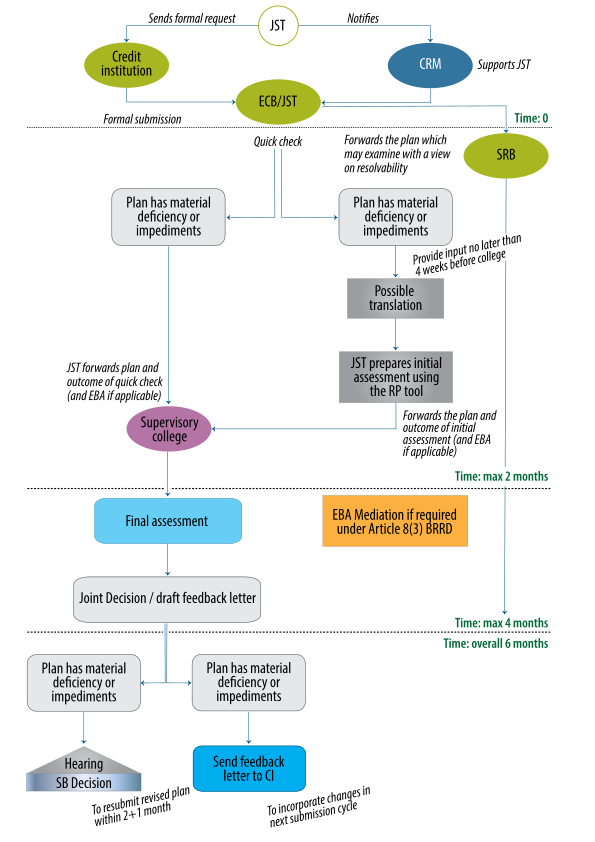
Annex III
Survey of supervised entities
Questions 1 to 5 are entities contact information requests of: country head office, entity name, and contact point name, email address and telephone number.
| 1. Standards provided by the EBA |
|---|
Question 6: How useful is EBA-GL-2015-02 (the EBA Guidelines on the minimum list of qualitative and quantitative recovery plan indicators)?
Question 7: Give details of any areas in which you found the guidelines to be incomplete (see Box 1.1).
| Extremely useful | 4 | 6 % |
| Very useful | 27 | 42 % |
| Useful | 27 | 42 % |
| Slightly useful | 5 | 8 % |
| Not at all useful | 0 | 0 % |
| No reply | 1 | 2 % |
| Total | 64 | 100 % |
Question 8: How useful is EBA/RTS/2014/11 (the EBA final draft Regulatory Technical Standards on the content of recovery plans)?
Question 9: Give details of any areas in which you found the standards to be incomplete (see Box 1.1).
| Extremely useful | 4 | 6 % |
| Very useful | 26 | 41 % |
| Useful | 30 | 47 % |
| Slightly useful | 3 | 5 % |
| Not at all useful | 0 | 0 % |
| No reply | 1 | 2 % |
| Total | 64 | 100 % |
Question 10: How useful is EBA/GL/2014/06 (the EBA Guidelines on the range of scenarios to be used in recovery plans)?
Question 11: Give details of any areas in which you found the standards to be incomplete (see Box 1.1).
| Extremely useful | 2 | 3 % |
| Very useful | 16 | 25 % |
| Useful | 35 | 55 % |
| Slightly useful | 9 | 14 % |
| Not at all useful | 1 | 2 % |
| No reply | 1 | 2 % |
| Total | 64 | 100 % |
Question 12: How useful is EBA/RTS/2014/12 (the EBA final draft Regulatory Technical Standards on the assessment of recovery plans)?
Question 13: Give details of any areas in which you found the standards to be incomplete (see Box 1.1).
| Extremely useful | 1 | 2 % |
| Very useful | 9 | 14 % |
| Useful | 28 | 44 % |
| Slightly useful | 17 | 27 % |
| Not at all useful | 0 | 0 % |
| Not applicable | 2 | 3 % |
| No reply | 7 | 11 % |
| Total | 64 | 100 % |
Question 14 - Do you consider the initial EBA guidance (EBA/REC/2013/02) on the development of recovery plans was adequate in the following areas?
(a) Recovery plan indicators and calibration levels;
| Excellent | 1 | 2 % |
| Good | 13 | 21 % |
| Adequate | 13 | 21 % |
| Poor | 20 | 32 % |
| Very poor | 3 | 5 % |
| No reply | 13 | 21 % |
| Total | 63 | 100 % |
(b) Recovery plan scenarios and options;
| Excellent | 2 | 3 % |
| Good | 14 | 22 % |
| Adequate | 16 | 25 % |
| Poor | 16 | 25 % |
| Very poor | 2 | 3 % |
| No reply | 13 | 21 % |
| Total | 63 | 100 % |
(c) Identification of critical functions and core business lines.
| Excellent | 1 | 2 % |
| Good | 8 | 13 % |
| Adequate | 19 | 30 % |
| Poor | 18 | 29 % |
| Very poor | 4 | 6 % |
| No reply | 13 | 21 % |
| Total | 63 | 100 % |
Question 15: What could be done to further improve the aspects addressed by the questions above (see Box 1.1)?
| 2. Overall guidance provided by EBA or in interaction with ECB (e.g. a JST) |
|---|
Question 16: If you have sent questions to the ECB, have you received replies within a reasonable timeframe?
| Very fast reply | 5 | 8 % |
| Fast reply | 7 | 11 % |
| Adequate response time | 24 | 39 % |
| Slow reply | 9 | 15 % |
| No reply | 1 | 2 % |
| Not applicable | 12 | 19 % |
| No answer for this question | 4 | 6 % |
| Total | 62 | 100 % |
Question 17: Are the ECB's replies clear and well explained?
| Always | 4 | 6 % |
| Often | 22 | 35 % |
| Sometimes | 17 | 27 % |
| Rarely | 3 | 5 % |
| Never | 0 | 0 % |
| Not applicable | 13 | 21 % |
| No reply | 3 | 5 % |
| Total | 62 | 100 % |
Question 18: Do the ECB's replies improve the quality of the recovery plan?
| Always | 11 | 18 % |
| Often | 17 | 28 % |
| Sometimes | 17 | 28 % |
| Rarely | 2 | 3 % |
| Never | 0 | 0 % |
| Not applicable | 12 | 20 % |
| No reply | 2 | 3 % |
| Total | 61 | 100 % |
Question 19: Are the ECB's replies or guidance prior to submission of the recovery plan consistent with the feedback letter issued at the end of the submission cycle?
Question 20: If no, please describe any problems and suggest improvements (see Box 1.2).
| Yes | 33 | 53 % |
| No | 2 | 3 % |
| Not applicable | 19 | 31 % |
| No reply | 8 | 13 % |
| Total | 62 | 100 % |
| Guidance on the structure and business of the institution section of recovery plans |
|---|
Question 21: What was the level of interaction with the JST on the structure and business of the institution section of recovery plans?
| High | 6 | 10 % |
| Medium | 29 | 47 % |
| Low | 19 | 31 % |
| None | 3 | 5 % |
| No reply | 5 | 8 % |
| Total | 62 | 100 % |
Question 22: From an overall perspective (e.g. JST work and EBA guidance), were you given clear guidance on the structure and business of the institution section of recovery plans in the following areas?
(a) Overall global business and risk strategy, business model and business plan;
| Very good | 4 | 7 % |
| Good | 27 | 44 % |
| Acceptable | 20 | 33 % |
| Poor | 3 | 5 % |
| Very poor | 0 | 0 % |
| Not applicable | 5 | 8 % |
| No reply | 2 | 3 % |
| Total | 61 | 100 % |
(b) Identification and mapping of core business lines and critical functions;
| Very good | 6 | 10 % |
| Good | 17 | 28 % |
| Acceptable | 21 | 35 % |
| Poor | 10 | 17 % |
| Very poor | 0 | 0 % |
| Not applicable | 5 | 8 % |
| No reply | 1 | 2 % |
| Total | 60 | 100 % |
(c) Internal and external interconnectedness.
| Very good | 3 | 5 % |
| Good | 18 | 30 % |
| Acceptable | 20 | 33 % |
| Poor | 13 | 21 % |
| Very poor | 0 | 0 % |
| Not applicable | 4 | 7 % |
| No reply | 3 | 5 % |
| Total | 61 | 100 % |
Question 23: What could be done to further improve the structure and business of the institution aspects addressed by the previous question (see Box 1.2)?
| Guidance in relation to the governance section of recovery plans |
|---|
Question 24: What was the level of interaction with the JST in relation to the governance section of recovery plans?
| High | 12 | 20 % |
| Medium | 29 | 48 % |
| Low | 11 | 18 % |
| None | 4 | 7 % |
| No reply | 5 | 8 % |
| Total | 61 | 100 % |
Question 25: From an overall perspective (e.g. JST work and EBA guidance), were you given clear guidance in relation to the governance section of recovery plans in the following areas?
(a) Development, maintenance and updating of the recovery plan;
| Very good | 9 | 15 % |
| Good | 35 | 57 % |
| Acceptable | 9 | 15 % |
| Poor | 2 | 3 % |
| Very poor | 3 | 5 % |
| Not applicable | 2 | 3 % |
| No reply | 1 | 2 % |
| Total | 61 | 100 % |
(b) Integration and consistency of the recovery plan with the institution's governance and internal procedures;
| Very good | 11 | 18 % |
| Good | 26 | 43 % |
| Acceptable | 16 | 26 % |
| Poor | 4 | 7 % |
| Very poor | 1 | 2 % |
| Not applicable | 2 | 3 % |
| No reply | 1 | 2 % |
| Total | 61 | 100 % |
(c) Escalation procedures for activating and implementing the recovery plan.
| Very good | 10 | 16 % |
| Good | 29 | 48 % |
| Acceptable | 13 | 21 % |
| Poor | 6 | 10 % |
| Very poor | 0 | 0 % |
| Not applicable | 2 | 3 % |
| No reply | 1 | 2 % |
| Total | 61 | 100 % |
Question 26: What could be done to further improve the governance aspects addressed by the previous question (see Box 1.2)?
| Guidance in relation to the recovery plan indicators |
|---|
Question 27: What was the level of interaction with the JST in relation to recovery plan indicators?
| High | 20 | 33 % |
| Medium | 25 | 41 % |
| Low | 10 | 16 % |
| None | 1 | 2 % |
| No reply | 5 | 8 % |
| Total | 61 | 100 % |
Question 28: From an overall perspective (e.g. JST work and EBA guidance), were you given clear guidance in relation to recovery plan indicators in the following areas?
(a) The set or framework of indicators;
| Very good | 7 | 11 % |
| Good | 32 | 52 % |
| Acceptable | 17 | 28 % |
| Poor | 2 | 3 % |
| Very poor | 1 | 2 % |
| Not applicable | 1 | 2 % |
| No reply | 1 | 2 % |
| Total | 61 | 100 % |
(b) How indicators should be calibrated (in relation to the institution’s business model, its size and complexity, regulatory requirements and other considerations) for recovery options to be activated;
| Very good | 3 | 5 % |
| Good | 15 | 25 % |
| Acceptable | 27 | 44 % |
| Poor | 12 | 20 % |
| Very poor | 1 | 2 % |
| Not applicable | 2 | 3 % |
| No reply | 1 | 2 % |
| Total | 61 | 100 % |
(c) Integration and consistency of indicators with the institution's general risk management framework for the purpose of effective risk and crisis management.
| Very good | 4 | 7 % |
| Good | 23 | 38 % |
| Acceptable | 24 | 39 % |
| Poor | 7 | 11 % |
| Very poor | 0 | 0 % |
| Not applicable | 1 | 2 % |
| No reply | 2 | 3 % |
| Total | 61 | 100 % |
Question 29: What could be done to further improve the recovery plan indicator aspects addressed by the previous question (see Box 1.2)?
| Guidance in relation to the recovery options |
|---|
Question 30: What was the level of interaction with the JST in relation to recovery options?
| High | 15 | 25 % |
| Medium | 30 | 49 % |
| Low | 9 | 15 % |
| None | 1 | 2 % |
| No reply | 6 | 10 % |
| Total | 61 | 100 % |
Question 31: From an overall perspective (e.g. JST work and EBA guidance), were you given clear guidance in relation to recovery options in the following areas?
(a) Assessing the institution's recovery options;
| Very good | 4 | 7 % |
| Good | 27 | 44 % |
| Acceptable | 22 | 36 % |
| Poor | 5 | 8 % |
| Very poor | 1 | 2 % |
| Not applicable | 1 | 2 % |
| No reply | 1 | 2 % |
| Total | 61 | 100 % |
(b) Analysing the credibility, impact and feasibility of recovery options.
| Very good | 5 | 8 % |
| Good | 23 | 38 % |
| Acceptable | 22 | 36 % |
| Poor | 8 | 13 % |
| Very poor | 1 | 2 % |
| Not applicable | 1 | 2 % |
| No reply | 1 | 2 % |
| Total | 61 | 100 % |
Question 32: What could be done to further improve the recovery option aspects addressed by the previous question (see Box 1.2)?
| Guidance on the matter of scenarios |
|---|
Question 33: What was the level of interaction with the JST on the matter of scenarios?
| High | 10 | 16 % |
| Medium | 30 | 49 % |
| Low | 15 | 25 % |
| None | 1 | 2 % |
| No reply | 5 | 8 % |
| Total | 61 | 100 % |
Question 34: From an overall perspective (e.g. JST work and EBA guidance), were you given clear guidance on the matter of scenarios in the following areas?
(a) Adequacy of the chosen scenarios;
| Very good | 4 | 7 % |
| Good | 21 | 34 % |
| Acceptable | 26 | 43 % |
| Poor | 6 | 10 % |
| Very poor | 2 | 3 % |
| Not applicable | 1 | 2 % |
| No reply | 1 | 2 % |
| Total | 61 | 100 % |
(b) Impact and feasibility of recovery options in scenarios.
| Very good | 2 | 3 % |
| Good | 22 | 36 % |
| Acceptable | 24 | 39 % |
| Poor | 8 | 13 % |
| Very poor | 2 | 3 % |
| Not applicable | 1 | 2 % |
| No reply | 2 | 3 % |
| Total | 61 | 100 % |
Question 35: What could be done to further improve the scenario aspects addressed by the previous question (see Box 1.2)?
| 3. Clarity of feedback letters |
|---|
Question 36: Do you consider that the feedback letters sent in response to the second round of recovery plans provided solid information in the following areas?
(a) Recovery plan indicators and calibration levels;
| Always | 7 | 12 % |
| Often | 20 | 33 % |
| Sometimes | 15 | 25 % |
| Rarely | 5 | 8 % |
| Never | 0 | 0 % |
| Not applicable | 8 | 13 % |
| No reply | 5 | 8 % |
| Total | 60 | 100 % |
(b) Recovery plan scenarios and options;
| Always | 5 | 8 % |
| Often | 23 | 38 % |
| Sometimes | 15 | 25 % |
| Rarely | 4 | 7 % |
| Never | 0 | 0 % |
| Not applicable | 8 | 13 % |
| No reply | 5 | 8 % |
| Total | 60 | 100 % |
(c) Identification of critical functions and core business lines.
| Always | 5 | 8 % |
| Often | 20 | 33 % |
| Sometimes | 11 | 18 % |
| Rarely | 4 | 7 % |
| Never | 3 | 5 % |
| Not applicable | 12 | 20 % |
| No reply | 5 | 8 % |
| Total | 60 | 100 % |
Question 37: Do you consider that the feedback letters met your needs in terms of clarity of the points raised?
Question 38: If you answered from Never to Sometimes to the previous question, what could be improved (see Box 1.3)?
| Always | 4 | 7 % |
| Often | 26 | 44 % |
| Sometimes | 12 | 20 % |
| Rarely | 4 | 7 % |
| Never | 0 | 0 % |
| Not applicable | 8 | 14 % |
| No reply | 5 | 8 % |
| Total | 59 | 100 % |
Question 39: If a feedback letter contained recommendations / suggested changes to the recovery plan, were you given sufficient time to implement these comments / address these weaknesses before submitting the next recovery plan or an ad-hoc update of the recovery plan?
| Always | 19 | 31 % |
| Often | 20 | 33 % |
| Sometimes | 11 | 18 % |
| Rarely | 1 | 2 % |
| Never | 1 | 2 % |
| Not applicable | 5 | 8 % |
| No reply | 4 | 7 % |
| Total | 61 | 100 % |
Question 40: Do you have a clearly established channel of communication with the ECB?
| Always | 49 | 80 % |
| Often | 9 | 15 % |
| Sometimes | 2 | 3 % |
| Rarely | 0 | 0 % |
| Never | 0 | 0 % |
| Not applicable | 0 | 0 % |
| No reply | 1 | 2 % |
| Total | 61 | 100 % |
Question 41: Are the members of the ECB available to clarify the findings of your institution?
| Always | 27 | 44 % |
| Often | 19 | 31 % |
| Sometimes | 8 | 13 % |
| Rarely | 1 | 2 % |
| Never | 0 | 0 % |
| Not applicable | 3 | 5 % |
| No reply | 3 | 5 % |
| Total | 61 | 100 % |
Question 42: If you answered from Never to Sometimes to the previous question, what could be improved (see Box 1.3)?
| 4. Discussion with the ECB on matters raised in feedback letters |
|---|
Question 43: Before resubmitting the recovery plan, were you given reasonable time to comment on the ECB's feedback and discuss it with the ECB?
Question 44: If not, please describe any problems and suggest improvements (see Box 1.4).
| Always | 21 | 34 % |
| Often | 18 | 30 % |
| Sometimes | 4 | 7 % |
| Rarely | 4 | 7 % |
| Never | 2 | 3 % |
| Not applicable | 8 | 13 % |
| No reply | 4 | 7 % |
| Total | 61 | 100 % |
Question 45: Do you think the process of addressing / implementing issues or measures mentioned in feedback is efficient?
Question 46: If you answered from Never to Sometimes to the previous question, what could be improved (see Box 1.4)?
| Always | 13 | 21 % |
| Often | 24 | 39 % |
| Sometimes | 12 | 20 % |
| Rarely | 2 | 3 % |
| Never | 0 | 0 % |
| Not applicable | 5 | 8 % |
| No reply | 5 | 8 % |
| Total | 61 | 100 % |
| 5. Updating of recovery plans |
|---|
Question 47: Is it easy to contact the supervisor to address issues relevant to the updating of recovery plans?
| Always | 27 | 44 % |
| Often | 19 | 31 % |
| Sometimes | 4 | 7 % |
| Rarely | 0 | 0 % |
| Never | 0 | 0 % |
| Not applicable | 7 | 11 % |
| No reply | 4 | 7 % |
| Total | 61 | 100 % |
Question 48: If the recovery plan assessment identified material deficiencies or impediments, is the 2+1 month period sufficient for submission of a revised recovery plan?
Question 49: If you answered from Never to Sometimes to the previous question, what could be improved (see Box 1.5)?
| Always | 0 | 0 % |
| Often | 6 | 10 % |
| Sometimes | 9 | 15 % |
| Rarely | 12 | 20 % |
| Never | 3 | 5 % |
| Not applicable | 28 | 46 % |
| No reply | 3 | 5 % |
| Total | 61 | 100 % |
Question 50: Has the ECB requested information for its assessment of a revised recovery plan which was already provided for the initial recovery plan assessment?
Question 51: Please give further details and suggest improvements (see Box 1.5).
| Always | 2 | 3 % |
| Often | 0 | 0 % |
| Sometimes | 8 | 13 % |
| Rarely | 6 | 10 % |
| Never | 15 | 25 % |
| Not applicable | 26 | 43 % |
| No reply | 4 | 7 % |
| Total | 61 | 100 % |
| 6. Overall assessment of recovery planning |
|---|
Question 52: From an overall perspective, has the recovery planning process added value in terms of your institution's understanding and crisis-preparedness?
| Very considerably | 10 | 17 % |
| Considerably | 31 | 52 % |
| Somewhat | 13 | 22 % |
| Very little | 4 | 7 % |
| Not at All | 0 | 0 % |
| Not applicable | 1 | 2 % |
| No reply | 1 | 2 % |
| Total | 60 | 100 % |
Question 53: How formal do you consider the overall process (i.e. how much does it focus on formalities rather than risks)?
| Very hands-on | 2 | 3 % |
| Hands-on | 9 | 15 % |
| Acceptable | 26 | 43 % |
| Formal | 13 | 22 % |
| Very formal | 7 | 12 % |
| Not applicable | 1 | 2 % |
| No reply | 2 | 3 % |
| Total | 60 | 100 % |
Question 54: Do you consider the key risks were discussed with you?
| Careful consideration of key risks | 16 | 27 % |
| Key risks often considered | 20 | 33 % |
| Some consideration of key risks | 10 | 17 % |
| Key risks given little consideration | 3 | 5 % |
| Key risks not considered at all | 0 | 0 % |
| Not applicable | 4 | 7 % |
| No reply | 7 | 12 % |
| Total | 60 | 100 % |
Question 55: Please suggest any further improvements, not already covered by your answers above, that could be made to the overall quality of recovery planning (see Box 1.6).
Box 1 - Survey of supervised entities
Regarding what could be improved, individual significant supervised entities commented that:
1. Standards provided by the EBA
- EBA Guidelines on the minimum list of qualitative and quantitative recovery plan indicators (EBA-GL-2015-02) of is very prescriptive (7 banks) in certain areas, leaving no room for the entities to reflect their own interpretation (e.g. the list of compulsory indicators). In addition, the entities commended that they should be allowed to select indicators that are most appropriate for their specific business model (12 banks) as this will allow for more efficient alignment with the existing information needs and risk management frameworks. Also, entities commended these guidelines should have included technical definitions (6 banks) per recovery indicator and elaborate more on the point of breach of recovery indicators. Also, the entities expressed the view that the interaction between parent company and subsidiaries should be catered better and a distinction should be made between mandatory indicators for parent entities and subsidiaries (2 banks);
- EBA final draft RTSs on the content of recovery plans (EBA/RTS/2014/11) does not provide clear guidance on the content of 'integrated' group recovery plan, on how to integrate individual material entities (subsidiaries) into group recovery plan (3 banks). In addition, the entities commented that banks have to add large amounts of information (based on the EBA guidance and the ECB feedback) which has limited use in times of crisis and are usually addressed in other documents shared with ECB (8 banks). Also, entities mentioned that a clear distinguish should be made between content relating to recovery plans and content relating to resolution planning and that parts of the content of recovery plans are irrelevant concerning recovery actions but are of high importance to resolution planning (4 banks);
- EBA draft Regulatory Technical Standards on the range of scenarios to be used in recovery plans (EBA/GL/2014/06) does not clearly defined the reverse stress testing methodology (9 banks). In addition, entities commented it would be very useful to further explain the distinction between fast-moving and slow moving events (4 banks) and further clarity on the severity and timeline of the scenarios would be helpful (3 banks);
- EBA final draft RTSs on the assessment of recovery plans (EBA/RTS/2014/12) requirements are too general (7 banks) and could be enhanced by providing additional guidance. In addition, entities commented that would be very useful to further clarify the integration of subsidiaries in the Group Recovery Plan (3 banks) and more details could be included on the way supervisors should apply proportionality taking into consideration the size and the business model (2 banks);
- EBA guidance, in general terms, is described on a very high level basis and it needs to be targeted, directive and to the point (9 banks) and entities commented that the calibration of recovery indicators should be explained in more depth (5 banks);
2. Overall guidance provided by EBA or in interaction with ECB (e.g. a JST)
- ECB's replies or guidance prior to submission of the recovery plan should focus more on the quality of the recovery plan and not driven by harmonization and comparability of recovery plans (3 banks). In addition, some entities commented that they have not received yet the feedback letters after the submission of the recovery plan and these are overdue (3 banks);
- on the matter of the structure and business of the institution, more detailed guidelines should be provided on how to identify/map core business lines and critical functions and internal and external interconnectedness (10 banks). In addition, entities commented that the guidance should be aligned to the resolution authorities’ requirements (8 banks). Also, entities commented that the interaction with JST should be more on receiving assistance or answers to technical matters and the JST members and other members of supervisory teams should interact more in order to avoid duplication of efforts due to the fact that the information required has often been already provided under other regulatory reporting’s (4 banks);
- on the matter of governance, more details in the guidance would be useful to have in terms of the governance that has to be described, interconnections with subsidiaries, escalation processes (5 banks).
- on the matter of recovery plan indicators, more clear guidance should be provided for calibration of indicators (8 banks). In addition, entities commented should have provision of greater flexibility in the assessment of an institution's choice of recovery indicators (5 banks);
- on the matter of recovery options, more details should be provided related to the criteria for the assessment of credibility and feasibility of the recovery options (11 banks);
- on the matter of scenarios, the overall level of required detail is not always clear (4 banks). In addition, the timing aspect should be more clear (2 banks) and reverse stress test scenarios /approaches are not enough explained in detail (5 banks);
3. Clarity of feedback letters
- on the matter of the feedback letters meeting the needs in terms of clarity of the points raised, it should be a clear distinction between recovery and resolution planning (2 banks), more details on the recommendations would be welcomed to implement expected enhancements (10 banks), more flexibility in the analysis and more willingness to understand bank perspective on recovery indicators and trigger levels (2 banks). Also, several banks mentioned they did not received yet the feedback letters (7 banks);
- on the matter of ECB’s members availability to clarify the findings, a better coordination of communication should be between all parties involved in recovery planning (6 banks). Also, some banks mentioned that the allotted time to implement the recommendations is often too short (3 banks);
4. Discussion with the ECB on matters raised in feedback letters
- on the matter of ECB's feedback before resubmitting the recovery plan, the entities commented that timelines/deadlines for the implementation of changes in recovery plans of large cross-border groups need to account for differences in local management/supervisor calendars which may not be compatible with supervisory demands. Greater flexibility is needed on this domain and dialogue/exchanges between supervisors is encouraged. Also, entities commented that there was rather one-way communication and there was no possibility to comment on the ECB feedback (3 banks);
- on the matter of addressing/implementing issues or measures mentioned in feedback, entities commented that sufficient time should be provided for the banks comments as well as sufficient time for the implementation of the final supervisory assessment (3 banks). In addition, entities commented that the ECB check-marks all elements in the EBA guidelines without full connection to what is relevant for a bank or not, leading to inclusion of additional information in a recovery plan that is of limited use for the institution during crisis times (5 banks);
5. Updating of recovery plans
- on the matter of the 2+1 month period for submission of a revised recovery plan (when the recovery plan assessment identified material deficiencies or impediments), entities commented that the period should be flexible depending on identified material deficiencies or impediments and if substantial problems are identified, the time frame is much too short (18 banks);
- on the matter of information requested by the ECB for its assessment of a revised recovery plan, entities commented that sometimes information is already available but seems to be not shared effectively with all the supervisors involved (4 banks);
6. Overall assessment of recovery planning
- to be more specific with respect to the improvements on the key elements and less formal referring to the guidelines which may reduce the effectiveness in practice (7 banks);
- that synergies between the information requested for the recovery planning (SSM) and those requested for the resolution planning (SRB) could be further exploited. This would significantly contribute to the consistency of the related information/data (also avoiding unnecessary overlaps) and would be beneficial for both the supervisory authorities and the banks (1 bank);
- that the focus on full harmonization of all (European) recovery plans seems to forgo the differences between banks. Remarks and feedback do not always add to the operational usability of the recovery plan and the preparedness of the bank for a recovery phase. Instead they seem to address issues of comparability of the recovery plans between banks, and in our opinion this should not be the ultimate goal of recovery planning (1 bank);
- that recovery plan should be strategic document in the ownership of the bank's Management Body. But with the requirements Recovery plan turned into heavy document (having hundreds/thousands of pages), difficult to read and to understand (1 bank).
Abbreviations
BCBS: Basel Committee on Banking Supervision
BRRD: Bank Recovery and Resolution Directive
CMG: Crisis Management Group
CMN: Crisis Management Network
CMT: High-Level Crisis Management Team
CRD: Capital Requirements Directive
CRM: Crisis Management Division
DG Statistics: Directorate General Statistics
EBA: European Banking Authority
ECA: European Court of Auditors
ECB: European Central Bank
EAP: Emergency Action Plan
ESCB: European System of Central Banks
ESMA: European Securities and Markets Authority
ESRB: European Systemic Risk Board
EU: European Union
FOLTF: Failing or likely to fail
FICOs: Financial Conglomerates
FSB: Financial Stability Board
GC: Governing Council
G-SIBs: Global - Systemically Important Banks
G-SIFIs: Global Systemically Important Financial Institutions
ICAAP: Internal Capital Adequacy Assessment Process
ILAAP: Internal Liquidity Adequacy Assessment Process
IMAS: Information Management System
IS-CMT: Institution Specific Crisis Management Team
JSTs: Joint supervisory teams
LSI: Less Significant Institution
MDA:: Maximum Distributable Amount
MoU: Memorandum of Understanding
MS: Member States
NCA: National Competent Authority
NPLs: Non-performing loans
PoC: Point of Contact
RAS: Risk assessment system
RIA: Risk analysis division
RTS: Regulatory Technical Standards
SB: Supervisory Board
SI: Significant Institution
SRB: Single Resolution Board
SREP: Supervisory Review and Evaluation Process
SRM: Single Resolution Mechanism
SSM: Single Supervisory Mechanism
SSM Regulation: Single Supervisory Mechanism Regulation
TFEU: Treaty on the Functioning of the EU
WCCAs: Written Coordination and Cooperation Arrangements
Glossary
Bank Recovery and Resolution Directive (BRRD): Bank Recovery and Resolution Directive (Directive 2014/59/EU of the European Parliament and of the Council of 15 May 2014 establishing a framework for the recovery and resolution of credit institutions and investment firms and amending Council Directive 82/891/EEC, and Directives 2001/24/EC, 2002/47/EC, 2004/25/EC, 2005/56/EC, 2007/36/EC, 2011/35/EU, 2012/30/EU and 2013/36/EU, and Regulations (EU) No 1093/2010 and (EU) No648/2012, of the European Parliament and of the Council (OJ L 173, 12.6.2014, p. 190)).
Crisis Management Group (CMG): Home and key host authorities of all G-SIFIs should maintain CMGs with the objective of enhancing preparedness for, and facilitating the management and resolution of, a cross-border financial crisis affecting the firm. CMGs should include the supervisory authorities, central banks, resolution authorities, finance ministries and the public authorities responsible for guarantee schemes of jurisdictions that are home or host to entities of the group that are material to its resolution, and should cooperate closely with authorities in other jurisdictions where firms have a systemic presence.
Crisis Management Network (CMN): A network of crisis management functions in national competent authorities (NCAs)
Capital Requirements Directive (CRD): Capital Requirements Directive (Directive 2013/36/EU of the European Parliament and of the Council of 26 June 2013 on access to the activity of credit institutions and the prudential supervision of credit institutions and investment firms, amending Directive 2002/87/EC and repealing Directives 2006/48/EC and 2006/49/EC) (OJ L 176, 27.6.2013, p. 338).
Global Systemically Important Financial Institutions (G-SIFIs): In November 2011 the Financial Stability Board (FSB) published an integrated set of policy measures to address the systemic and moral hazard risks associated with systemically important banks. In that publication, the FSB identified as Global Systemically Important Financial Institutions (G-SIFIs) an initial group of large banks, using a methodology developed by the Basel Committee on Banking Supervision (BCBS).
European Systemic Risk Board (ESRB): The European Systemic Risk Board is tasked with overseeing risks in the financial system within the EU as a whole (macro-prudential oversight).
National Competent Authority (NCA): A National Competent Authority (NCA) is a national authority with responsibility for banking supervision. It can be either a national central bank or a specific entity dedicated to banking supervision, or a two tier model. This term is used to incorporate the different types of institutions that carry out banking supervision across Europe.
Failing or likely to fail assessment (FOLTF): An assessment by the supervisory or the resolution authority if a bank infringes, or is likely to infringe in the near future, requirements for continuing authorisation, which can trigger insolvency or resolution procedures. The reason for such a determination include but are not limited to: it has incurred or is likely to incur losses that will deplete its own funds; its assets are, or are likely to be in the near future, less than its liabilities; it is, or is likely to be in the near future, unable to pay liabilities as they fall due.
Joint Supervisory Teams (JSTs): The day-to-day supervision of significant institutions within the SSM is conducted by Joint Supervisory Teams (JSTs). The JSTs comprise staff from both the ECB and the NCAs of the countries in which the credit institutions, banking subsidiaries or the significant cross-border branches of a given banking group are established. A JST is established for each significant institution.
Maximum Distribution Amount (MDA): The maximum amount a bank is allowed to pay out, for example for bonuses or dividends.
Single Resolution Board (SRB): Under a new banking resolution mechanism for the euro area, significant powers have been transferred to the Single Resolution Board (SRB). The objective of the SRB is to ensure an orderly resolution of failing banks with minimum impact on the real economy and public finances. It establishes uniform rules and procedures for failing significant banks under ECB supervision and other cross-border groups. It removes obstacles to resolution e.g., banks’ internal organisation and operations, cross border recognition of resolution measures.
Supervisory Review and Evaluation Process (SREP): The Supervisory Review and Evaluation Process (SREP) for banks under the direct supervision of the ECB is performed within JSTs to ensure that supervised institutions have adequate arrangements, strategies, processes and mechanisms in place, that they maintain adequate capital and liquidity according to the relevant rules, and that they have sound management and coverage of risks to which they are or might be exposed. The SREP process results in an individual score for each bank.
Single Resolution Mechanism (SRM): The Single Resolution Mechanism (SRM) is one of the pillars of the banking union, alongside the SSM. It is set to centralise key competences and resources for managing the failure of any credit institution in the participating Member States.
Single Supervisory Mechanism (SSM): The Single Supervisory Mechanism (SSM) refers to the system of banking supervision in the euro area. It comprises the ECB and the national supervisory authorities of the participating countries. Its main aims are to:
- ensure the safety and soundness of the European banking system
- increase financial integration and stability
- ensure consistent supervision
The SSM is one of the two pillars of the EU banking union, along with the Single Resolution Mechanism.
Single Supervisory Mechanism Regulation (SSM Regulation): Single Supervisory Mechanism Regulation (Council Regulation (EU) No 1024/2013 of 15 October 2013 conferring specific tasks on the European Central Bank concerning policies relating to the prudential supervision of credit institutions (OJ L 287, 29.10.2013, p. 63).
Endnotes
1 SSM refers to the system of banking supervision in the EU. The SSM comprises the ECB and the national supervisory authorities of participating countries; its main aims are to enhance the stability of the European banking system, increase financial integration and stability and ensure consistent supervision.
2 BCBS Core Principles for Effective Banking Supervision (2012), p. 4.
3 See Council Regulation (EU) No 1024/2013 of 15 October 2013 conferring specific tasks on the ECB concerning policies relating to the prudential supervision of credit institutions.
4 SREP stands for “supervisory review and evaluation process”. The key purpose of the SREP is to ensure that institutions have made adequate arrangements (including strategies, processes and mechanisms) and have sufficient capital and liquidity to ensure the sound management and coverage of their risks.
5 Our mandate to audit the operational efficiency of the management of the ECB is explicitly confirmed in Article 27.2 of the Protocol (No 4) on the Statute of the European System of Central Banks and of the ECB and Article 20(7) of the SSM Regulation.
6 Directive 2013/36/EU of the European Parliament and of the Council of 26 June 2013 on access to the activity of credit institutions and the prudential supervision of credit institutions and investment firms, amending Directive 2002/87/EC and repealing Directives 2006/48/EC and 2006/49/EC.
7 See paragraphs 126 to 137 Special Report No 29/2016 “Single Supervisory Mechanism - Good start but further improvements needed” (http://www.eca.europa.eu).
8 Special Report No 29/2016.
9 E.g. CRD IV.
10 Article 115 of CRD IV and Article 5 Commission Delegated Regulation (EU) 2016/98 of 16 October 2015.
11 See Directive 2002/87/EC of the European Parliament and of the Council on the supplementary supervision of credit institutions, insurance undertakings and investment firms in a financial conglomerate (OJ L 35, 11.2.2003, p. 1). The purpose of the directive is to establish common standards for the prudential supervision of financial conglomerates.
12 Article 4(1)(h) of SSM Regulation states that the ECB must participate in supplementary supervision of a financial conglomerate in relation to the credit institutions included in it, and assume the tasks of a coordinator where so appointed in EU law.
13 Article 18(2) of Commission Delegated Regulation 2016/98 requires the consolidating supervisor to explain measures and actions (taken or planned) to college members. The WCCA template refers only to the authorities’ endeavour to share “expeditiously the minimum set of information referred to in Article 114 of CRD IV”, which is less explicit than the requirement in the Commission Delegated Regulation.
14 Article 6(4) BRRD.
15 Article 6(2) BRRD.
16 “The JSTs should allow national experts from horizontal functions to participate in deliberations regarding the assessment of recovery plans”.
17 EBA guidelines on recovery plan indicators – EBA-GL-2015-02.
18 These aim to help supervisors conducting assessments to identify the key elements to be considered by institutions when designing their recovery plans. See EBA recovery planning comparative report on governance arrangements and indicators, p. 4.
19 In this regard, the Supervisory Manual says that the results of an assessment are to be incorporated into the SREP; any findings and deficiencies identified in the assessment of recovery plans should be considered when assessing internal governance and institution-wide controls. However, this guidance remains quite generic, as was confirmed by our interviews with JSTs.
20 The IS-CMT acts as the SSM’s central internal coordination body with respect to supervisory actions necessary to mitigate a crisis situation. It is also the central hub for information-sharing and coordination of the ECB’s supervisory response.
21 This distinction was seen to be particularly lacking in regard to the identification and detailed mapping of legal entities, critical functions and business lines, all of which were felt to be of little relevance for recovery planning.
22 One bank had not received a feedback letter after the first round of submissions on time. The six other comments related to the second round.
23 Audit trail is a system that traces the detailed transactions or information relating to an item. It is the record of changes made in a specific database or file.
24 The RAS evaluates credit institutions’ risk levels and controls.
25 EBA Guidelines on triggers for use of early intervention measures pursuant to Article 27(4) of Directive 2014/59/EU, EBA/GL/2015/03, 29 July 2015.
26 Only the overall SREP score is mentioned, but not the RAS components which are part of the ECB’s crisis identifier according to its internal processes.
27 In some cases the delay exceeded 6 months.
28 The relevant guideline states “While the determination that an institution is failing or likely to fail remains the discretionary assessment of the relevant authority, these Guidelines set forth broad elements on the basis of which this judgment should be based. The identification of a single objective element specified in these Guidelines with regard to a particular institution should neither lead to an automatic determination that it is failing or likely to fail, nor automatically trigger resolution actions. On the contrary, in each case, the relevant authorities should decide whether the institution is failing or likely to fail on the basis of a comprehensive assessment of both qualitative and quantitative objective elements, taking into account all other circumstances and information relevant for the institution. Furthermore, the set of objective elements provided in these Guidelines is not exhaustive and does not prevent the relevant authorities from taking into account other considerations signalling that an institution is failing or likely to fail.”
| Event | Date |
|---|---|
| Adoption of Audit Planning Memorandum (APM) / Start of audit | 28.2.2017 |
| Official sending of draft report to the European Central Bank | 3.11.2017 |
| Adoption of the final report after the adversarial procedure | 12.12.2017 |
| Official replies of the European Central Bank received in all languages | 14.12.2017 |
Audit team
The ECA’s special reports set out the results of its performance and compliance audits of specific budgetary areas or management topics. The ECA selects and designs these audit tasks to be of maximum impact by considering the risks to performance or compliance, the level of income or spending involved, forthcoming developments and political and public interest.
This report was produced by Audit Chamber IV – headed by ECA Member Baudilio Tomé Muguruza -which has a focus in the areas of regulation of markets and competitive economy. The audit was led by ECA Member Kevin Cardiff. He was supported in the preparation of the report by Gediminas Mačys head of the private office and Shane Enright, attaché; Tony Murphy, director, Zacharias Kolias, director, Mirko Gottmann, head of task. The audit team consisted of Paraskevi Demourtzidou, Jörg Genner, Violeta Radu and Giorgos Tsikkos.

Contact
EUROPEAN COURT OF AUDITORS
12, rue Alcide De Gasperi
1615 Luxembourg
LUXEMBOURG
Tel. +352 4398-1
Enquiries: eca.europa.eu/en/Pages/ContactForm.aspx
Website: eca.europa.eu
Twitter: @EUAuditors
More information on the European Union is available on the internet (http://europa.eu).
Luxembourg: Publications Office of the European Union, 2018
| ISBN 978-92-872-9126-4 | ISSN 1977-5679 | doi:10.2865/678227 | QJ-AB-17-027-EN-N | |
| HTML | ISBN 978-92-872-9067-0 | ISSN 1977-5679 | doi:10.2865/492542 | QJ-AB-17-027-EN-Q |
© European Union, 2018.
For any use or reproduction of photos or other material that is not under the European Union copyright, permission must be sought directly from the copyright holders.
GETTING IN TOUCH WITH THE EU
In person
All over the European Union there are hundreds of Europe Direct Information Centres. You can find the address of the centre nearest you at: https://europa.eu/european-union/contact_en
On the phone or by e-mail
Europe Direct is a service that answers your questions about the European Union. You can contact this service
- by freephone: 00 800 6 7 8 9 10 11 (certain operators may charge for these calls),
- at the following standard number: +32 22999696 or
- by electronic mail via: https://europa.eu/european-union/contact_en
FINDING INFORMATION ABOUT THE EU
Online
Information about the European Union in all the official languages of the EU is available on the Europa website at: http://europa.eu
EU Publications
You can download or order free and priced EU publications from EU Bookshop at: http://bookshop.europa.eu. Multiple copies of free publications may be obtained by contacting Europe Direct or your local information centre (see https://europa.eu/european-union/contact_en)
EU law and related documents
For access to legal information from the EU, including all EU law since 1951 in all the official language versions, go to EUR-Lex at: http://eur-lex.europa.eu
Open data from the EU
The EU Open Data Portal (http://data.europa.eu/euodp/en/data) provides access to datasets from the EU. Data can be downloaded and reused for free, both for commercial and non-commercial purposes.