Spotlight on Open Data
Data is everywhere nowadays transforming our lives and becoming the prime commodity of the 21st century. One of the most data intensive sectors is the public sector, producing massive amounts of data while performing its activities.
When this readily available resource becomes freely available to the public for reuse, in which case it is called Open Data, the produced value out of it multiplies. Why? Because it is put in many other uses, in addition to the original ones for which it was created. The resulting applications, added value services, innovations and –ultimately- knowledge based on it can provide solutions in countless real-life societal challenges: from reducing waste and creating safer and cleaner transport systems to re-establishing freedom of movement during a pandemic. At the same time open data stimulates economic growth, enhances transparency, and contributes to better decision-making in all levels: individual, organisational, national and international.
For all these reasons the European Union follows an open data policy that is part of a broader European strategy for data. A tremendous amount of open data from the European public sector is at your disposal allowing you to make your own research, combine it with other data to draw your conclusions, or create your own app. Find it on data.europa.eu: the official portal for European data, where you can also find additional information, use cases and other resources about open data.
This edition of our newsletter features publications related to this highly dynamic area, along with publications on other interesting topics.
|

|
PDF |
|
Common governance and coordinated investment for the EU’s digital transformation by 2030
|
|
On the road towards digital transformation, common data infrastructure and services is one of the critical areas where investment will be facilitated by multi-country projects. These are large scale projects designed to pool EU, national, and private resources. Find out more in this factsheet that presents a simplified roadmap of the digital decade. |
Available in all the official languages of the EU except Irish
|

|
PDF |
|
A European perspective |
This is the last edition of the annual study assessing the level of open data maturity against four dimensions: policy, portal, impact and quality. It clusters countries according to their maturity into four different groups: trend-setters, fast-trackers, followers and beginners. For each of the groups, recommendations tailored to their level of maturity are provided. If you have a particular interest in the topic, you can find more information about this yearly exercise here. |
Available in English |

|
PDF |
|
A study on companies transforming open data into economic and societal value |
The objective of this report is to understand how organisations, primarily within the private sector, use Open Data and what business models have been developed around its re-use. One of the key findings is the mismatch between what data sets are mostly available and what are mostly re-used. |
Available in English |
More on this topic |
 |
HTML/PDF |
|
|
The EU directive on open data and the re-use of public sector information stresses the importance of the principle of re-using and publishing open government data from public sector bodies for both commercial and non-commercial purposes. |
Available in all the official languages of the EU |
|
|
HTML/DOC/PDF |
|
|
The Digital Services Act proposed by the European Commission determines intermediaries’ obligations and accountability across the single market to ensure a high level of protection for users. It proposes rules on how platforms moderate content, on advertising, on algorithmic processes and on risk mitigation. The end goal is to ensure that platforms – in particular the very large ones – assume responsibility for their actions and the systemic risks they pose, including that of disinformation. |
Available in all the official languages of the EU |
|
|
HTML/DOC/PDF |
|
|
The Digital Markets Act proposed by the European Commission aims to ensure that large online platforms, which act as ‘gatekeepers’ in digital markets, behave in a fair way. Along with the Digital Services Act, it is a centrepiece of the EU digital strategy. |
Available in all the official languages of the EU |
Research and innovation |

|
PDF/Paper |
|
(Research*eu – November 2021) |
Every month, the Research*eu magazine brings you the results of EU-funded research and innovation. Among other subjects in November’s edition, its special feature presents seven EU-funded projects that focus on the Arctic: its climate, its flora and fauna, and its people. |
Available in English
(Individual article also available in English, French, German, Italian, Polish and Spanish on the CORDIS website)
|
Also out recently |

|
PDF/Paper |
|
|
The EU Justice Scoreboard presents an annual overview of indicators on the efficiency, quality and independence of justice systems. Its purpose is to assist EU countries improve the effectiveness of their national justice systems by providing objective, reliable and comparable data. The 2021 edition brings new indicators on the digitalisation of justice systems, the independence of national supreme court judges and more. |
Available in English
|

|
PDF |
|
|
The European Green Deal aims at achieving a sustainable EU economy and this objective requires access to sustainable raw materials. This publication is intended to align the understanding and public acceptance of sustainable extraction and processing of raw materials. |
Available in all the official languages of the EU except Irish |

|
PDF |
|
How disruptive technologies create opportunities for a green and digital economy: main report |
This report provides a global overview of the state of play of artificial intelligence and blockchain technologies. It shows, among others, that Europe needs to address an investment gap of up to €10 billion that is holding back development and deployment of artificial intelligence and blockchain technologies in the EU. |
Available in English |

|
PDF |
|
April 2020 to mid-July 2021 |
This is the annual report of the European Union Agency for Cybersecurity (ENISA) on the status of the cybersecurity threat landscape. It identifies prime threats, major trends observed with respect to threats, threat actors and attack techniques, and also describes relevant mitigation measures. |
Available in English |
You may also like |
 |
PDF/Paper |
|
Impact on fundamental rights and freedoms: report |
This report examines the EU’s main criminal law instrument in the field of counter-terrorism, Directive (EU) 2017/541. Specifically, it considers how the directive engages issues of fundamental rights, affecting individuals, groups and society as a whole. It is based on fieldwork in Belgium, France, Germany, Greece, Hungary, Spain and Sweden, and provides valuable insights on the impact of counter-terrorism measures on human rights. |
Available in English |
 |
PDF |
|
An open, sustainable and assertive trade policy |
Trade is one of the EU’s most powerful tools. As a result of the openness of its trade regime, the EU is the world’s largest trader of agricultural and manufactured goods and services and ranks first in both inbound and outbound international investments. With a new, more sustainable growth model as defined by the European Green Deal and the European Digital Strategy, the EU needs a new trade policy strategy. This publication summarises such a strategy. |
Available in all the official languages of the EU except Irish |

|
PDF/Paper |
|
Strategy and interdependence |
The notion of European ‘strategic sovereignty’ is increasingly important to debates about the EU. Given rapidly shifting global geopolitical and technology trends, and the seeming fragmentation of the multilateral order, the EU is being forced to confront its own position in international affairs. This publication examines in detail the elements of the debate about European sovereignty by also providing case studies. |
Available in English |

|
PDF |
|
A toolkit |
This toolkit in the form of a book is addressed primarily to pupils and teachers, but not only! It provides rationales, tools and tips to foster dialogues in schools about food but it is easily adaptable to other subjects and situations. Today it can be food in our canteens, tomorrow it can be the school future or mobility options in our neighbourhoods. The toolkit includes a set of activities to help triggering conversations about topics we may care and we may want to do something about, as citizens. |
Available in English |
Our news |
| |
Find out more about open data through the EU Open Data Days and the data.europa.eu newsletter |
|
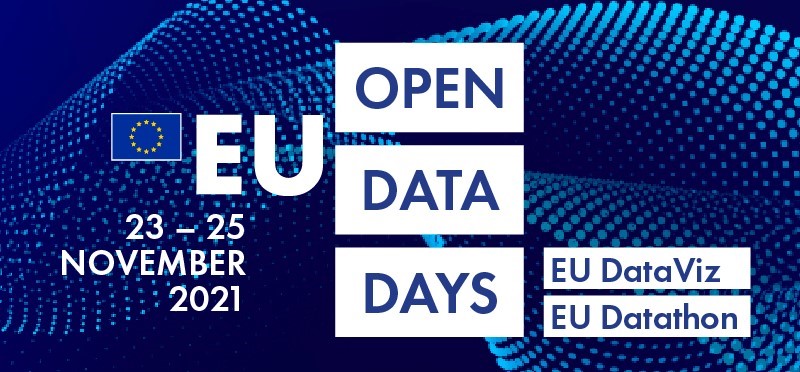
The EU Open Data Days taking place online from 23 to 25 November aim to bring the benefits of open data to citizens and businesses. The three-day event will provide a platform for exchanging ideas, experience and best practices related to open data and data visualisation. The programme features EU DataViz, a conference on open data and data visualisation for public administrations from 23 to 24 November, followed by the finale of EU Datathon, the annual EU open data competition on 25 November. The event is free and open for everyone to follow through streaming service.
To stay informed about developments in the field of open data, you can also subscribe to our quarterly data.europa.eu newsletter to receive the latest news, articles, stories, studies and more.
|
|
|